

On August 10th 1873, Tannaker Buhicrosan took his troupe of Japanese performers to the Channel Island of Jersey, sailing on the Havre from Southampton.
This may have been the first time for Japanese people to visit the island, although earlier that year, in April, a “Japanese troupe”, which actually was a duo, claiming to have performed at Windsor in front of Queen Victoria, juggled torches and balanced on balls at the Theatre Royal in St Helier. This had attracted one of Tannaker’s attack advertisements, in which he cautioned the inhabitants of Jersey “against some parties who paint their faces, put on wigs, and call themselves the Japanese troupe”, saying that his troupe was the only real performing Japanese troupe in the country.
It is possible one of the duo was actually D’Alvini/William Peppercorn, who often advertised himself as a Japanese juggler, had appeared with the Great Dragon Troupe and who was at the time performing as Monsieur and Madame Der Hang – “marvellous balancing, top spinning and double fire manipulation.” The reference to performing in front of the Queen at Windsor would imply he was with the Matsui Gensui troupe in 1867. D’Alvini would later join Tannaker’s troupe.
Tannaker’s troupe in Jersey
Perhaps the imposter act was provocation enough for Tannaker to decide to visit Jersey himself, although it was not the obvious choice for an acrobatic troupe to tour and no Japanese troupe came to the island after 1873. There could, however, have been another motive, to do with his missing father.
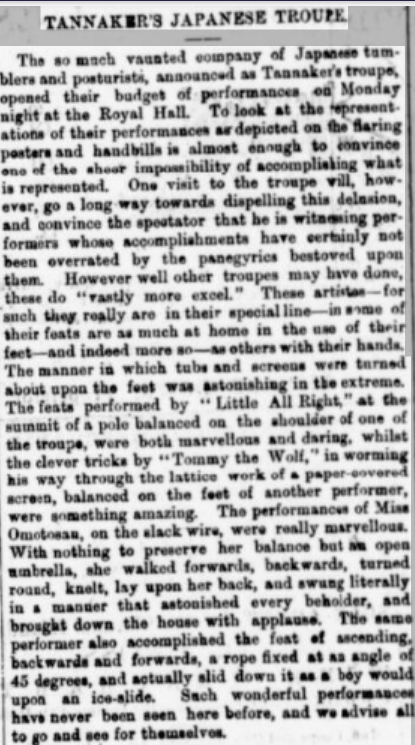
Tannaker’s troupe performed until the 30th August at the Royal Hall on Peter Street in St Helier. The troupe members included the child performers Little Allright (possibly Tannaker’s 4 year old daughter Tani) and Tommy the Wolf (possibly Hasegawa Tomikichi, tub and screen balancing with his “father” Hasegawa Harukichi as the understander), as well as Omotosan on the slack rope (Omoto), Godison (Godayū) juggling, Yasso (Kondo Yasokichi) and Condertorro (Kondo Torakichi) – tumbling.
Some members of the troupe were photographed by the photographers Asplet & Green while they were there and the photographs were turned into cartes de visite, as can be seen in the photographs above from Robert Sayers’ collection. The reverse of the cards read “Photographs may be had of Tannaker, Japanese, 122 Wardour Street, London W.”
At the end of the week, Tannaker invited the inmates of the Home for Infirm and Aged Women, and of the Lunatic Asylum, as well as the boys of the Gorey lndustrial School to a free performance at the Royal Hall.
Tannaker’s father William Neville – son of an assassin?
Tannaker usually claimed to be born in Japan of a Batavian father and a Japanese mother, but Paul Budden, in his biography of Tannaker, makes a convincing case that Tannaker’s father was a doctor called William Bellingham Neville, the son of an English merchant John Bellingham and Irish born Quaker, Mary Neville. John Bellingham had been executed in 1812 for the assassination of the prime minister, Spencer Perceval.
Bellingham refused to plead insanity at his trial. His reason for the assassination was a grievance against the British government, stemming from his arrest in Russia where he had been living with Mary since 1804, working as an agent for an import/export house. He was imprisoned there in 1806, and was finally allowed to return to Britain in 1809.
John and Mary had three sons – James born in Russia, William born when Mary had returned to Britain after John’s imprisonment, in 1806 in Wigan at her uncle James’ house, and Henry, born in 1811, in Liverpool.
Mary reverted to her maiden name, Neville, and married, in 1813 – the year after John Bellingham’s execution – James Raymond Barker, a banker and one of the wealthy Raymond Barker family of Fairfield, Gloucestershire. The wedding took place in the Yorkshire village of Thornton-in-Craven but they lived in Highbury Grove, London until James’ death in 1832. Presumably her three sons lived with them in London until they reached maturity.
Insanity – its Nature, Causes and Cure
William Neville senior claimed to have trained as a doctor in Edinburgh and Germany and was the author (William B. Neville) of the 1836 book – On Insanity : its Nature, Causes, and Cure – perhaps inspired by his father’s troubles. An advertisement in the Morning Post in 1834 shows him as the Resident Surgeon-Apothecary for Mrs Bradbury’s Establishment for Nervous Affections – Ladies only, in Old Brompton, London.

In 1837 he wrote a letter to The Evening Chronicle, in defence of lunatic asylums:

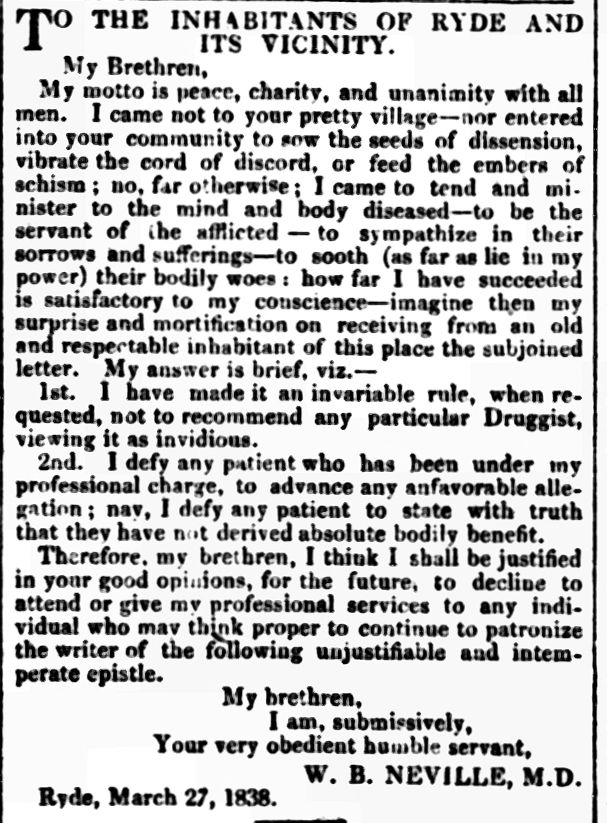
He had moved to Ryde on the Isle of Wight in 1838, apparently preferring it to Madeira, which he had recently visited. Some residents, particularly the local pharmacist, clearly thought he was a charlatan, judging by the following letter to the Hampshire Independent regarding an advertisement he had placed for his book on insanity and his current researches into cures for consumption, apparently promoting something called Wazel Crottle African – a lichen:
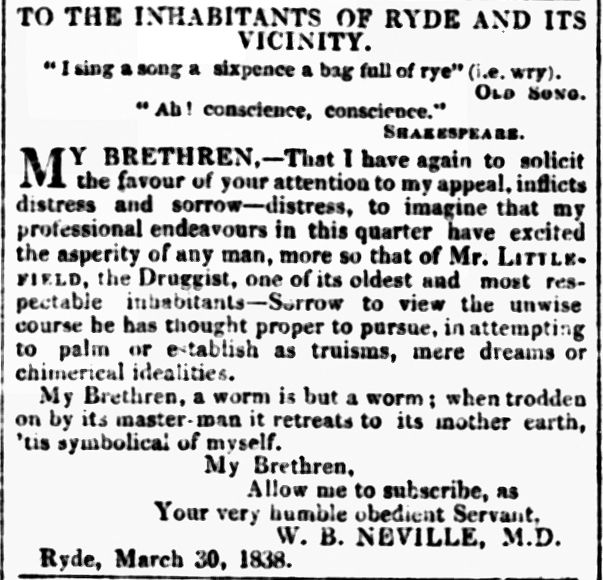
Another letter to the Hampshire Independent followed a few days later:
William Neville clearly left Ryde in a hurry, as an advertisement appears in April 1840 in the Hampshire Advertiser advising that if a hair trunk, a deal box, a hamper and a glass case with their contents, the property of Dr Neville, formerly of Ryde, are not collected within a month from Stirling House, they will be sold.
A showily dressed young woman
Dr Neville is next spotted in London in May 1839, where a “showily dressed young woman” named Madame Catherine Vincent was charged with having stolen a gold watch and jewellery from him. She said she had met Neville in Portsmouth “in the character of a physician” and he had brought her to London and got her a job at a tobacconists in Pall Mall. “His conduct to her had been so objectionable and even accompanied by personal violence” that she decided to leave him, and had taken the “trinkets” with her as she had been allowed to wear them when they were on friendly terms. When she heard he wanted them back she returned them. He claims they then went missing again, but found them in his coat pocket – where he assumed she or an acquaintance had placed them. As there was no charge to answer, the case was dismissed.
Neville presumably moved to Liverpool shortly after, where his son William Bellingham Neville junior (later Tannaker Buhicrosan) was born around 1839-1840. He was baptised at St Peter’s Church in September 1840 with his parents recorded as William Bellingham Neville and Hannah. William Bellingham Neville senior’s occupation is given as surgeon. What Hannah’s maiden name was is not clear. Nor can any record of William Bellingham Neville senior’s marriage to a Hannah be found. The one possible marriage is of a William Neville to Hannah Wilmshurst, in Stepney in London, in 1827. That William Neville is recorded as a widower, however, which seems unlikely for William Bellingham Neville at the age of 21. The location and the gap until 1839 before any children are born also seems a stretch.
No record of a Hannah Neville or William Neville senior or junior that fit their profiles can be found in the 1841 census. Perhaps Hannah died shortly after giving birth. A 16 year old Hannah William died in October 1841 in the workhouse and was buried on October 9th at St Mary’s cemetery in Liverpool. If this meant Tannaker ended up in a workhouse or orphanage, it might well explain his later habit of giving free shows to orphanages and workhouses, and perhaps even his own abuse of children. There are several Williams of around 10 years old in the Liverpool Workhouse in 1851.
In 1842 Dr Neville is mentioned as the prospective purchaser of a lunatic asylum in Stockland, Dorset, but the current owner did not have their licence renewed.
Tannaker’s father in Australia
A Dr Neville then arrived in Sydney in December 1843, preceded by a poem he had written, published from the barque Madras, in Port Adelaide, published in October in the Southern Australian. Neville was practising in Sydney in 1844, advertising himself as a Dr W.B. Neville, member of the council of the British Medical Association, “attending to the poor gratuitously” and showcasing his book on the nature, causes and cure of insanity and nervous diseases. There was a lawsuit in which he was involved, again regarding the theft of some of his property from August 1844 to February 1845. He then left Sydney, arriving in Bombay, India in May 1845.
The next sighting of a Dr Neville is in Hamburg in October 1848, where he is assistant physician at the General Hospital there during a cholera outbreak. He claims to have trained in Germany. Whether this is our Dr Neville or not is difficult to assess – the date would perhaps clash with his marriage to Frances Mary White, the daughter of Charles Valentine White, a banker, in Peterborough, Northamptonshire in August 1848.
He seems to have returned to Sydney in April 1849, only to depart for London in May. There was no mention of a similar Dr Neville in Australia after 1849.
Tannaker’s father in Jersey – and another theft
William moved to Jersey by 1851, with his wife Frances. The 1851 census shows them living at St John’s Cottage, St John’s Road, William as 34 (although actually he would have been 45) and Frances 24, and one servant. William is a physician, but not practising and attached to a university.
The next sighting of William Neville senior is in the will of his mother, who died, in April 1853. She left all her substantial estate, inherited from her second husband James Raymond Barker, to be split equally between William Neville and his two brothers James and Henry.
James never married, and seems to have used his inheritance to live independently with a housekeeper in Edmonton, Essex, until his death in 1872.
Henry was a “colonial broker” who married his cousin Anne Neville. By 1850 he was living in Islington, near his mother.
William was initiated into the Mechanics Lodge of the Freemasons in Jersey in October 1853. This hints at another link to Tannaker, as Tannaker Buhicrosan was also a Freemason. His address was given as St John’s Road, profession “medical” and his age as 43, when in fact he would have been 47 according to other records. He continued to pay his dues until 1855. That same year there was a fire at his house in St John’s Road and a servant was accused of stealing several articles from his house.
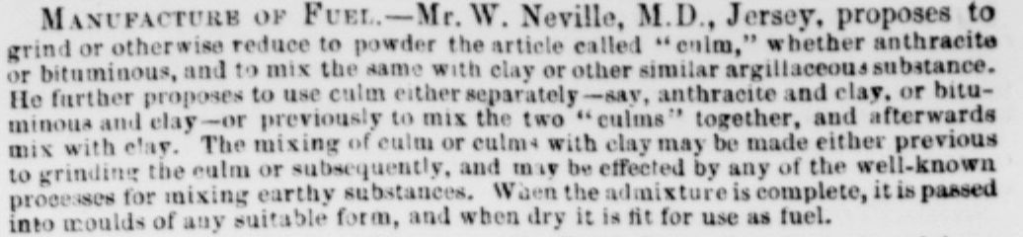
He then appears in the records as having filed a patent in 1857 – “Island of Jersey – doctor of medicine, improvement in amalgamating certain substances for the production of fuel.”
The last record was ten years later, on the 27th September 1867, when William Neville died at his house on 13 Westmoreland Road, Paddington. The cause of death was a tumour of the liver, jaundice, and cavity in the lungs. He was aged 61, “physician, retired from active practice for many years” and ” formerly of Jersey.” His brother Henry was at his death. The sole executor of his will was Frances, his wife.
Tannaker goes to Australia – instead of Britain
The 28 year old Tannaker, his Japanese wife Otaké and his troupe were supposed to be heading for Britain when they reached India in September 1867 after departing Japan, but then decided to sail to Australia instead. Had Tannaker heard that his long lost father had died, or at least was very ill? Did he decide to sail to Australia to avoid being tracked down as a possible heir, and then his double bigamy and military desertion coming back to haunt him?
If he had asked after his father in Australia, they would have told him he had left 18 years previously.
When he finally arrived in Britain a year later, in December 1868, he stayed in the Liverpool area, where he was born, for the first few months, and then started a punishing tour of the British Isles which went on for several years.
Did he then decide to follow his father’s footsteps to Jersey in 1873, either out of curiosity or, if he did not know of his father’s death, to track him down? Knowing Tannaker, he would certainly have been interested in any inheritance.
The original record of the probate for Tannaker/William’s father’s will in 1867 shows “effects under £200”, but this was amended to “effects under £5,000” in 1875 – a substantial difference – around £725,000 in present day value. Frances, his widow, was the sole executrix. Coincidence or not, 1875 was also the year William’s brother Henry died, which meant that the three people who might have known his true identity – his father and uncles, were now dead.
Frances Mary – Tannaker’s stepmother
Frances Mary, William Bellingham Neville senior’s wife, seems to have separated from Neville and was working at a small girls’ school in Kensington by 1861. She may have been the Mary (her middle name) Neville who in 1871 was a cook and housekeeper, living on her own in Finsbury, place of birth “not known”.
She remarried in March 1873 to William Bush, a widower and the principal of Heath Mount School in Hampstead, who had a five year old daughter, Lilla. Perhaps Mary had been the house keeper of the school. By 1881 they were living in St John’s Villas in Islington, with Lilla and two servants.
William died in 1890 at the age of 60 of “apoplexy 7 hours following alcoholism”. His occupation was given as Mathematical Master, PhD. Lilla died in 1895 of tuberculosis, at the young age of 27, in Watford, where she was boarding. Frances continued to live at their house in St John’s Villas, Islington, until her death in 1911, at the age of 85.
Tannaker, Frances’ presumed stepson, died in 1894, of cirrhosis of the liver and jaundice. He had finally settled down with his family in Lewisham, shortly after his return from Jersey, in 1874, and married Otake in 1879. His father’s name was recorded on the marriage certificate as William Nevell Buhicrosan, deceased, doctor.

