
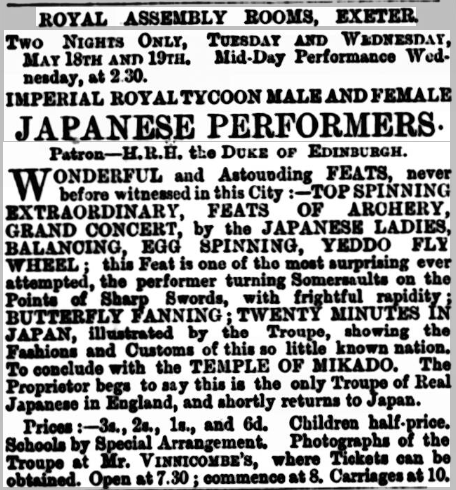
1869 May and June – Royal Tycoon Troupe Royal Assembly Rooms (now the Royal Clarence Hotel) (also Tiverton, Plymouth, Barnstaple, Bideford)
1869 December – Professor Risley’s Imperial Japanese Troupe – Victoria Hall – consisting of 12 male and female performers and the world renowned Little Allright. “are the original and superior troupe. The party that visited Exeter a few months ago were very amusing, and they performed some remarkable tricks, but they are wholly cast into the shade the Imperial Troupe. The tricks are surprisingly dexterous and clever, but the balancing is something that would hardly be credible on description. The Chief balances bamboo, nearly the height the hall, for some ten minutes upon his shoulder, while a nimble little Japanese boy runs to the top of it and performs monkey tricks that seem to defy entirely the lays of gravitation. A similar but far more extraordinary feat is that the Chief balancing a lofty ladder, warranted to weigh upwards of 3 cwt., on the soles of his feet, while the lad scampers up and goes through the most remarkable evolutions, moving it last along another ladder strapped to the first, and standing out at right angles to it, near the roof of the building. The entertainment is a most marvellous one of its kind, and we have no doubt when it is known that this is the genuine troupe which performed at Paris during the International Exposition, the attendance will much greater to-night and to-morrow night than was last evening
1872 December – Royal Public Rooms (Subscription Rooms – now Boots?) TANNAKER’S GREAT DRAGON TROUPE OF JAPANESE. This troupe has taken the Royal Public Rooms for a fortnight for its performances. is composed of twelve of those singular orientals, male and female, who commenced business last night to crowded house. It is easy to predict that they will be well patronized while they stay here, for cleverer performances, defter tricks, or more daring exploits in balancing, bending, and, summersault turning were never witnessed in the city. The juggling, the butterfly trick, the ring, plate, egg, and umbrella spinning are surprising.
When every point in the programme is so good it difficult to select any for special remark, but the chief applause the evening was given to the extraordinary feat of Miss Omotosan, who ascends slanting slack rope angle of 45 degrees. This task, which would appear to be absolutely impossible, skilfully achieved, and from the loftiest point the hall this artiste slides down the rope to the stage. Her progress—fan in one hand and open umbrella in the other —is watched with breathless interest.
Amongst the leading performers must also be mentioned Harrosan and ‘”Tommy the Wolf,” alias “Little All Right.” The former, lying on his back, balances on his feet tubs screens, or ladders, winch the younger Japanese desports in nimblest fashion. He astonishes every beholder by climbing ladder balanced as described, and at the top gliding out a transverse ladder, performing gymnastics on the bars, and ever and anon fanning himself as coolly if he were on firm ground. This performance concluded the evening’s entertainment, and was greatly applauded.
Between the parts Mr. Tannaker made speech, stating that the programme would be gone through every evening this week, and would be changed for next week. There are two day performances on Wednesday and Saturday, and the entertainment one of the kind that every youngster of both sexes will delight to see.”
Godaion, who plays a flute while the intrepid Little All Right ascends to the top of the pole and performs on it the most surprising gymnastics.
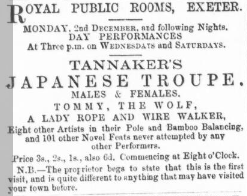
1872 December – Frank Tannaker Buhicrosan was fined £10 for child cruelty – a boy of 4 and a half, (or seven according to other accounts) entrusted to him to learn gymnastics (or his son according to other accounts), in Exeter. It was proved that on the previous Saturday, Tannaker had locked the boy up in a cupboard, tying his hands above his head to a nail. In this attitude he kept the poor child until midnight, and the boy was only released at the entreaty of the lodging house keeper.
The court proceedings were recorded as follows:
CRUELTY TO A CHILD BY JAPANESE
At the Exeter Police Court on Frank Tannaker-Buhacrosan the manager of the Japanese Troupe lately performing in this city was summoned for assaulting and ill-using his son on Saturday.
Mr Toy appeared for defendant — Matilda Physick stated she lived in Castle-street and the defendant with others had lodged in her house for the past fortnight. On Saturday last about eleven o’clock in the forenoon she heard the defendant’s son crying whilst both the parents were in the house. She heard blows, but did not see anything. About half-past two both Mr and Mrs Tannaker went out, and the boy was still crying. In consequence of what one of her young ladies told her, she went up to the bedroom occupied by them, in which there was a cupboard, and the boy Johnny was locked up in it. He was crying and witness tried to get him out but could not. He said something to her and she took him up some bread and cheese but it could not be got into the cupboard. Mr and Mrs Tannaker returned between four and five o’clock and left again about seven. The boy was still locked up in the cupboard, and he had not been out of it from eleven o’clock in morning up to that time. When witness first heard the crying and chastisement she thought the child was in drawing-room. The performers returned again about ten o’clock and she asked Mr Yesso to go and let boy out which he did. Witness told Mr Tannaker that a policeman had been there about the child and he said punished him because he would not learn his lessons. She said it was a shame to let him stay in the cupboard so long. and Mr Tannaker said he would go down to the police-station and see it was had given the information. The boy was crying most of the time that he was in cupboard, but the defendant said he could do he liked with his own child. The boy told her that his hands were tied, but she did not see any marks upon them. Witness had heard corrections before that time. The boy was taught to bend, and whether he liked it or not he was made to do it.
PC Symes stated that on Saturday night some one came to him and made a complaint about the child. That was about a quarter to eleven o’clock and in consequence of it he sent an officer to Mrs Physick’s house. Shortly afterwards Mr Tannaker came to the station-house and wished to know the reason why an officer been sent to his lodgings. Witness told him it was through a complaint being sent to the Guildhall respecting his ill-using the child — keeping in a room with his hands tied with bread and water the whole of the day. Mr Tannaker said he kept the boy in the cupboard, and gave him him bread and water, but in the morning gave coffee as well. He was a very stubborn child. Respecting the boy’s hands being tied up the defendant said he buckled them up with two buckles that he used with his travelling rug to keep him from going sleep. He asked the boy in the morning “ Will your learn your lessons or will you have a thrashing?’’ and the boy said he would not learn his lessons. The defendant added that the boy’s hands were tied up against the wall.
Miss Tryphena Bedgood, an assistant at Mrs Physick’s said ten and eleven o’clock she heard the little boy Johnny crying. From what she heard in the under room witness thought it was a cane or a bucklestrap that the defendant was punishing the boy with. In the afternoon she went into the bedroom occupied by the defendant, and the boy was in the cupboard crying. Mrs Physick tried to open the door, but she could not. Witness heard crying in at half-past eight.
Mr Toy, in defence, stated that in this case it was deeply to be regretted that the child was not old enough to understand the nature of an oath or to be called as a witness. If he had been he would have told the Bench a very different tale to what they had been told. With reference to the assault complained of, he said the cries of the boy were more from being placed in the cupboard than from the punishment he had received. There had not been the slightest evidence given of any marks of violence found on him, and he contended the punishment given to the lad was nothing more than he deserved.
The Bench retired, and on their return into Court the Mayor said they were of opinion that the defendant had been guilty of an act of very gross cruelty. There had been conclusive evidence given of assault and the defendant himself had admitted it. The position in which the boy had been placed was approaching crucifixion, and being locked up in the cupboard for over ten hours without anything to eat or drink or without receiving any possible assistance for that length of time was, at the least, a very cruel act indeed. It was quite clear that the child, who appeared to the Bench to be a very delicate one, was in his power for the purpose of learning the gymnastic exercises. The Bench, however, exceedingly regretted that a child so young and so delicate should be put through these exercises, and this was a case which he thought the defendant – whatever might be the practice in his country – would find was not allowed in England, The magistrates would have wished to have sent him, without any chance of paying a fine, to prison, and they would have done so had they not thought that other persons under him would be thrown out of employment. The sentence of the Bench was that he pay a fine of £10 [around £1500 at present day value] and costs or in default have three months’ imprisonment with hard labour. The money was paid. The child is only 4 1/2 years of age. (North Devon Herald, 19 December 1872 p 6)
Exeter Gazette editorial:
It is certainly not generally known that even the most delicately-sensitive ladies allow their enjoyment of boiled lobster and pate-de-foie-gras to be interfered with by thoughts of the sufferings inflicted on the unfortunate animals whose mortal remains furnish these dishes, but it may charitably be taken for granted that the delight of public audiences in viewing acrobatic performances would be considerably lessened were it generally known that gymnastic trainers treat their little pupils after the fashion during the hearing of a remarkable case at the Exeter Police Court yesterday. Little children, whether they be “adopted” from English parents by enterprising foreigners who cater for the public amusement, or are the real offspring of these gentlemen, and therefore ” born “in the profession,” are neither lobsters nor Strasburg geese, and in this country, at least, the law requires them to be treated as human beings. Mr. Frank Tannaker-Buhacrosan, manager of the Japanese troupe lately performing at the Royal Public Rooms, learned that lesson yesterday, and as he had to pay fee of ten sovereigns for it, the chances are that he will remember it. We cannot profess to gauge the value to the public of seeing a child perched inside a tub, on the top of half-a-dozen other tubs, placed one upon another upon the soles of a supine acrobat, but we have a notion that it scarcely counterbalances the wickedness of imprisoning a four-year-old infant in a cupboard for ten consecutive hours, he being all all the while fixed in an attitude which the Mayor yesterday compared to crucifixion. If such means as these are necessary to the education of “juvenile ” wonders ” in the acrobatic profession, we take upon us to say that the public would rather dispense with “juvenile wonders” altogether. Last summer, when the Bill for prohibiting the employment of children in acrobatic entertainments was before Parliament, the Earl of Shaftesbury “brought upon himself no end of raillery for exhibiting what was termed “an excess of benevolent credulity,” with regard to the treatment which young gymnasts have to undergo in the course of their training. His statement of a case where a lad was to stand upon his head for so many hours a day, was poohpoohed as a ridiculous story that had been palmed off on the credulity of his Lordship. Perhaps it was only ” story his Lordship could not vouch for it on the ground of personal observation. One or two of the managers of great metropolitan places amusement wrote indignant letters to the newspapers, denying that the training of young acrobats was made the occasion of cruelty, and pointing out that it would be impossible to gratify the public taste for gymnastic exhibitions unless those intended for the ” profession” were put to it at an age when more fortunate children are still in their pinafores. They got the public at last pretty well persuaded that upon the whole the trainers had been traduced and that, somehow or other, little limbs could be twisted anyhow, and little tender muscles stretched to a degree that would make even strong men cry out in agony—and all without causing the children pain. We know what became of the Bill intended to put a stop to these practices. -Perhaps its fate might have been different had the most notorious performance in which Mr. Tannaker-Buhacrosan is ever known to have been engaged transpired six months ago instead of last week. Nay, we are not without hope that this clever artiste’s achievement may even yet have some influence on the question. The news of it will certainly gain wide circulation, and however this advertisement may affect Mr. Tannaker-Buhacrosan’s business, it cannot fail to benefit the interests of the unfortunate class to which his poor little victim belongs. Incredulous but enlightened Liberals will now know that there was a horrible substratum of truth in Lord Shaftesbury’s ” story,” and that youthful gymnasts may have to do even more painful things than stand with their heels where their heads should for a couple of hours. We heartily share the regret expressed by the Mayor yesterday, that he was unable to send Mr. Tannaker-Buhacrosan to prison without the option of a fine. In his special case the accompaniment of hard labour might have been appropriately exchanged for solitary confinement, with the “buckle” accessories. In Japan the quid pro quo style of punishment is held in high esteem.
1878 November – Tannaker’s troupe – Victoria Hall – “It is some 6 years ago that one of these wonderfully clever troups visited this city, and the present party only includes two of those who then appeared” Little All Right. Japanese sword ladder. Top spinning. Tumbling. Presents. Pole balancing. Also performed at Torquay, Sidmouth, Newton, Honiton, Exmouth, Teignmouth, Crewkerne, Chard, Dawlish, Crediton, Barnstaple, Southmolton and Topsham
1889 February and April – Tannaker’s Japanese Entertainment “quaint dancing and posturing by the Japanese ladies” – 10 or 12 including 4 women and 1 boy. Royal Public Rooms. Chiyokichi, Kondo Torakichi, Odratersan, Little All Right, Gintarro. Will give illustrations of the life and customs of the land of the rising sun. Distribution of presents.
1892 – Lord John Sanger’s circus – Circus Field St James Road – Tarro-san marvellous Japanese artiste “at an enormous salary, and completely dwarfs all others”
1895 April – Gilbert’s Circus at Victoria Hall featuring Tycoon Troupe of Japanese jugglers “Tycoon Japanese direct from Japan”
1902 October – Gilbert’s Circus – Victoria Hall, Exeter – Japanese jugglers and sciographic entertainers
1903 Poole’s Myriorama, Victoria Hall, Coma juggling feats, Condas and Una real Japanese feet equilibrists
1904 Zennettos – Japanese troupe (actually are not Japanese)
1905 February – The Three Condos Poole’s Myriorama Victoria Hall
1905 October Lukushima Troupe – Gilbert’s Circus, Victoria Hall. Japan’s Greatest Native Entertainers
1907 January Royal Tokio Exeter Theatre – A MARVELLOUS TURN. Clever Japanese Artistes at Exeter Theatre.
The attraction of attractions last night—as it will be all this week —was the performance the Royal Tokio Troupe of Japanese artistes. Conventional phrases of commendation are altogether inadequate for the Japs. Most people have, at one time or another, seen Japanese jugglers and acrobats and admired their sure deftness, their clean-cut tricks. But none we have seen approach the Royal Troupe now at our Exeter Theatre. They have absolutely no nerves, or are all nerve—have it which way you like. They perform the most daring feats with utmost unconcern. Imagine a ladder; another hanging at right angles to it, and a third at right angles to that, parallel of course with the first. One of Japs lies down and balances it his feet. This is no small balancing feat; but is only the beginning. A youth climbs these ladders and actually stands on the very top, far away up by the ceiling. The really marvellous part, of the performance is that the Japanese are so cool, so easy, so deft, in short, that spectators hardly realise the risk run until it is all over.
The finale of the performance is equally sensational in its way, although it appears quite ordinary until one thinks about it. A rope is stretched an angle, of course, from the stage to the roof, some distance behind the central lamp. Up this inclined plane one of the Japs walks, gripping the rope with his toes. That is sufficiently wonderful, but having reached the top, he just glides down gracefully, standing erect!! The house simply rocked with applause as he made his bow at the finish.
If the Royal Tokio Troupe does not fill the Theatre every night this week, nothing will.
1907 October – Gilbert’s Circus – Victoria Hall – Lukushima troupe “from the land of our Eastern allies” – real Japanese entertainers – Otara san Japan’s premier lady. Also The Debreans – Japanese entertainers
1908 January Royal Tokio troupe with little Jap’s slide for life. Theatre Royal
1910 August Hippodrome – fine troupe of Japanese jugglers and equilibrists
1911 March – The Royal Banzai Family – genuine Japanese artistes – Hippodrome Tiny Nogi
1911 April – Imperial Tokio Troupe Bostock’s circus
1915 Hippodrome – troupe of Japanese acrobats
1916 April – The marvellous feats of the Yamagata Japanese troupe acrobats held the audiences spell-bound – Exeter
1916 December – The Kotenichi Troupe Japanese performers comprise four artistes, each of whom has extraordinary abilities – 3 ladies and a gentleman Hippodrome. Kotenichi Troupe Japanese performers comprise four artistes, each of whom has extraordinary abilities as •ar conjuring concerned. The curtain on gorgeous Oriental stage setting, and the haunting orchestral accompaniment once infuses that fascinating sense of mystery which prevails throughout the turn. There are three ladies and gentleman, and all are attired in finely-worked Japanese costumes, which, coupled with the fanciful scenic effects, make extremely attractive chow. One of the ladies starts doing- a number of tricks with a sheet paper and Handkerchief* various colours. host perplexing illusions follow, and the audiences last evening stared incredibly when one M the artistes proceeded to calmly push through cabinet which a fellow-performer had, presumably, taken refuge. Lye* were even more widely opened when the ugly weapons were removed, and the who was incarcerated stepped from cabinet— not covered with wound:., but e» and as when the entered, again, the Jan, with thumb* bound, hi.- through couple soldier* Matron*! must have been perception the eean whUe the “enchanted fountains”
1917 June – Akebono family of Japanese acrobats – Hippodrome
1918 – Takase Kiyoshi
1918 July – Esa Trio – ladder and pole balancing – Hippodrome
1918 November Yamagata Japanese troupe Hippodrome
1920 March – Hippodrome – Ko-Ten-Ichi Troupe of Japanese conjurors are no strangers Exeter, and, even before they took the boards at the Hippodrome last evening on the occasion of a return visit, they were assured of a hearty welcome. The illusions they offer are essentially their own, and the enchanted fairy fountains —the item which has made their turn famous, not only in England but abroad, are mystifying as ever. The Ko-Ten-Ichis are picturesque in everything they do, and a wonderfully conceived stage setting adds to the charm of their entertainment.
1921 January – very much the top of the bill the Fuji Japanese bring Exeter an acrobatic and juggling turn which little short of marvellous. The troupe includes two diminutive juveniles who appear to be perfectly at home in mid air going through a number of thrilling evolutions at the top of a ladder.
1921 May Royal Nikko with Broncho Bill Wild West Exhibition Pinhoe Road Exhibition fields
1921 July – Deguchi Troupe incomparable Japanese entertainers – including Risley, acrobat and hand to hand balancing – Hippodrome
1923 May – Takeo and Koma Namba – The Famous Jappo-American Eccentric Entertainers – Hippodrome
1923 June – Everyone must see the great ROYAL MIZUNO TROUPE of Japanese Wonders defined and highly finished artistes. (The favourite entertainers of the Japan). Exhibition Fields, Pinhoe Road – Broncho Bill’s Circus
1923 December – IIZUKA and PARTNER A New Style Japanese Balancing and Tumbling Speciality – Hippodrome
1925 Special display at Bobby & Co in Exeter of kimonos. “The writer was received by a charming young Japanese lady, O’kiku Tadda-san from Tokio.”
1925 April – “The Medatsu family or Japanese acrobats and hand-to-hand balancers will appear for the first time. Their programme is daring, original, and clever. The Medatsu’s are among the most accomplished Japanese acrobatic troupes.”
1926 March – Royal Kondo and Miss Hanako a clever Japanese speciality act – Hippodrome
1926 June – Broncho Bill’s circus – Mizuno troupe of Japanese acrobats – Exhibition Fields – Pinhoe Road These artistes have gained a great reputation by their surprising skill and daring,
1927 November – Royal Kondo and Miss Hanako – Hippodrome – smart Japanese speciality act
1928 December – At the bottom of the bill are “The Three Kiraku Brothers,” a trio of Japanese acrobats who are clever and humorous. Tumbling and somersaults are their speciality, and the neatness and nonchalance with which they execute their “stunts” keeps interest throughout. Exeter Hippodrome
1929 November – Tomio and Val – Japanese novelty entertainers – Hippodrome -bewildering conjuring presented in an artistic style
1931 December – Kondo and Hanako fully maintained the Japanese reputation as jugglers of the first rank. The male member of the two does most of the work and it is extraordinarily clever business including that of picking up a glass of water while balancing on his head and drinking the liquid. All his tricks are neatly and cleverly done. His lady partner skips and dances well. Theatre Royal
1932 November – Uno Togo the royal Japanese juggler – Theatre Royal “Uno Togo fully maintains the reputation of our Japanese friends as clever and accomplished jugglers”
1935 November – Kondo and Hanako, who complete this exceptionally fine bill, are among the cleverest I have seen. The male member can do the most exacting balancing feats with his feet with greater ease than many could do them with their hands, and his partner a dainty and worker with the skipping rope Exeter Theatre Royal
1936 The Great Japanese Andos Family – Theatre Royal – dainty young lady rope walking.
1937 November – Tomio and Val – Oriental Conjurors and Illusionists, with their Astounding Thumb Trick, Theatre Royal
1938 August – Kondo and Hanako Balancing speciality – Theatre Royal
1940 May – Kondo and Hanako will appear in an oriental speciality – Theatre Royal Exeter
1948 Syd Amoy, the umbrella man – Theatre Royal, Exeter
1950 December – Java Brothers unique balancing act, Theatre Royal

