
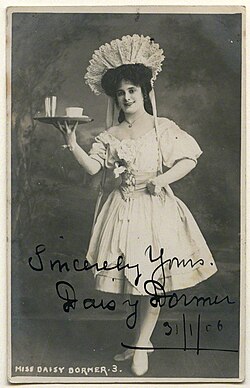
Iris Miyako was charged with stealing a lady’s half hoop diamond ring valued at £30 [worth around £4,600 now] from the Walthamstow Palace music hall dressing room of Daisy Dormer on 24th June 1908.
In court, Iris claimed to be an 18 year old Japanese subject, and gave her occupation as a music hall artiste and lady wrestler, resident at 88 Ashworth Mansions in Maida Vale.
“A member of the staff of the Japanese consulate was in attendance, and in consequence of some communication he had made to the Bench, Mr. Eliot Howard said that the Court appeared to have been misinformed as to the accused’s nationality. They were told that she was a Japanese subject, but did not seem to be correct. The only result, so far as the Bench was concerned, was that the accused got more consideration as a stranger on our shores, but it would be seen that any conclusions the public might have drawn from her description as a Japanese were un-founded. Mr. W. Daybell who defended – “she is either Japanese or English or neither! She was born in England, of Japanese parents.” Mr. Eliot Howard. – “Well, we will not go into the matter any further.” 1
I could not find anyone of the name of Iris Miyako, or any variation of that, born 1889-1890 in Britain of Japanese parents.
There was no entry in the census records of 1911 for 88 Ashworth Mansions, nor did any of the neighbouring addresses in Ashworth Mansions have any Japanese names.
Daisy Dormer, a well-known music-hall artiste and singer, said the prisoner had great affection for her and that she first met Iris in October 1907 at Portsmouth and had worked with her in four other places. Dormer also stated the prisoner had been out of engagement for some time.2
The other acts who had performed with Daisy Dormer in Portsmouth in October 1907 included Raku, a Japanese wrestler, supported by Japanese assistants. This was the stage name of Uyenishi Sadakazu, a jujitsu practitioner and professional wrestler.
Uyenishi had come to Britain in 1900 and set up a school of Japanese self defence in Piccadilly in London in 1903. In 1904, he had a child with Louisa Moto Kitchee, the older daughter of British woman Hannah Storey and Japanese acrobat Murakami Kumataro, who had come to Britain as a child, with the Royal Tycoon’s Private Troupe in 1870.
Louisa and Uyenishi had three more children together by 1908. She sometimes appeared on stage with him as “Miss Moto” to show how a young woman could defeat an attack by a man. The Music Hall and Theatre Review noted “this young lady can certainly take care of herself, and the young man upon whom she exercises her skill has my deepest sympathy.”3
Her younger sister, Maud Omoyo, who was born in 1888, also performed on stage with another jujitsu practitioner, Francis Long, and married him in 1907.
It seems unlikely Iris Miyako was either Maud or Louisa, given their circumstances by 1908 and their birth dates, but she may have performed with them, and even been friends with them.
One further clue from the court hearing is that Iris Miyako had a brother.
Miyako explained she had “suddenly succumbed to the temptation” to keep the ring, when Daisy had asked her to fetch it. When a police officer asked her about the ring she said “Well, I will tell you the truth. I had it, and I pledged it for £15.” She then gave to Philips a contract note showing that she had pledged a ring. When told she must be taken into custody she said, “I am so sorry ; I don’t know what made me do it. It must have been a sudden temptation.” At the police station she was searched and £6 18s found on her, and she gave up a number of receipts, and said she had spent £7 or £8 of the money she had received. The Bench remarked that it seemed to be a case of absence of the moral sense, and remanded the prisoner on her brother’s bail of £20. The Bench’s view was that they felt they were not dealing with a habitual thief, and on the promise of Iris’s brother to redeem and return the ring, she would be bound over on her brother’s surety.
The person that most fits the profile in terms of Japanese parentage, birth date, an older brother and a connection to music hall and Jujitsu wrestling is Ohmoto Sarah Ellen Gingero, the daughter of John Gingero, Murakami Kumataro’s acrobat partner.
Omoto Sarah was born 1889 in Birmingham of John Gingero and Annie Hughes. Omoto Sarah was later recorded as “niece” to Murakami’s second wife, Therese Laubach, in the 1911 census. She had an older brother, Sentaro or Centre George Gingero, who was also a performer.
It is therefore highly likely she would have known Murakami Kumakichi’s daughters, and maybe even regarded them as cousins.
Her father John Gingero died before 1900, and according to the 1901 census, Ohmoto Sarah was living in Lancashire as Sarah Richardson, aged 12, with her mother Annie, who had married Edward Richardson, a railway shunter, the year before. Her older sister, Fuzzer Annie, who had been a performer in the Gingero troupe, with their brother Sentaro, was also living with them and her photographer husband. Fuzzer died shortly after, in 1904, at the age of 24, of gastroenteritis. A year later, Ohmoto Sarah’s stepfather Edward Richardson also died.
Perhaps Sarah had moved to London to be with her cousins after the death of her stepfather, and became one of Uyenishi’s “Japanese assistants”.
By 1908, however, Uyenishi had taken to touring Spain and Portugal regularly, and by 1912 he had returned to Japan, with Louisa and their children. This would account for Iris’s lack of engagements.
Ohmoto Sarah must have given up her career as a performer by 1911, as she is recorded in the census as having the occupation of waitress. As for her brother Sentaro George Gingero – his name does not appear in any records or the British or international press after 1905. It is likely he was running a troupe, but from the 1900s, Japanese troupes rarely named their individual performers.

