
On the 24th April 1871, Pablo Fanque’s Great Troupe of King’s Tycoon Japanese had its opening night in Oldham, Lancashire. For the next week they performed as Pablo Fanque’s Japanese Circus, until Saturday 29th, advertising it as “the greatest success ever achieved in Oldham”.1
“After an absence of considerable extent, this popular caterer for public amusement has made another appearance in this town, where he seems almost to command success. Always alive to any entertainment calculated to divert his patrons, with a troupe of performers, equestrian, acrobatic, and of all other classes found in an establishment of this nature, he again comes before the public of Oldham with all the requisites for delighting his audiences, and as usual was honoured with a full house. The horsemanship introduced is very excellent and all the remaining portions of the entertainment provided, thoroughly up to the mark; but the most attractive feature is the Japanese troupe, who execute remarkable feats of balancing, &c., which strike the spectators with feelings of wonder. The circus will remain open in Tommy Field during the remaining portion of the week.
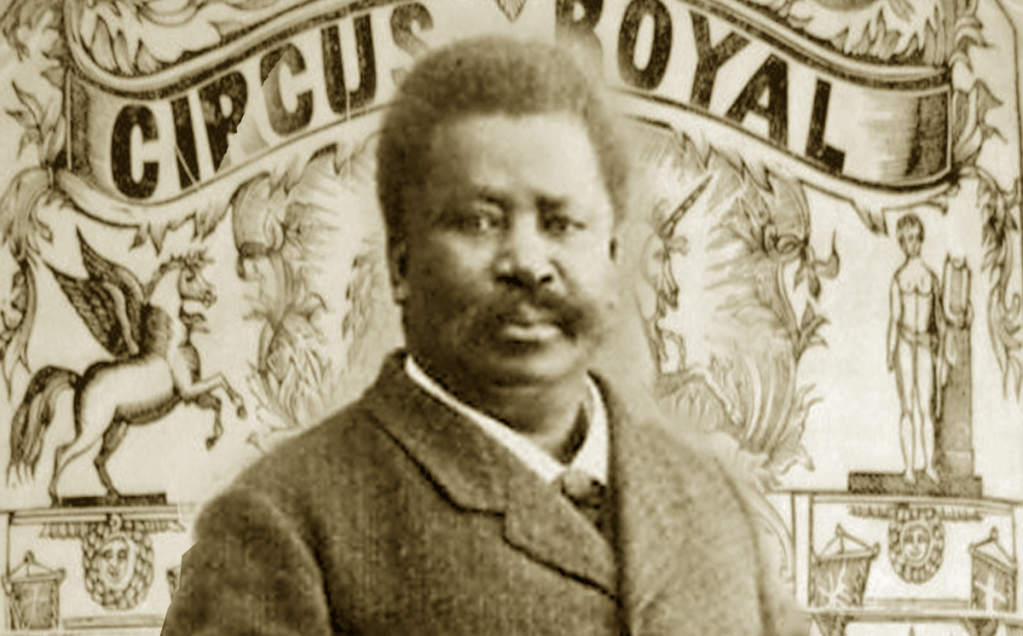
Pablo Fanque, the first Black circus owner in Britain, was born William Darby in St Andrew’s Workhouse, Norwich, in 1810. A few days after the circus moved from Oldham to perform at the May fair in Stockport, he died, suddenly, at the age of 61, or 71 or 75, after 6 weeks of suffering bronchitis and of an effusion on the brain – probably meningitis. The troupe that was to have been part of his Japanese circus was almost certainly Thomas King’s Royal Tycoon’s Private Troupe.
Thomas Lemon King
Thomas Lemon King was born in 1835 in London to Isaac Thomas Lemon King, a waiter, and Sarah. By 1851 he had become a pot boy – a waiter in a pub.
He acted with the London Printers & Bookbinders Club and by the time he married Louisa Aldridge in London in 1855, he had become a bookbinder. The couple moved to Australia shortly after, where he became a cabman. Thomas left Louisa to live with Mrs Kernohan in Emerald Hill, then to work in the goldfields in Queensland. He then became a horse dealer.
In 1868 he was charged with deserting his wife and two children and ordered to pay Louisa 15s a week. He continued living with Mrs Kernohan in Sydney, Queensland and Ballarat, and was respondent in a divorce case. He got into other financial trouble with his horse dealing, and clearly decided leaving Australia for Japan was a politic move – perhaps inspired by the success of Lenton & Smith’s Dragon Troupe and Tannaker’s Tycoon Troupe who were touring Australia in 1868.
He obtained passports for thirteen Japanese performers in September 1869, some of whom – probably Matsui Yoshigorō’s group from Asakusa – had performed in front of the Duke of Edinburgh when he visited Japan in the summer of 1869.
- Naminosuke aged 45, foot equilibrist, Mitsu, his wife aged 36, accompanist, Genji, Naminosuke’s son, aged 12, acrobat, Kanekichi, Naminosuke’s son, aged 7, acrobat.
- Fujikichi aged 38, block piling, Fusa, aged 38, wife of Fujikichi, accompanist, Kumakichi, son of Fujikichi, aged 12, acrobat, Asajirō, son of Fujikichi, aged 11, acrobat
- All above employed in Osaka by Kamekichi
- From Tokyo Asakusa: Yoshigorō, (Matsui Gensui XV) aged 36, top spinner, Moto 茂登 aged 38 (or 41), in the employ of Isojirō, Sawa, daughter of Moto, aged 18 (or 21), accompanist, Kinjurō, son of Moto, aged 8 (or 11), acrobat from Asakusa
- From Osaka: Torakichi aged 36, propsman
- From Yokohama: Isokichi aged 52 (in employment records only, not passport).
The death of Pablo Fanque was the latest in a long line of misfortunes for the troupe. Their ship had been wrecked off Sarawak in 1870, they then toured India and finally arrived in London in July of that year. They performed at the Alhambra, Crystal Palace and other London venues through to early 1871, when one of their senior members, Fujikichi, died of a tropical abscess on the liver and blood poisoning.
They then started a tour of the provinces, and in April, in Dewsbury, the youth who had taken on Fujikichi’s name fell from a suspended bamboo when a cord had broken. He landed on the footlights and one of the pipes from the gaslight had entered between his ribs and another had entered the anterior of his thigh. He was attended to by doctors and taken away for further treatment, but it seems, survived.
A tale of two widows
Fanque’s wife was Elizabeth Darby, nee Corker, a circus rider and daughter of George Corker, a publican of Bradford. The marriage certificate of 1848 gave her age as 21, but it seems she was only 17.
She was left with two teenaged sons – George and Edward and a precarious financial situation. In an ensuing court case it became clear that she had thought that the circus belonged to her husband, and that she was to administrate it as part of the inherited assets, but it turned out that her husband had already sold the circus to a Mr Knight for £150.
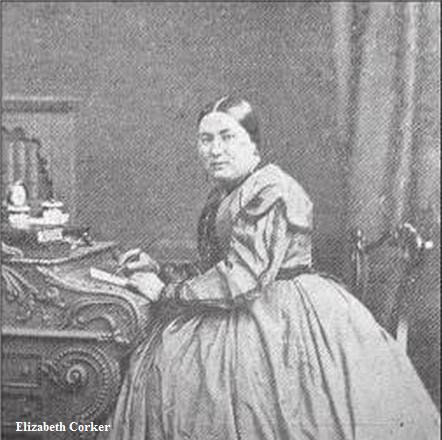
Pablo Fanque was buried next to his previous wife, Susannah, in Leeds. He also had several children by at least two other women. Elizabeth Darby remarried at the age of 43, to George Lush Pearson, an engine fitter who was 15 years younger than her, in 1874. She died at the age of 67, in Kent. Her son with Pablo Fanque, Edward, became known as Ted Pablo, a boxer and her other son George became a musician, but died at the age of 28.
The Japanese troupe seem to have stayed in England during the summer of 1871, and then moved to Arnhem in the Netherlands. They were billed as
- Namenoski, first equilibrist
- Tora Kitchee, accuracy specialty
- Oh Ra To, court top spinner to the Tycoon.
- Famous Salon artists Gin Geron and Jeddo.
- Eso Kitchee, clown and magician, never seen before, performing 6 turns.
- Cooma Kitchee , Ca Na Kitchee, Mo Ko So, Ha Sa, Kinta – Artists who perform the latest and most surprising turns.
- Oh Sa Wa, Oh Mits Sa, Oh Soo Sa, Oh Can Sa – the only Japanese ladies who can leave Japan. 2
Thomas King continued to travel with them and presumably was therefore the proprietor, as his name and “Mrs King” is mentioned in hotel records of January 1872 in Hamburg. Gio Kitchee, Nomenoski, To Ra Kitchee, Gin Gero, Yo Schee Goro, Yeddo, To Ro Kitchee, Rin Zo, Ha Sa, Ca Na Kitchee (all male). Oh Mit Sa, Oh Mo To, Oh Foo Sa, Oh Sa Wa (all female) and Coo Mo Kitchu (male).
In Hamburg a series of photographs were taken of them by Carl Dammann, including of Fusa and Kumakichi, with one of the other men.
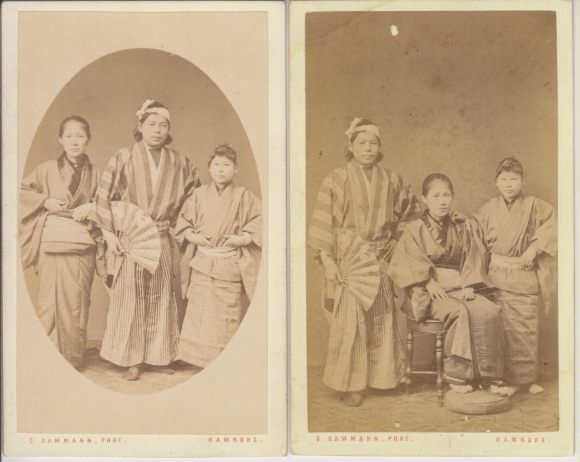
They toured Germany, Denmark and Sweden to May 1872, at which point the troupe clearly began to worry what would happen once their three year contracts were up. The troupe had already left some disgruntled suppliers and audiences in their wake by absconding before paying bills or performing.
Matsui Yoshigorō asked Isokichi (the Kagami guild leader who had joined them) and King for money for return fares to Japan for himself and three others. No money was forthcoming so he made his way back to London and asked Japanese minister Terashima Munenori for assistance.
On the 18th July 1872 a Mr & Mrs King and two children (who would have been Helen aged 8 and Rosalie aged 6) left Southampton on the P&O Mail Steamer the Mongolia, bound for Yokohama, via Gibraltar, Malta, Alexandria, India and China. There was no indication of any Japanese passengers on the ship.
The rest of the troupe continued to tour Europe, initially as part of Charles Crosby and Little Todd’s troupe and then as part of Myer’s circus. Fusa continued to be the master – or rather mistress – of ceremonies. The troupe returned to Britain in 1876 as “The Royal Crystal Palace Tycoon Japanese Troupe” with Gin Goro Jack, Fousah Ketchey, As Sa Ma Ki, Yama Moto, Moto Ketchie and Como Ketchey. Fousah Ketchey is clearly Fusa, As Sa Ma Ki we can assume is Asajiro, her younger son and Como Ketchey is Kumakichi, her older son. Gin Goro Jack may be Genji, Naminosuke’s son. Moto Ketchie was probably Tamamoto Chiyokichi, a rope walker from the Lenton & Smith Great Dragon Troupe. Yamamoto may be the same as the Yamamoto written on the back of the photograph above from Carl Dammann in Hamburg.
In 1877 The Era noted “the doings of the Tycoon Japanese troupe, introduced by an elderly Japanese lady, who has a tongue which she knows how to use, we have very recently referred, and it is only necessary to say that their extraordinary feats of rope-walking, balancing, and tumbling continue to meet with the warmest marks of approbation.”3
In October 1877 “A Japanese lady provided a description of each feat in her native language, which causes great laughter” – this was the last mention of Fusa. 4
The 1881 census shows John Gingero with his British wife Annie, their three year old son Sentaro and one year old daughter Fuzzer Annie, presumably named after Fusa, were living in Newcastle. Gingero’s performing partner Kumakichi does not appear in the census. It seems likely he returned to Japan, perhaps with his mother’s ashes. He came back to Britain in 1884 and performed with Gingero’s troupe, before becoming independent. The full circle back to Pablo Fanque/William Darby’s birthplace, Norwich, was completed in 1891, when Gingero’s troupe performed with Ginnett’s Circus at the Agricultural Hall.

