Categories
Uncategorized

Did Gingero and Kumakichi visit Japan in 1886?

In the course of researching whether Otake visited Japan in 1886 (final version of the post here ), I came across this in the Rising Sun and Nagasaki Express of 22nd December 1886:

“Mr WH Gingiro, Mr Y Kumakichi for London on the Teheran from Yokohama and way ports”.

The Teheran was a P&O steamer ship which sailed between Nagasaki, Hong Kong and Yokohama. It would have connected with steamers to London at Hong Kong.

Could this be the ever elusive John Gingero and Kumakichi Murakami? It seems too much of a coincidence that these names are so similar to the names of two people who called each other brothers, performed together and had been living in Britain since at least 1876. According to other passenger lists, they were accompanied by another Japanese, Hisashige.

Various questions arise though in verifying if they are the same people – are there any conflicting dates of them performing elsewhere? Why are the initials not the same as their usual given names? How, when and why did they go to Japan in the first place?

Also, could investigating this lead to the answers to the biggest unanswered questions about Gingero and Kumakichi – when and where did they die and were there two Kumakichis or just one, living a double life in Australia and Britain?

When did Gingero and Kumakichi leave Britain for Japan?

Looking first of all at Gingero’s movements, he may have travelled with his troupe to Germany in early 1886, then on to India in the spring, and from there to Japan, perhaps with Kumakichi, leaving the rest of the troupe to return to Europe.

The diminishing numbers in the troupe seem to support this. For example, according to the Berliner Börsen-Zeitung the “Royal Gingero” troupe had 10 people in it in January. In May, in Baden, the “Original Japanese troupe Gingero” were four people and two children. Then in June “Two Japanese Gingero – one of which performed on a pole” were in Marburg.

The Times of India noted that a Royal Tycoon Troupe, which is the name Gingero’s troupe often used, played at the Alfred Theatre in Bombay and Madras in the middle of March 1886. It was taking just over three weeks to sail from Europe to India at the time, via the Suez canal. There would then have been just enough time to sail back to Europe in time to perform as the Japanesischen Gesellschaft Gingero that performed in Znaim with the Circus Frankloff (now Znojmo in Czech Republic) in mid April.[2] However the journey overland to Znojmo from a European port would have been lengthy.

There is then a gap from July to September where no records can be found of the troupe performing until October 1886, when an unnamed troupe of 16 Japanese people were in Duesseldorf. The last mention of the “Original Japanese Troupe Gingero” was late November 1886 in Budapest.

From December 1886 to February 1887 there are a few advertisements for the Royal Tycoon Troupe playing in London, but no details of the performers’ names are noted.

Gingero is next mentioned as performing in Britain in April 1887 as Tycoon Gingero and his Marvellous Children, late of the Tycoon Japanese Troupe, at the beginning of five months’ engagement in Scarborough.

As for Kumakichi – he was performing in Middlesbrough to August 1885, as Koomakitchee, but there is no mention of “Koomakitchee” in Britain after that point. So he may have joined Gingero’s troupe, and then gone on to Japan, via India, with Gingero. He must have returned to Britain by February 1887, as his son Mura Kamy was born in November 1887 in Britain, to Hannah Storey.

The return to Britain of Kumakichi and Gingero on the 1st February 1887 on the P&O Steamer Mirzapore, which departed Shanghai December 16th 1886, therefore fits well with both of their activities in Britain in the first half of 1887.

We can see from this that the journey between Shanghai to London was taking six weeks, sailing via Calcutta, Madras, Colombo, Aden, Marseilles and Plymouth, to which we can add a few days to sail from Yokohama to Shanghai. So there would have been enough time for them to travel to Japan, in the summer of 1886 after performing on the Continent and then to spend a few months in Japan before returning at the end of 1886.

Names

The Overland China Mail of 21st December 1886 confirms the passenger list of the Rising Sun and Nagasaki Express, but with slightly different renderings of Kumakichi and Gingero’s names – “Mr T Kimakichi, Mr W. H. Gingero had arrived in Hong Kong per Teheran, for London.” The “Y” is often transposed for T or J in other accounts of Japanese names in the English language press, and Gingero is occasionally spelled Gingiro.

The London and China Telegraph on 24th January 1887 gave yet another rendering – Mr J Kumakichi and Mr W.H. Gingird for the Mirzapore passenger list. Name manglings were common for foreign names, so maybe not too much should be read into the different spellings.

Kumakichi’s daughter Louisa was registered as Louisa Kitchee on her birth in 1885. Kumakichi’s name was given as Comar Kitchee. Around that time Kumakichi was using the stage name Komakitchee, but by 1889 he had changed his stage name to Como Tarro. So was he calling himself Taro Kumakichi, hence T Kumakichi, in 1886?

As for the W.H. for John Gingero – this is harder to rationalise. The official British records all have John Gingero as his name. Only once, when he was living in Amsterdam in 1894, was his name rendered differently – as Hansman Junkaro. Hansman is a dimunitive of Hans, and Hans is itself a shortened version of Johannes, the Germanic equivalent of John.

Why, how and when did they go to Japan?

Although the ban on travel abroad for Japanese people was lifted in 1866, the Meiji government continued to be very concerned about human trafficking and rejected several applications for Japanese workers to be hired by foreigners. There must also have been some concern amongst those who had left Japan without permission, or under permission for a limited time by the Bakumatsu government, would be banned from leaving Japan again, if they returned.

By the early 1880s, however, the Japanese government began to be more supportive towards emigration, perhaps because of the poor economic situation in Japan (although not so accommodating towards Tannaker Buhicrosan’s attempts to recruit for his Village in 1884). The first officially government sanctioned emigration, of 945 workers to Hawaii, took place in January 1885.

Neither Gingero nor Kumakichi’s names appear in the passenger lists published in the English language newspapers of any ships sailing to Yokohama after March 1886, however, although this may have been because only first class passengers were usually named.

Another possibility is that Gingero and Kumakichi joined up with Chiarini’s circus to travel to Japan – their passage would therefore have been paid.

Chiarini’s circus began touring Japan from July 1886. There was a notice in The Era in January 1886 that all artists selected for tour of Australia and China for Chiarini Circus via Parravicini left London on 30th December 1885 for Hong Kong by P&O Rohilla. The passenger lists for the Rohilla do not have any Japanese names, although the Zetina family, who joined Chiarini in Asia, are noted.

It may be that Gingero and Kumakichi took a different route and never went to India. A group of Japanese acrobats, headed by a Charles Bonelli, who arrived in Boston from Nova Scotia, travelling on to Japan in April 1886, were also for Chiarini’s circus. One of the members of the group was H Gengiro, and there was also a Kormata Kamackichi – which could be a mangling of Kumataro Kumakichi. More recognizable was the name Oogawa Torakichi, presumably Ogawa Torakichi, who had been in the Great Dragon Troupe, and had moved to Germany in 1885. Maybe he met up with Gingero and Kumakichi when they were touring Germany in early 1886, and together they decided to join Chiarini’s circus.

This journey from Europe to Japan via the United States would also have conflicted with John Gingero performing in Austria in May and June 1886.

Kumakichi, Chiarini’s Circus and Emma Stoodley

Chiarini’s circus started performing in Asia from 1881. From 1882 the members of the circus included Emma Stoodley and her siblings – equestrians – touring Australia and New Zealand.

Emma Stoodley left Chiarini’s Circus in the summer of 1885, performing in New Zealand again from September to November 1885 with the Grand International Circus, along with Cooma Ketchie on swinging bamboo or bamboo perche, also balancing tubs (or Kitchie Cooma, Japanese contortionist and tumbler by other accounts).

A Cooma Ketchie had been with Woodyear’s Circus in Australia and New Zealand from March 1883 to March 1885. The name is of course very similar to Kumakichi/Kumataro who worked with Gingero in Britain – and both were tub balancers and bamboo pole perche performers. However Koomakitchee was performing tub balancing with Gingero’s Royal Tycoon Troupe in Wales in March 1885 and in July 1885 in Middlesbrough. This is a direct clash with Cooma Ketchie performing in New Zealand in March 1885. It is notable however that the Koomakitchee name was dropped from advertising for the Tycoon Troupe after March 17th 1885, and only “the Man Monkey, the marvellous Barrel Performer” is referred to. Perhaps James Dubois had taken over.

Emma Stoodley also seems to have left her partner in Australia in the summer of 1885 – Joseph Hall or Joe Walhalla, by whom she had two children, including a daughter who had died in infancy in 1884 in Australia. Joseph Hall set up his own circus – “Walhalla Brothers” – which started performing from July 1885 in Australia.

Emma Stoodley re-joined Chiarini’s circus by April 1886, when it was touring China. Perhaps Cooma Ketchie joined Chiarini’s circus with her, but there is no record of him or Gingero performing with Chiarini in 1886.

Emma Stoodley and Joe Walhalla’s son Claud died in June 1886 in Shanghai when he was only 16 months old and shortly after, Emma travelled with Chiarini’s Circus to Japan.

She only stayed in Japan a few months – The New York Clipper reported in October 1886 that Emma Stoodley, French and Angelo, and some English clowns had quit Chiarini’s circus in Yokohama and travelled to Australia.

Emma Stoodley’s name appeared in the passenger list for the Tanais, published in the 30th November 1886 Overland China Mail, which had arrived in Hong Kong from Yokohama. It seems she did not travel to Australia from there but instead went back to Britain. Had Kumakichi and Gingero also quit around the same time – maybe even travelling home with her?

The departures from Chiarini’s circus would explain the advertisement that appeared in The Era on the 15th January 1887 for “first class single or double artists – gymnasts, acrobats, clowns, equestrians for Chiarini, Japan” placed by the agents who often represented the Japanese acrobats and troupes – Parravicini.

Emma Stoodley advertised in The Era that she had returned to Britain in January 1887 and by November 1887 she was appearing with John Sanger’s Circus. In December 1887 John Gingero’s troupe of acrobats were also appearing with Sanger’s Circus. There is no further mention of Emma Stoodley’s name in the British press after 1888, however.

Unfortunately, there is no definitive proof – yet – of Gingero and Murakami’s movements in 1886-7, but plenty of circumstantial evidence. Finding out what the W.H. of Gingero’s initials stood for might be a significant clue – and could even help uncover when and where he died.


[2] The Times of India, 13 March 1885 p 2

[3] The Era, 10th September 1887

[4] The Era, 15 October 1887, p 22

Categories
Uncategorized

Talk to the British Music Hall Society July 22nd London

Pernille Rudlin is giving a talk to the British Music Hall Society on July 22nd 7pm – 9pm, at the Water Rats, London. Open to non-members.

Tamamoto Chiyokichi, was a rope walker, who left Japan at the age of 10. He claimed to have fought in the Zulu war, and then settled in Britain, married a British woman with whom he performed in music halls and circuses, and was apparently a founder member of the Variety Artistes Federation.

(Above photo from Robert L Sayers collection – Chiyokichi is probably on the left)

Categories
Uncategorized

Ellen Mary Watanabe 1887-1940

In commemoration of International Women’s Day – and Women’s History month, I thought I would record the life of Ellen Mary Watanabe. She was not, strictly speaking, part of the Japanese performer group I have been researching, but there are connections, as I will explain.

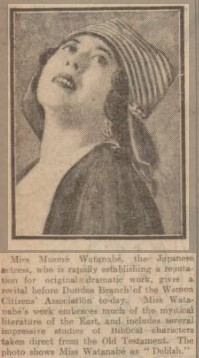
I had originally thought the “Musme” Watanabe, who gave recitals and also exhibited her works of art in Britain in the 1920s was Susan or Suzanne Watanabe, the step-daughter of Watanabe Seishu, the leader of the Fukushima Troupe. I assumed Susan had adopted Musme as a stage name, as it is a rendering of the Japanese word “musume”, which simply means “daughter” or “miss”.

Suzanne Watanabe was born in 1898 in Paris, and came over to Britain with the Fukushima Troupe in around 1900. She went to a boarding school in Clacton and also performed with the troupe in the 1910s. Her mother Tora left for Japan in 1923, then Suzanne departed for Japan in 1924 and finally Seishu was deported in 1925.

I thought perhaps Suzanne had returned from Japan and continued her life in Edinburgh, as Musme Watanabe.

Then Jamie Barras contacted me to say that thanks to my website, he was able to piece together more about Sussie Wata, an actress he was researching, who seemed to be Susan Watanabe, but that he thought Musme Watanabe was in fact Ellen Mary Watanabe. I agreed with him that Sussie Wata and Susan Watanabe were one and the same person. More about Sussie Wata can be seen on Jamie Barras’ website here.

So that led me to look into who Ellen Mary Watanabe might be.

She was born in Edinburgh on September 11 1887 to Kaichi Watanabe (aged 29) and Janet, nee Norval (aged 31). Kaichi and Janet had married on the 8th of April 1887, so presumably Janet was already pregnant with Ellen at this point.

Janet Norval was the daughter of a comb maker, William Norval, and Mary, who had died in 1862 when Janet was five. Janet had been living with her father up to 1881, working as an envelope folder. Her younger sister Helen died in 1881, followed by her father in 1882, and her younger brother Alexander in 1884.

Fortunately, although Watanabe is a very common Japanese family name, the given name Kaichi is not. So we can be pretty certain that Kaichi Watanabe was the same Kaichi Watanabe who left Liverpool for New York on the SS Servia on January 14th 1888, only 4 months after Ellen’s birth.

Kaichi’s occupation is given on the passenger list as engineer, and he had left only four days after being elected as an associate member of the Institution of Civil Engineers. He had graduated from Glasgow University in 1886 with a BSc in engineering.

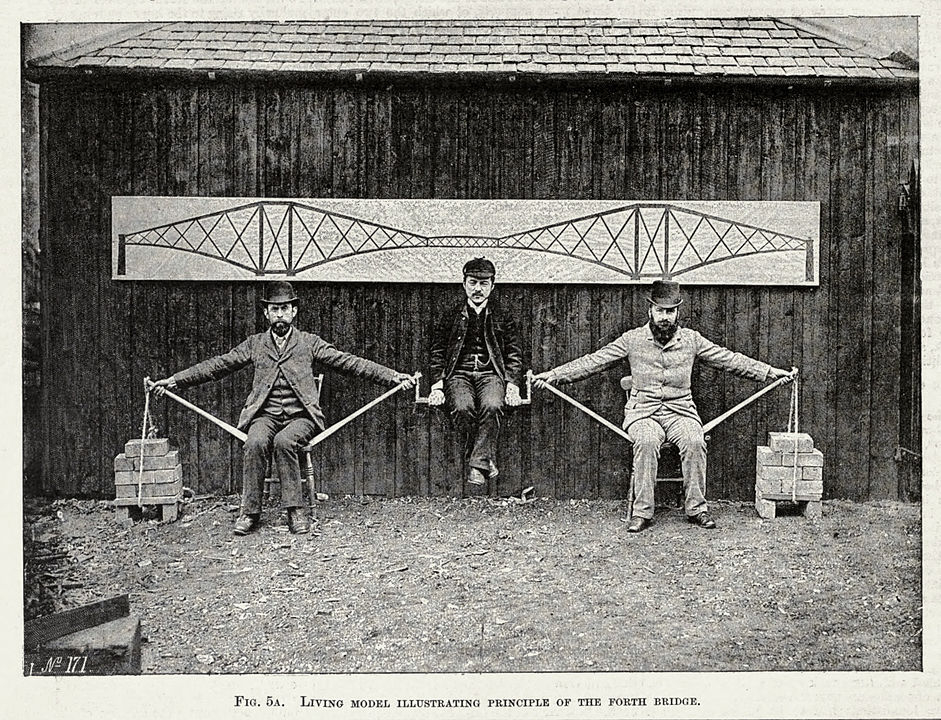
I then searched for Kaichi Watanabe in Japanese, and discovered from the Eikoku News Digest that he was known as one of the fathers of Japanese civil engineering, and also appears on the Scottish £20 note, sitting in the middle of a mock up of the Forth Bridge, whose design he worked on. At which point I realised he must also be known in the English speaking world too, and indeed there is a Wikipedia page on him.

None of the articles I have found about him seem to be aware of his Scottish wife and child, however, only mentioning his marriage in Japan, to the daughter of the family he was adopted into, Yoshi Watanabe.

His marriage to Yoshi took place before he came to Britain in 1884, and he had already had one daughter before Ellen Mary. He went on to have six further children by Yoshi and also a son, by a mistress, who became a well known pianist.

As was the tradition with wealthy Japanese, this liaison and child was recognised and the son entered on the family register.

Janet continued to call herself Watanabe until her death in 1946, at the age of 90. Under the 1870 Naturalization Act she had lost her British subject status on marriage to Kaichi, but Ellen would be British by “jus soli” having been born in Britain.

Janet and Ellen (or Nellie) lived with her older sister Mary until Mary’s death in 1902. Janet was named as executrix of Mary’s will, and the probate record refers to Janet as being the wife of Kaichi Watanabe, currently resident in Japan.

Janet was described as the widow of Kaichi Watanabe right up to the notice of her death in the Edinburgh Evening News, in 1946 – so she must have continued to be open about her connection to Japan, throughout wartime.

Kaichi had died in 1932, at the age of 74, after an illustrious career as an engineer, including as president of the Sangu railway company. There is no evidence he ever returned to Britain to see Janet and his daughter Ellen, however. Nor is there any evidence that Ellen visited Japan.

Ellen nonetheless put her Japanese heritage to the forefront of her acting and artistic career and reviewers frequently referred to her being “Japanese” and marvelled at her speaking perfect English.

Before becoming a performer she was a “photographic artiste” according to the 1911 census, living with her mother Janet in a tenement in Dalry Road, Edinburgh. Before that, and after Janet’s sister Mary’s death, they were living in a tenement at 37 Caledonian Crescent, just round the corner from Dalry Road, and Janet had been working as a dressmaker.

Ellen’s first performance was in an amateur dramatic society – the Newlands club, appearing in 1914, at the age of 27, as a French woman, Madame Didier, in Op o’ me Thumb.

She started performing professionally as Miss Musme Watanabe, in Rabindranath Tagore’s The Post Office, in Edinburgh in 1919, where her “wonderfully flexible voice, and her imitation of the bass of the men’s voices and the piping treble of the child Amal” was noted. (Gentlewoman – Saturday 8 March 1919)

She then went on to play all the parts of “a Japanese tragedy – The Pine Tree” in which the devotion of the servant to the master “a national characteristic of Japan” was “tragically brought out.” (Edinburgh Evening News – Thursday 22 April 1920).

She continued to recite a mixture of classical Japanese plays, the Bible and European literature such as Hans Anderson and Aesop, including broadcasting on the wireless.

Above – Dundee Courier, 25 January 1923

She mainly performed in Scotland up until 1925, but in 1926 was in Paris and then also toured England through the late 1920s.

A review in the Falkirk Herald in 1924 described her as one of “the most fascinating and individualistic of artistes appearing on our platforms of to-day… In the day of the theatre and the music-hall, the cinema and broadcasting, the claim to have evolved a new form of dramatic art seems difficult substantiate. Yet it has been done by Miss Musme Watanabe, the Japanese actress of the platform, occupies a unique position in the dramatic field, but whose highly successful work has so far found no imitators. This is probable [sic] due the fact that Miss Watanabe combines the dramatic traditions of Japan with the most modern methods of the West in a manner requiring many years of study, and the possession of an unusual personality. The realism of stage scenery by which the Western actor seeks to create atmosphere has no place in the East, the illusion of scenery and stage properties being left to the personality and technical skill of the actor playing upon the imagination of his audience method which is just beginning to penetrate to the West.

With only a plain curtain as background, and on quite a small platform, Miss Watanabe has presented complete plays with ten or more characters, taking each part herself, changing her personality completely that each character becomes a clearly defined individual with a separate voice, gesture, carriage and even appearance. Miss Watanabe, in the words of a well-known critic, displaying psychological agility little short of marvellous.”

“Her nationality, combined with her perfect command of English, make her unique interpreter of the beauty and mysteries of the East, and she has done much valuable work in presenting to Western audiences works never before performed English, and in giving, in her own special method, new interpretations works already known. Miss Watanabe is deeply appreciative of the wonderful literary quality, and unerring insight into character possessed by the Bible author, particularly in the Old Testament.”

“These writings,” she says, “go down the very roots of human emotion, and are written with purity of language and dramatic intensity unexcelled in the whole range of literature.”

In 1927 she performed in Cuckfield in Sussex as a “Japanese lady”, wearing “appropriate Japanese costumes” for her presentation of a selection of Noh plays. In her introduction she noted that “the Japanese had always had an extensive knowledge of literature, but good illustrations of native literature in England were very rare. This was because the translation from Japanese into English was so difficult. She was that evening, however, going to give them two plays translated by Mr. Arthur Waley, of the British Museum.”

“An interesting fact concerning Japanese poetry was that it had developed on high level, and many Emperors and several Empresses of Japan had become famous poets. As regards the theatres in Japan, there was a great difference between the Japanese and European houses of entertainment.”

“If one wanted to see a play in Japan one had to rise early, for the performance began at am and continued all day, there usually being from twelve to twenty acts. (Laughter). In order to save time in changing the scenes, a revolving stage was used. This device was introduced long before it was ever heard of in Europe. Another feature of some Japanese theatres, which had not been adopted in the West, was the thoughtful provision by the management of a tear room. This enabled people overcome with emotion to go and have a good cry. (Laughter)” (Mid Sussex Times – Tuesday 22 November 1927)

I am grateful to Jamie Barras for the information that in 1928 Musme Watanabe was a delegate to the International Federation for Housing and Town Planning Conference in Paris – perhaps as part of the Scottish National Housing and Town Planning Committee, who also attended. The Federation had been established by Ebenezer Howard to promote garden cities in 1913. Perhaps her father’s profession as a civil engineer had been an influence after all.

In 1930, at the age of 45, she gave recitals as Madame Watanabe, the change of name reflecting perhaps that she had married Henry Scott Harrison, a photographer (although I was not able to find any evidence of this marriage). Again reviewers noted her “fortunate combination of Japanese birth and an English education”. She does not appear to have performed on stage again after 1930, instead returning to her other vocation as a visual artist.

Above – The Scotsman, 21 November 1929 p 12

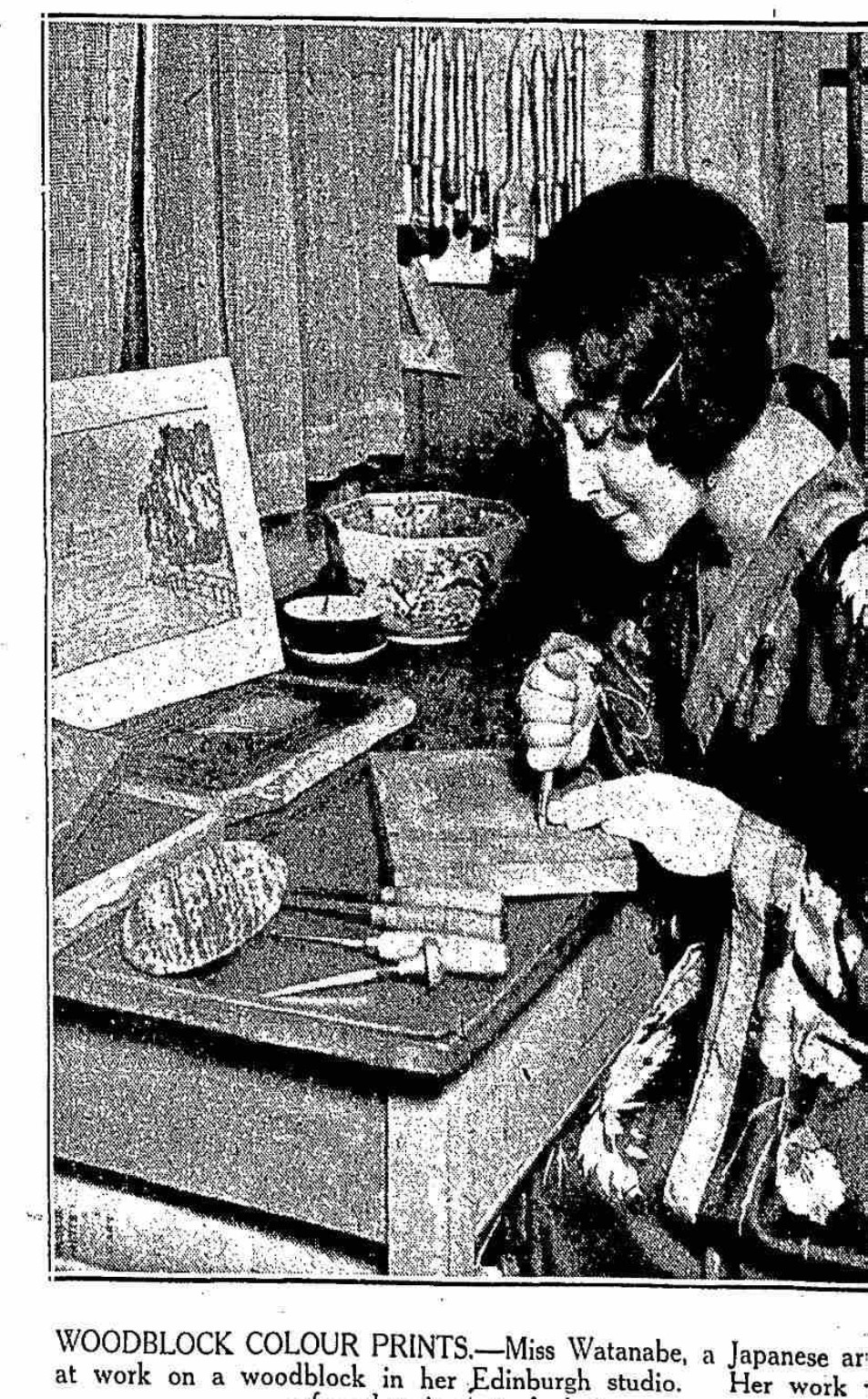
According to The Scotsman in 1929, Ellen had studied Japanese woodblock print making “with” Frank Morley Fletcher, at the Edinburgh College of Art. Morley Fletcher was principal of the college from 1907 to 1923 and gave some lectures during that period, although he did not do any teaching. He also published a book on Japanese woodblock print making in 1916.

Ellen exhibited her work regularly from 1923, including a print “The Pine Tree”, with the Society of Scottish Artists. She does not seem to have been a member of the Society, but exhibited again with them in 1929. Henry Scott Harrison became a member of the Society in 1931. Her last exhibition, as “Madame Watanabe”, in 1938, was of her painted fabrics and pastels at an exhibition in Edinburgh.

Ellen and Henry continued to live together in Edinburgh until her death in 1940, at the age of 52. Henry, who became chief press photographer for Edinburgh Evening News, died in 1952 at the age of 67. They did not have any children.

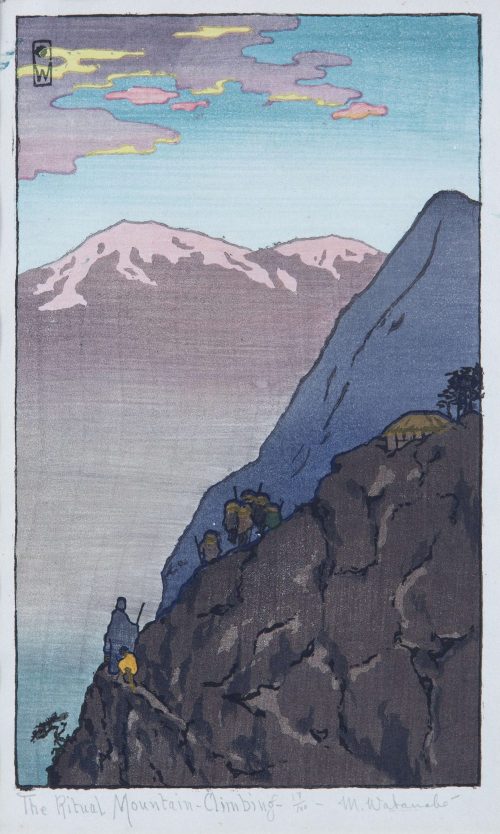
The woodblock print illustrating this post is “The Ritual Mountain Climbing” – signed M Watanabe.

Categories
Uncategorized

Did Otaké visit Japan in 1886?

Another puzzle I wanted to solve during my recent trip to Nagasaki was whether Otaké really did visit Japan in 1886.

Tannaker Buhicrosan announced in The Era on the 11th December 1886 that his wife Otaké had departed for Japan on Friday 10th, for the first time in 20 years and that he had “engaged a special saloon and stewardess for her comfort. Her visit was meant to be of a private and family nature, but we believe she intends embracing the opportunity to secure several novelties and natives for her husband’s business, as it is the intention of Mr Buhicrosan to run to Villages in the provinces next year, as well as one in America, still keeping the one at Albert-gate open.”

There is no further mention of her visit in the English language press, nor does her name appear in any of the passenger lists for the P&O steamers that were the usual way to travel to Japan from Britain at that time.

If she had left for Japan in December, she would have been three months pregnant. She had returned to Britain by June 1887, when her daughter Chiyo was born, in Lewisham.

There was also no further mention of the declaration Tannaker had made when he first opened the Japanese Village in London, that the proceeds would be used to improve the position of women in Japanese society and promote Christianity there.

So if Otaké did go to Japan, were there any records of her visiting Nagasaki, and her home town nearby of Mogi and was there any evidence of her having recruited people for Tannaker’s new village?

Recruiting for the Japanese Village

Tannaker visited Japan in August 1884, to recruit 50 (or 100) people for his Japanese Village in London, which opened in 1885. In an interview with the Yubin Hochi Shinbun he claimed that he only wanted high class craftsmen and performers, no geiko (Kyoto term for geisha) and that they would be looked after by his Japanese wife.

The Japanese Ministry of Foreign Affairs raised concerns about Tannaker and his plan. Some of the recruits were then denied passports and it seems that in the end Tannaker took the Japanese group out of Japan with the undercover help of Charles Henry Dallas and his firm Rottman Strome, from Yokohama to Nagasaki and then presumably on to Shanghai.

The village opened in January 1885, but a fire in May forced its closure, and it reopened in Berlin. At least one Japanese person died in the fire, Enami Shonosuke (1863-1885) who had been employed as a wood carver. Tannaker returned to Japan to purchase further fittings in the summer of 1885.

The Berlin exhibition closed in August and then transferred to Munich, until the end of the year. The exhibition then reopened in London in December 1885. It came up against competion with a colonial exhibition with electric powered fountains opening in London in April 1886. Visitor numbers to Tannaker’s Village recovered in the autumn of 1886 but there were few sales of the more expensive items.

The Japan Weekly Mail noted in 22nd January 1887 that

“I fear by the frantic efforts which Mr Tannaker Buhicrosan is making to advertise his Japanese village at Knightsbridge that this interesting entertainment must be on its last legs.

He must have done uncommonly well with the Knightsbridge show, so perhaps he will retire on his fortune to Japan and there set on foot the various philanthropic and other schemes which he was so lavish in promising the British public a few years ago. The elevation of woman in the social scale was the principal one of these; it was, according to his account, a work that cried aloud for someone to do it, for the poor Japanese woman was in a terrible state.

He was, he observed, specially competent to pass an opinion on these subjects for his wife was a Japanese lady, who, under his tutelage, now saw the error of past ways, and the degradation of a position which she shared with all her countrywomen.

I should however do Tannaker the justice to say that once the show was fairly started, he said no more about social and religious forms.”

The Japan Weekly Mail‘s prediction proved to be correct. Tannaker sold the village to to the Japanese Village and Oriental Trading Company in January 1887, just after Otaké left for Japan.

The Japanese Village and Oriental Trading Company was owned by Marcus Samuel junior, founder of the Shell Transport and Trading Company which later became Royal Dutch Shell. The bankruptcy of the London Village in August 1887 may have been due to, or was one of the causes of, Samuel deciding it was better to focus on the oil business.

The Japanese villagers who had transferred to Samuel’s company took out court proceedings in October 1887, to sue for the funds for their passage home. Tannaker turned up to the hearing and offered support and to employ some of the personnel – but said that as he had already recruited new people for his new villages. One had opened in Saltaire in May 1887 and he opened a further one in Liverpool, in November 1887.

These new recruits had been spotted by the Rising Sun and Nagasaki Express, on 23rd February 1887: “a party of Japanese, male and female, left in the SS Cardiganshire for London yesterday, under agreement to join Mr “Tanaka’s” Japanese Village.”

The SS Cardiganshire was mostly used as a cargo ship rather than a passenger ship, so passenger lists were not published. Perhaps Otaké accompanied them to Britain, and had arrived in Japan by a similar arrangement. Journeys from Britain to Japan were taking at least 6 weeks at this point, so if she had left on December 10th, she would have reached Japan at the end of January or beginning of February. This would have given her 4 weeks to recruit and despatch the Japanese villagers.

Otake may have been assisted by Charles Henry Dallas but he had moved back to Shanghai in 1885. But perhaps he or his colleagues were able to help from there.

Otaké’s knowledge of Japan

As well as being nominated to look after the villagers while they were still in Tannaker’s employ, and then asked to recruit more personnel, Otaké was credited as the author of a guide to the Japanese Village, titled “Japan, past and present. The manners and customs of the Japanese, and a description of the Japanese native village”, published in 1885, reprinted in 1886. An online version of the 1885 edition can be seen here.

It was edited by Reinagle Barnett, which could lead to the supposition that he actually wrote it, and Otaké was just the front. But Barnett was no expert on Japan either. Examination of the text reveals that it is mostly a cut and paste job from the works of Rutherford Alcock, Isabella Bird and other visitors and residents to Japan.

It could be that the very act of compiling and commenting on these excerpts, and perhaps asking Tannaker what he had seen on his trips back to Japan, that forced Otaké to realise her knowledge of her home country was now very out of date. She may also have wanted to see her family again, to show them how far she had come since being sold into a teahouse. Without Charles Henry Dallas, and Tannaker’s rather poor record on looking after previous groups of Japanese, there was also a business case that she might be more trusted and able to recruit Japanese people.

Promoting Christianity

The only parts of the Japanese Village guidebook that read as authentically by Otaké are those dealing with Christianity and the role of women in Japan. She clearly had bitter recollections of the treatment of women in Japan, and as a recent convert to Christianity, may have felt a missionary zeal in returning to Japan.

Significant legal changes had already been implemented regarding women’s status in Japan, such as the emancipation of prostitutes in 1872 – although whether this had much impact is questionable. Christian evangelising was also far more permitted than before, with organisations such as the Salvation Army active in Japan by the 1880s, including rescuing “fallen” women.

Otaké had already been a Christian for several years before her putative trip to Japan. She had been baptized at St Mary’s Lewisham in 1883, taking on the Christian name of Ruth. Seven of her children with Tannaker were baptized at the same church the following year.

Tannaker claimed that he and Otaké were married in Nagasaki both by a Shinto priest and in a Christian ceremony in 1868. If true, the marriage must actually have been the year before, as they had sailed for Australia in 1867, when Otaké was 16 or 17. Strictly speaking, this marriage would not have been recognised in Japan or Britain. Marriages between foreign men and Japanese women were only officially permitted by the Japanese government in 1873. And if Tannaker was William Neville, then his first wife was still alive, and he would have been committing bigamy for the second time.

Neville/Tannaker’s first wife, Elizabeth, nee Carter, probably died in 1875 in Liverpool if she was the 34 year old Eliza Neville recorded in the Anfield cemetery register. A similar age Eliza Nevil had been living in Liverpool in 1871, with Elizabeth aged 9, the right age to have been Catherine Elizabeth Nevell, born to Elizabeth and William Neville/ Tannaker, in 1862.

It was not until four years after Elizabeth Neville’s death, however, in July 1879, that Otaké and Tannaker Buhicrosan were married in a registry office in Manchester. If Otaké was concerned about the treatment of women, one wonders what she made of Tannaker’s bigamy, which she must have known about, considering he acknowledged the daughters from his first marriage, the older of whom was living with the Tannakers in the 1880s.

Elizabeth Neville, the second daughter of Tannaker and Elizabeth, was recorded in the 1881 census as Laura Buhicrosan, at a boarding school in East Grinstead, and then as marrying John Hubbard in Australia later that year, as Laura Neville Buhicrosan.

She and John Hubbard had two children, and Elizabeth gave her maiden name as Catherine Elisabeth Laura Neville Buhicrosan on the register of their son’s birth.

Tannaker Buhicrosan was one of the directors of John Hubbard’s mining company which had been established in February 1887. Perhaps Tannaker bought his shares with the proceeds of the sale of the London Japanese Village.

Although the Tannaker’s home was in London, his marriage to Otaké took place in Manchester – where Tannaker’s Temple of Japan had been performing in July 1879. It was noted in The Era that several members of Tannaker’s Japanese troupe were to leave Britain to return to Japan – perhaps Tannaker was due to accompany them, and wanted to legitimize Otaké’s status before he left. Eight months later, Otaké and Tannaker’s 6th child and fourth daughter, Otakesan Maude, was born in London.

Tannaker’s name is in the registry office records as Tannaker Billingham Nevell Buhicrosan aged 38 and Otaké as Otakesan Ohilosan Buhicrosan, formerly Ohilosan, aged 32. Their supposed marriage in Nagasaki in 1868 was also noted. Tannaker gave his profession as merchant and his father’s profession as doctor, and name as William Nevell Buhicrosan deceased – not very Dutch sounding despite Tannaker’s earlier claims to be the son of a Batavian Dutch man. Otaké records her father as Haggrosan, a farmer – the same name she used as her maiden name in record of her baptism.

The treatment of women in Japan and Britain

Otaké and Tannaker stayed together until Tannaker’s death in 1894 at the age of 54, of cirrhosis of the liver and acute jaundice. Although this indicates Tannaker must have had a drink problem, there is no evidence that he mistreated Otaké as a consequence.

Otaké would have been aware, however, that the exploitation of women and domestic violence was not only a problem in Japan. The Matrimonial Causes Act came into force in Britain in 1878, providing protection for women who experienced domestic violence in their marriages. The act gave women the ability to obtain a protection order from a magistrates’ court, which was essentially a judicial separation that also granted them custody of their children.

One of the first men to be tried under it, in July 1878, was Thomas Edward Miles, who, with his wife Alice Edith, had been a witness to Otaké and Tannaker’s marriage in July 1879 in Manchester.

Thomas Edward Miles was the son of John Miles, a theatrical printer, who became a partner in Tannaker’s Japanese Village company in the 1880s.

It seems the Miles family connection to the Tannakers dated to at least 1878, as Miles Neville Buhicrosan, Otaké and Tannaker’s second son, was born in February 1878, and seems to have been given the name Miles in tribute to John Miles – perhaps John Miles was even Miles’s godfather. Or, it is speculated, his actual father, perhaps by Otaké, because when Miles later renamed himself, when living in South Africa, as Neville Miles, he claimed his father was John Miles.

A counterargument to this would be that laws heralding the apartheid era were beginning to be passed in South Africa, making it difficult for non-whites to own land. It may have been wise for Miles to claim as much white-sounding ancestry as possible, and distance himself from any exotic names.

The Croydon Times reported the Thomas Edward Miles case as follows on 10th July 1878:

“Thomas Miles, printer, No. 9, Great Titchfield-street, was summoned before Mr. Cook, for assaulting his wife, at present residing at Blyth-hill, Mr. Alsop appeared for complainant, and Mr. Parks for defendant —Mr. Alsop stated Mrs. Miles complained of constant ill-usage since her marriage, about three years ago. She had miscarried through the defendant’s violence. She had been repeatedly kicked and otherwise assaulted. On Wednesday last, on going to the defendant’s lodgings, in Charlotte street, the defendant said he would have his revenge on her, held a knife up, told her to get out of the room or he would throw he out, dragged her to the door, and her arm and knees were much hurt by her falling. The defendant was of intemperate habits, had been recently charged at that court with being drunk, and was so violent when under the influence of drink that he had torn his wife’s clothes off and held a razor over her while in bed—Mrs. Miles, a delicate, ladylike woman, deposed to various acts of ill-usage on the part of her husband, and to his irregular and intemperate habits, and then detailed the specific acts of violence to which she had been subjected on the day named in the summonses—Replying to Mr. Parks, complainant said her husband, when sober, was a good husband, and treated her kindly.—Mr. Parks having replied, and called a witness, Mr. Cooke said he had been asked to act under the new statute, but could only do so where it was shown that there was an aggravated assault. In the case before him he did not think that the evidence amounted to an aggravated assault, and what he should do was to call upon the defendant to find two sureties in the sum of £10 each to keep the peace towards his wife.”

A letter to the Daily News the next day from “Pitiful” read “will you further permit me to ask the presiding magistrate when he would consider the safety of this “delicate, ladylike woman,” poor Mrs Miles, to be “in peril,” since being “repeatedly kicked and beaten” – caused to miscarry, and threatened with a knife, and now with a razor, does not constitute “peril”? Surely when those drunken outbreaks of Thomas Miles some day reach their natural conclusion, and his wretched wife is killed by his kicks or his razor, a very dreadful responsibility will rest with the magistrate to whom the law confided the power to shield her, and who refused to use it.”

Tannaker and Otaké surely must have been aware of this case, and yet they asked Thomas and Alice to witness their own marriage a year later.

Thomas and Alice seem to have reconciled after the court case and decided to move to Lancashire, perhaps to try a fresh start. The advertisements for Miles’ printing business in London ceased after September 1879 and in June 1880 they had a son, John Miles, born in Salford. The 1881 census shows Alice, Thomas (who was working as a letter press printer), their nine month old baby John and a servant, living in Eccles New Road, in Salford.

The Tannakers returned to their home in Lewisham, however, although they may have continued to be in touch with Thomas and Alice through Tannaker’s business partnership with John Miles senior from 1883. Once Tannaker sold up his interest in the Japanese Village in Knightsbridge, in 1887, this partnership would have come to an end.

There is no sign of Thomas and Alice in the 1891 census, although an Alice Edith Miles (described both as married and as single) was admitted to Southwark workhouse in April 1888, and then admitted and discharged from the Southwark workhouse in July and August 1890.

An Alice E Miles died in Lambeth in 1934 – if it was Alice Edith Miles, then she lived until she was 80. As for Thomas Miles and their son John, there is no obvious record of either of them in the 1901 census nor records of death or marriage which match closely.

Tannaker was declared bankrupt in 1892, the same year that his old business partner John Miles died, at the age of 70. Miles was pre-deceased by his wife and both his daughters. Tannaker had his own family tragedy the year before, with the death of his four year old daughter Chiyo, after accidentally taking an overdose of Tannaker’s morphine.

As noted above, Tannaker died in 1894, of cirrhosis of the liver and jaundice. Otaké died twenty years later, on the eve of World War I.

Conclusion

Clearly someone must have recruited the Japanese people who travelled on the SS Cardiganshire in February 1887 for Tannaker’s new villages. Whether it was Otaké , on her first visit to Japan in twenty years, or someone else, is difficult to prove.

Otaké had plenty of reasons to want to visit Japan, not just to reconnect with her family and show off her wealth. She must have wanted to see for herself how far Japan had changed, both with regard to the influence of Christianity and the status of women. She may well have been able to persuade Tannaker that her trip would also make business sense, if she was able to recruit the new people he needed for his next Japanese villages.

But maybe, yet again, Tannaker was the master of self promotion, and having gained the publicity he wanted for his new villages, he simply used some of his old business contacts to find new recruits, thereby sparing the expense of actually sending Otaké in saloon class, with a stewardess.

Categories
Uncategorized

Did Tannaker go to Japan in 1870?

On my recent trip to Nagasaki, I found the following article in the Nagasaki Express, Saturday 16th July 1870 p 106:

“KIDNAPPING EXTRAORDINARY – A daring and successful act of kidnapping was performed in our settlement on Thursday last, which for the boldness of its conception, and consummate impudence of its execution, proves that the perpetrator must be thoroughly proficient in his art.

The culprit was traced from the Golden Age and again to that vessel on her departure, taking with him the poor child he had stolen. It appears that this boy-stealer was travelling disguised as a gentleman; we understand that he mixed with the first class passengers, indeed, we hear, that at all moments and under all circumstances he would thrust his little self and his little grievances upon his neighbours – always unasked – and from the fact of not actually receiving a kick in reply, soon thought himself intimate with those he was travelling with.

On shore he still maintained his disguise until the last moment. He appears actually to have called, upon some of the residents, but from enquiries made by the Police we are glad to hear that – thanks to the day-light – their plate chests seem to have been left untouched; some own however to having lost their tempter – all their patience with this artful, talkative little thief who hid his ultimate intentions under the cloak of claiming sympathy for some deep grievance practiced upon him elsewhere – either in Yokohama or Shanghai. As night set in his true propensities seem to have come out: by importunity he introduced himself to the table of one of our residents and in return for this hospitality he kidnapped an intelligent, good-looking little boy! The theft was not discovered until too late to stop it, and the wonder in the settlement now is: how could this have been done? What charms could have been laid on the boy, what stupifying [sic] medicine made use of ? Serious apprehensions are also felt for the fate of the child himself: for what object has he been abducted? We trust not for any such purposes as those lately laid at the door of missionaries in China. But, if the boys eyes are not in danger, can we still think that the lad is safe in such hands?

As a warning to others who may be imposed upon by this same ravisher, we may add that in height he stands about five feet nothing, is of slight frame, has a small head, but a very large nose which, he is continually obtruding into other people’s affairs: he has a special liking to surnames only: speaks much and wildly, and can always be recognized from the traces left on his weak intellect by a late illness of Supreme Court on the brain. “

He did apparently later return the child.

Does his appearance match?

If Tannaker was the William Nevell who enlisted in the 18th Hussars, then he was 5 foot 4 1/2 inches – more than “five feet nothing”.

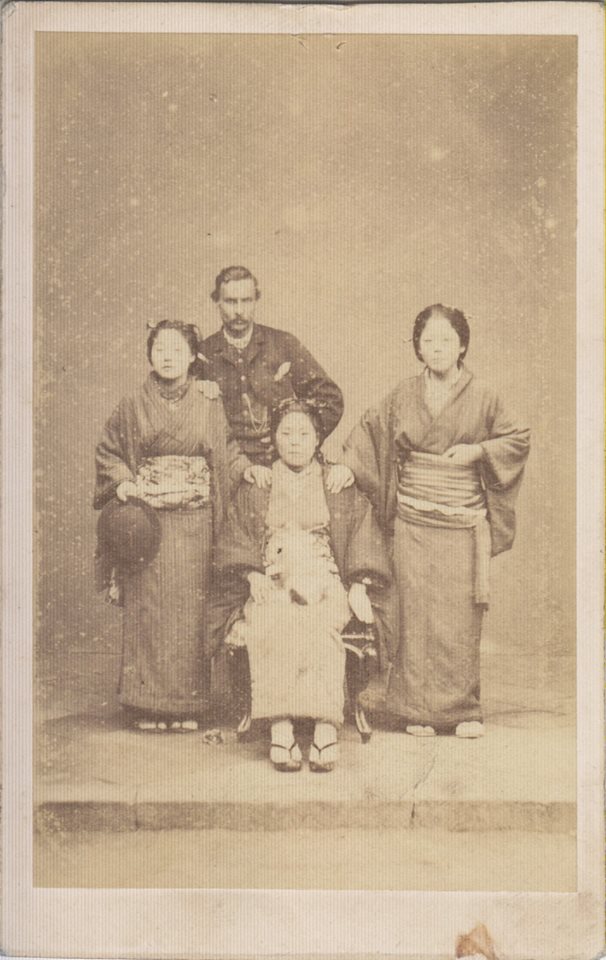
The photograph which might be of Tannaker with “Otackee” and two other women and the newspaper sketch of him show someone of a slight frame with a small head – nose is average?

“Special liking to surnames only” – a reference to Tannaker’s preference for using Tannaker as his name rather than William or Frank (or Buhicrosan?).

Speaking much and wildly. There are many accounts of his amusing and verbose narration, in supposedly broken English, during performances.

Timing

How long would it have taken him to get to Japan, and was there any conflicting record of him being in Britain?

There is an account of Tannaker giving “an oral accompaniment explanatory of the performance in broken but perfectly intelligible English an insight into many of the customs of Japan, poking fun by the way, in a quiet unsophisticated manner that was very pleasing, at several of our insular fashions” in Greenock, in April 1870.

if he arrived on the Golden Age, this was part of the Pacific Mail Steamship Company, and was in 1870 sailing from from Yokohama to Shanghai and then Nagasaki. It may have been met by San Francisco to Yokohama steamers such as the Japan. It’s likely Tannaker would have sailed to New York (7 to 10 days) then crossed America by rail to San Francisco (6 days). The journey from San Francisco to Yokohama took around 2 to 4 weeks. So this was approximately 6 weeks travel time, but it seems the person also spent some time in Yokohama and Shanghai according to the above account.

It’s likely, if it was Tannaker, that he would have left Britain by mid May, in order to arrive in Nagasaki by mid July.

21st May there was a review of the troupe in Ulverston – Tsurukichi and Hikonosuke were performing, and the butterfly trick was performed by the manager, Orantoroto, an Englishman.

There was also a report of Buhicrosan performing the butterfly trick and brick balancing in Tenby in August 1870. However, it was Hikonosuke who performed brick balancing, not Tannaker.

There are mentions of him performing, as an interpreter, in Britain from late September/October.

The need to go to Japan in 1870

Did Tannaker need to recruit new performers?

Advertising claimed the troupe were eight or nine strong by April 1870. Compared to Risley’s Imperial Troupe and the Great Dragon Troupe (12 to 13 performers) Tannaker’s troupe was smaller, and lacked child performers like Little All Right.

Cowsakichiro, a fire eater, had joined the troupe by April 1870 – may have been Cutswhoroge in August 1870. D’Alvini was also in the troupe until June 1870.

After much delay, and claims that they should leave Britain by April 1869 and then by April 1870, on 26th of June J Peters announced in The Era that, “four of the best performers of this well-known troupe”, “the Japanese Tycoon Performers”, had been re-engaged for a further twelve months. The remainder were to leave for Japan on the Coldinghame[1], on the 30th June, the term of their agreement having expired. Seems the four were Otake, Mitsuko, Otomi and Hikonosuke as they were still performing in January 1871. So Tsurukichi returned to Japan?

1st May George Gibson, who worked for Tannaker in Australia, placed an advertisement in The Era saying he was in London, looking to chaperone troupes, was about to return to Australia, and asking W Buhicrosan to get in touch for “news of importance.”

15th May – advertisement in The Era from a Mr Rigby, asking Mr Buhicrosan to get in touch to learn of an advantageous offer.

William Peppercorn/D’Alvini left the troupe in June 1870.

Thomas King’s Royal Tycoon’s Private Troupe (15-16 strong) arrived in Britain in July, and started performing at Crystal Palace in July, having left Japan in October 1869 and toured Hong Kong, Manila, Singapore, India.

Had Tannaker expected to add the Royal Tycoon’s Private Troupe members to his troupe, but Thomas King gazumped him? This may have been the cause of his complaints about what happened in Yokohama and Shanghai.

In any case, Tannaker took over the Great Dragon Troupe in February 1871.

In December 1872, Frank Tannaker Buhicrosan was fined £10 for child cruelty – a boy of 4 and a half, (or seven according to other accounts) entrusted to him to learn gymnastics (or his son according to other accounts), in Exeter. It was proved that on the previous Saturday, Tannaker had locked the boy up in a cupboard, tying his hands above his head to a nail. In this attitude he kept the poor child until midnight, and the boy was only released at the entreaty of the lodging house keeper.

There had been other instances of attempted child abduction involving the Matsui Gensui troupe, Professor Risley and Little All Right.


[1] The Coldingham did indeed leave London for Shanghai on 30th June, arriving Shanghai 30th November

Categories
Uncategorized

Japan Society talk

A video of Pernille Rudlin’s lecture to the Japan Society at the Swedenborg Institute in London on 15th July 2024 on “Karuwaza, a Risky Business: Japanese acrobats in Victorian Britain” is now available on YouTube as below:

Categories
Uncategorized

Japan Society 1892

In April 1901 Maruichi Sentarō performed for the Japan Society in London with members of the Nishihama and Fukushima troupes. Even before then, the Japan Society were discussing Ju Jitsu, the martial art which many of the Japanese performers became involved in demonstrating in Britain – as can be seen in the account of the first proceedings of the Japan Society below:

THE JAPAN SOCIETY OF LONDON. This Society was established in 1892 mainly by the exertions of Mr. Arthur Diosy and Mr. Daigoro Goh, now its Honorary secretaries, and of a few others interested in Japan. Its object is to encourage the study of the language, literature, art, manners, etc of the Japanese people, past and present, and the discussion of Japanese matters in general except those of a controversial character in religion and politics.

From the first the Society received the approbation and support of the Emperor of Japan, and it has for its President his Excellency the Viscount M. Kawase, his Majesty’s Ambassador to this country. The Council, of which Professor W. Anderson is Chairman, consists of members known either for their writings on Japan or their official relations with that country.

The present work forms the first volume of the Transactions and Proceedings of the Society, and, in addition to the usual information about its statutes, financial accounts, lists of members, etc contains reports of four most interesting lectures delivered at the meetings and of the discussions that followed them.

At the first meeting, held on the 29th of April, 1892, after the inaugural address by the President, Mr. T. Shidachi, secretary of the Bank of Japan at Tokio, read a paper on “Ju-Jitsu, the Ancient Art of Self-defence by Sleight of Body.” This, the speaker explained, is not altogether the same as our wrestling, inasmuch as the result of wrestling is determined by skill and physical strength, whereas in Ju-Jitsu, literally meaning “Soft Art,” victory depends on the observance of certain physical laws and peculiar training alone, over even the strongest uninitiated opponent. Enthusiasts in these matters should make a point of reading Mr. Shidachi’s explanations.

At the second meeting a paper was read by Mr. Charles Holme on ” The Uses of Bamboo in Japan.” After referring to the multitudinous purposes to which this valuable plant is put, he explained that it was not utilised in Japan for houses, bridges, ships, etc, there being plenty of suitable timber available. As an article of food it is common among the peasantry, and the Japanese labourer is often represented in works of art ” digging up the bulky and succulent bamboo shoot, or carrying it on his back, slung from his hoe, for his frugal wife to cook and prepare for the simple meal of himself and family.” Mr. Holme then went onto describe the various purposes to which the bamboo is applied in agriculture, domestic economy, decorative art, and personal adornment. Symbolically, in conjunction with the pine tree and plum blossom, the bamboo makes up a trio emblematic of long life, beauty, and uprightness.

Mrs. Ernest Hart’s discourse on “Some Japanese Industrial Art- Workers” was followed by many remarks as to the contrasts of Japanese and English dress fabrics and costumes. “The Naturalistic Art of Japan” was treated of at the fourth meeting by Mr. W. Gowland, whose experience in Japan extends through seventeen years, during which he was connected with the Imperial Mint at Osaka. He followed the development of Japanese pictorial art from the earliest times through the various schools to the ‘”Shi jo.”‘ which is the modem representative school. In the discussion that followed Mr. Goh remarked  that “no artist in Japan can command a high reputation without displaying as much poetical conception in composition as skill in execution.” And he quoted a Japanese saying to show how much a combination of these two elements are appreciated : -” A poem is a picture with a voice: a picture is a voiceless poem.”

A communication by Mr. E. Gilbertson, received too late to be read, but here printed, consists of a translation by Mr G.  Kowaki about the Miochin family, members of which were armourers, swordsmiths, and artists in iron to the Japanese Court for over six hundred years from the twelfth century to the end of the eighteenth. The above lectures are all illustrated with artistic engravings which alone give to this publication a special value.

The session was closed by a dinner presided over by the Viscount M. Kawase. Many speeches were made, and among other toasts that of “Success to the Japan Society ” was responded to by the hon. secretary Mr. Arthur Diosy. With his concluding words all who know anything of Japan, especially those who have resided in the land, will cordially sympathise. After describing how in the graphic woodcuts of popular Japanese romance the hero and heroine are represented bound together by a red cord proceeding from heart to heart, so that the reader may make no mistake, and know who are the people intended for each other, he says, ” If the Japan Society succeeds in the course of years in twisting only one more silken thread into the red cord between the hearts of the people of Japan and the hearts of the people of England, then I think the Society will not have existed in vain.” It may be mentioned that in starting the Society had one hundred and ninety members, and that at the end of April, 1893, they numbered four hundred and thirty.

*Transactions and Proceedings of the Japan Society Vol. I. The First Session,1892. London : Kegan Paul, Trench, and Co.

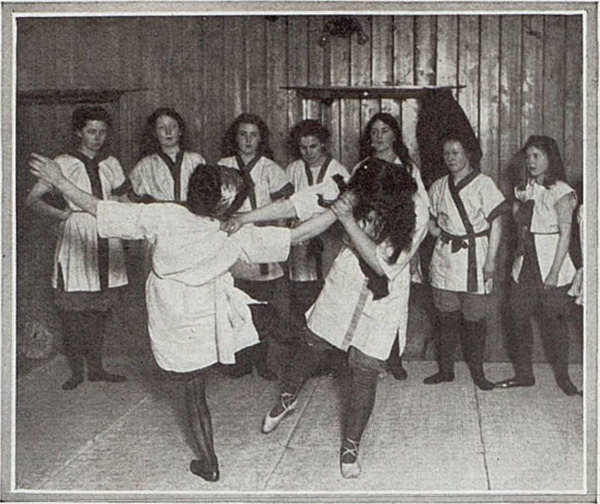
Header photo – Edith Garrud’s dojo (Creative Commons) https://www.messynessychic.com/2018/10/02/bow-down-to-the-queens-of-judo/

Categories
Uncategorized

Talk at the Sainsbury Institute for the Study of Japanese Arts and Cultures

Pernille Rudlin gave a talk on September 16th 2023 on the Japanese performers who came to Norwich in the 19th and 20th centuries at the Sainsbury Institute for the Study of Japanese Arts and Cultures in Norwich, as part of the national Heritage Open Days.

The talk explored the lives of the sometimes overlooked individuals who performed as part of the itinerant acrobatic troupes that toured the UK and beyond, and what their experiences and lives reveal about British perspectives on Japanese culture at the time and vice versa. 

Categories
Uncategorized

Another Norwich/Japan connection: Dr Herbert Blackburn

Dr Herbert Blackburn (1862-1902) was director of the Nagasaki hospital from 1892 to 1895.

He married Emily May Sutton at the Congregational Church in Prince’s Street, Norwich on the 10th September 1890. He was working in Hong Kong as a medical practitioner at the time, so we can assume that Emily traveled to Hong Kong with him after the marriage and then went on to Nagasaki with him.

Emily was born in 1861, in Norwich, the daughter of a Norwich analytical chemist, Francis Sutton. Francis Sutton was the author of “Systematic Handbook of Volumetric Analysis” and the founding partner of a chemical manure works, Baly, Sutton & Co. He was also the Public Analyst for the County of Norfolk and Consulting Chemist and Analyst to the Norfolk Chamber of Agriculture.

Herbert Blackburn was born in 1862 in Lancashire, the son of a clerk in the colonial service, James Blackburn and his wife Mary Kirkham nee Bowen. James Blackburn had been in Calcutta in the 1870s, returning to England in the early 1880s, perhaps because of illness, as he died in May 1882 at the age of 46. His widow Mary died a year later, at the age of 43, in Rawalpindi.

Although Herbert’s younger brother Arthur was baptised in India, Herbert appears to have stayed in Yorkshire with his aunt and uncle as a child and then went on to study medicine in Manchester and Edinburgh.

The Blackburns also had Norfolk roots, through Joshua Blackburn, Herbert’s grandfather and Sophia, his grandmother, who were both born in Norfolk.

Herbert and Emily moved from Hong Kong to Nagasaki in 1892 and a year later, Emily gave birth to their first child, Enid Marjorie. 20 months later, their second child, Stanley Napier was also born in Nagasaki. Napier was the maiden name of Emily’s maternal grandmother.

The foreign settlement at Nagasaki had by that time been established nearly 40 years and was entering its ‘golden years’. Nikolay Aleksandrovich, the future Nicholas II and last tsar of Russia had visited in 1891, the 5th Earl Spencer in 1896 and Sun Yat Sen several times from 1897. Although Nagasaki had lost ground to Yokohama and Kobe in commercial and political importance, Japan’s victory in the Sino-Japanese War of 1894-5 meant that the port’s proximity to China gave it a new salience. The Canada Pacific Railway’s transcontinental railway completed in 1886 had resulted in a British “all red” route from Britain to Australasia, taking in Nagasaki on the way.

In 1894 the Unequal Treaties were revised and a new Anglo-Japanese Treaty of Commerce and Navigation was signed. In the same year, Herbert was appointed vice consul to the US Consul William H Abercrombie, a fellow doctor.

Despite this, the Blackburns’ time in Nagasaki was shortlived and unhappy. Emily died 6 months after giving birth to Stanley, at the age of 33 in March 1895 at 8 Minamiyamate. She was buried at the Sakamoto International Cemetery.

Herbert travelled back to Britain with his children in October 1895. Initially the children stayed with their grandparents, the Suttons, in St Faiths Lane and then Lower Close, Norwich, until they were old enough to go to boarding school.

Herbert seems to have continued to travel abroad and within Britain, from a base in Rickmansworth, but by February 1902 he was staying at Weir Hall in Edmonton, a high class home for inebriates. He was meant to have left the home in March, but had an attack of sciatica. According to the wife of the proprietor of Weir Hall, at the beginning of March he seemed depressed, and explained to her that it was the sixth anniversary of Emily’s death. He went out on the evening of the 7th of March, coming back “unsteady”, and explaining he had had a glass of beer. He played a game of whist and then retired to bed. He was found the next morning, breathing heavily and perspiring. A doctor was sent for but he died later that day, of an overdose of opium. Herbert’s brother in law, presumably Francis Napier Sutton, testified that Herbert was addicted to drink. The evidence showed that he was also in the habit of taking drugs. A verdict of death from misadventure was returned. He was buried at the Rosary Cemetery in Norwich.

Enid went on to board at Uplands School in St Leonards on Sea and Stanley became a naval cadet at Dartmouth Naval College. Enid married Cunliffe Middleton at St Peter’s Notting Hill in 1920. She died in 1985, at the age of 92, in Woodbridge, Suffolk.

Stanley went on to become a naval commander, and was awarded the King George V Silver Jubilee Medal in 1935, for commanding the Victoria & Albert royal yacht and was also awarded a DSO and CBE.

He was appointed from the battleship Collingwood to the Laforey Class destroyer Linnet on 15 December, 1914. He as also awarded the Royal Humane Society’s Bronze Medal for lifesaving at Harwich on 31 January 1916 and was promoted to the rank of Lieutenant on 30 July, 1916 while still in this appointment.

Stanley was promoted to the rank of Lieutenant-Commander on 30 July, 1924, and then promoted to the rank of Commander on 31 December, 1930.

He lived in Bury St Edmunds towards the end of his life and was placed on the retired list in 1944 on account of age, at the rank of captain. He died in 1950, at the age of 55, at Addenbrookes Hospital in Cambridge of a variety of ailments including cirrhosis of the liver.

Categories
Uncategorized

The origins of acrobatics (karuwaza) in Japan

Karuwaza is a general term covering what in the West would be called acrobatics – such as juggling, wire walking and perche acts. Karu 軽 means light, or agile, waza 業 is trick or business. A secondary meaning is “risky business”.

Acrobatics are said to have been brought to Japan from China in the seventh century. Records from that time show that popular arts (both acrobatics and conjuring) from China were known as sangaku 散楽.

During the Muromachi period (1392–1573) a form of acrobatics – largely wire walking and paper walking – called “spider dancing” 蜘蛛舞 (kumomai) was sponsored by aristocrats and military leaders as a type of religious entertainment and incorporated into kabuki. When women (who were usually courtesans) were banned from performing in kabuki in the 17th century, these roles were taken over by young boys aged 11 to 15.

During the early Edo period (1615-1868), Japan became increasingly urbanized and commercialized and acrobatics began to be performed in urban areas as a kind of commercial enterprise for the enjoyment of all classes of society.

When performed by outcastes in the Edo era, juggling and acrobatic feats were known as 放下(hōka, symbolizing “release” and something “below”). According to some, because of the religious connections of many performances, this may also refer to Zen Buddhist monks “releasing” themselves into earthly relations, to a low level in society.

In Britain

Many of those Japanese performers who settled in Britain and elsewhere in the 19th century were tightrope/slack wire walkers (often men dressed as women), feet equilibrists and jugglers – they may also have started their careers as children who were kakubeejishi:

John Gingero

Kintarō (Arthur King Tarro)

Ogawa Torakichi

Tamamoto Chiyokichi