
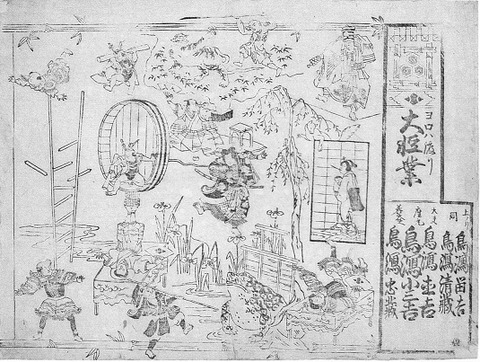
Headed by Torigata/Torikata Kosa(n)kichi 鳥潟小三吉 (1842-1909), a rope walker from Odate, Akita. There is a museum to the Torikata family in Akita.
1842 born in Hanaoka, Akita in 1842 under the name of Yamamoto Konosuke. (Kurata)
Went to Osaka and became apprentice to Hayatake Torakichi I under the name of Kotora.
1867 Passports as a servants for the Yokohama group of the Matsui Gensui Troupe as Kosakichi with Kamekichi (aged 23), Inosuke, Kakichi (stage name Kotaki) and Torakichi/Tarakichi (a child).
Claimed he had been displayed in a cage as an example of the yellow race. In France in July 1867 he appeared as Yamamoto Kosakichi, with Yamamoto Torakichi/Kotaro/Takoba, a child.
1869 July – Le Cirque Imperial Japonais – same who were in Paris Exposition – under the direction of the Godefroid/Godfroy brothers – Kiainsi top spinning, Ka-me-chi and son – pyramid of Yedo, Mlle Ko-sa-ki-chi and Jacobo, ladder and wire dancing (Journal de Charleroi 11th July)
He split with the Matsuis with other former members of the Matsui Gensui Troupe, Kamekichi, Kakichi/Kotaki and Torakichi/Kotaro/Takoba.
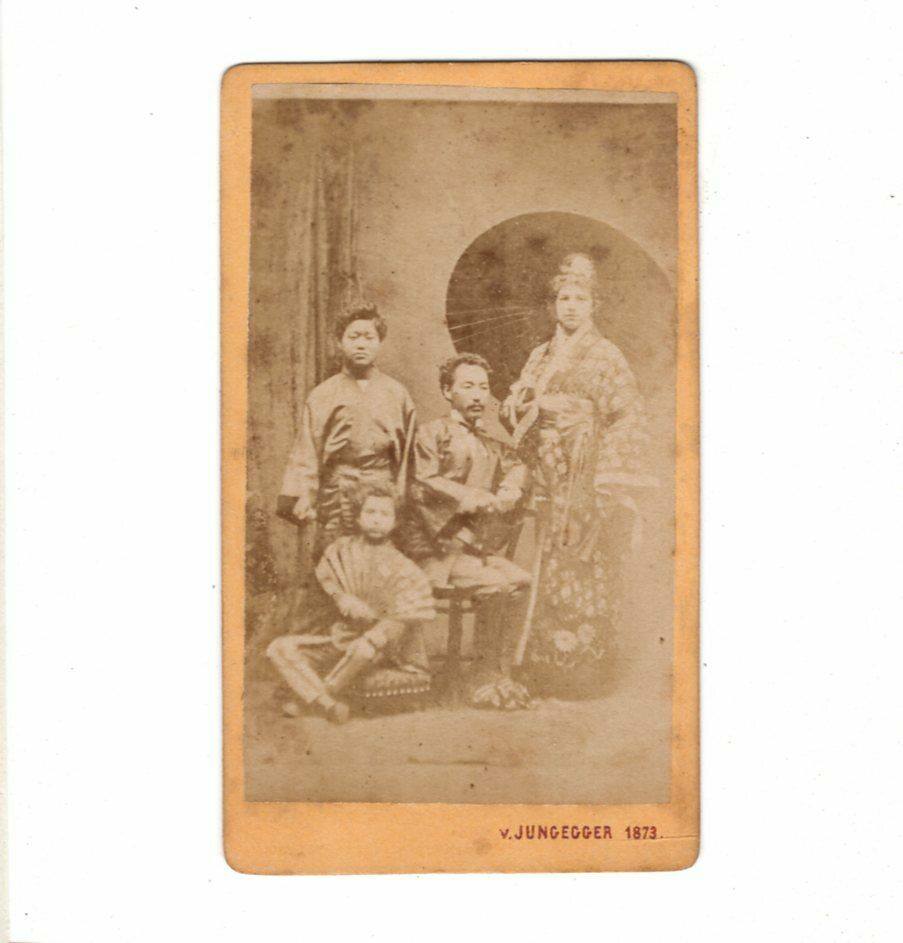

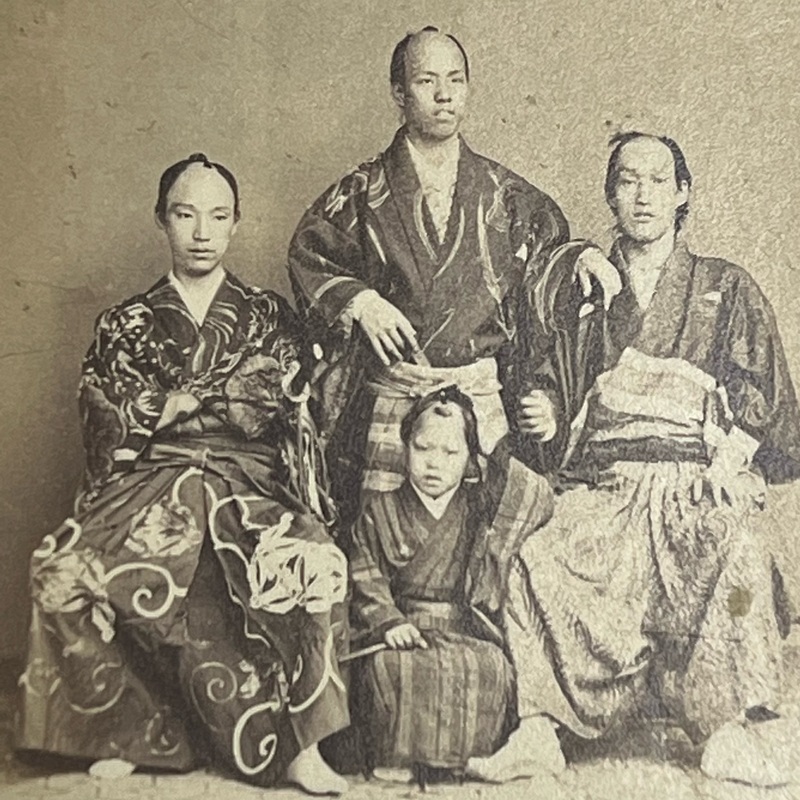
Below: Torikata Kosakichi on the left, Kotaki standing, Kanekichi on the right, Takoba in the middle. Marseille, France, 1867 or 1868 (From Bakumatsuya site )
1870 – may have been Cowsakachiero who was a male fire eater with the Tannaker Royal Tycoon Troupe in Britain
“The Freaks of a Fire-Eater. A fire took place in some farm-buildings at Penrith last week. Whilst the fire was its height one of the Tycoon Japanese, who is professional fire eater, and who had the previous evening astonished large concourse in the Crown Assembly Room, appeared upon the scene, evidently “half seas over,” and with frantic gesticulations declared “it was no fire at all, and that he could eat it all.” He made dash at the doorway of the barn, and to damp his “‘fiery” ardour the contents of few buckets of water were pitched at him. However, in spite of the police he managed to obtain admission to the barn, where he was in great danger of having his cranium bruised by the falling slates as well as to be consumed bodily. Whilst in this imminent position, he proceeded to confirm his rash assertion by seizing a handful of burning straw and cramming it into his mouth. During the performance of this operation he found his way again to the opening, where he was deluged with water, and in spite of his remonstrance was provided with cheap lodgings at the police station.[1]
[1] Carlisle Patriot 29 May 1870 p 5
1873 was at Vienna World Fair, with the Circus Renz
1873 Married a German woman, Fanny Birzle. Or according to the Berliner Börsen-Zeitung (30 December 1884 p15), Marie Pilsler, in Vienna. Marie was 16 and her father was an attorney living in Leopoldstadt, in the same house as the Japanese consulate. Torikata was in Vienna for the World Exhibition aged 25. Was with Circus Renz (according to marriage record) . Was given permission to marry Marie on condition he became a Christian. Was baptized Johann in 1873. Child born in 1880.
1876 returned to Japan because his father was ill.
1877 performed in Japan – other names in troupe are Torigata Naoyoshi, Torigata Kosankichi, Torigata Seizo, Torigata Tomekichi, Torigata Chuzo. Masaru Kawai Collection

1882 Returned to Europe.
1883 – were in Brussels, five in number “They are remarkably clever, and run up ropes and poles by the sole aid of their hands and toes with marvellous rapidity, one of them supporting himself on a bar on the roof of the building, and there sustaining the weight of the other four. In the second part, one of the performers, lying on his back, manipulates with his feet a large tub three or four yards in diameter, spinning it round in every direction. Two boys of the troupe then take their places, one on its inside, the other on the outside, while the same process is going on. In the third part, the youngest performer walls up a pole supported on the shoulders of the eldest of the troupe, and performs all sorts of curious gymnastics.” The Era January 1883
1883 Torikata Tasakiki in court in Paris for allowing his “son” to perform without a net
1884 – represented by Rosinsky’s in Paris
1884 in Vienna – with a 4 year old son, 20 year old Saito, 18 year old Cschirso (Chuzo?), 12 year old Thomi and 9 year old OncScha all adopted by Torikatta since no Japanese under the age of 22 is allowed to leave the country unless he is adopted. Moreover a large sum has to be paid for each individual. Berliner Börsen-Zeitung (30 December 1884 p15)
1885 – at Tannaker’s Japanese Village in London
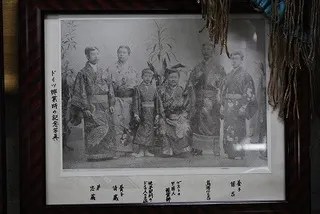
1885 November – in Hamburg. Photo below is from when in Germany. In the museum (see below)
1885 December – in Halle/Saale Saale-Zeitung, allgemeine Zeitung für Mitteldeutschland 16 December -p2
1886 March – first appearance in Britain as the Torikata Troupe at the Paragon Theatre of Varieties, Mile End. Male and female, eight in number.
1886 May – Imperial Torikata Troupe of Japanese, who recently appeared before the Royal Family
1886 June – Torikata Imperial Japanese Troupe and Madame Torikata in her charming butterfly act – Crystal Palace
1886 July – Dublin – great Torikata troupe of (7) Japanese whose performance has the charm of variety and novelty. From the Japanese Village Colonial Exhibition. Great Tub Acts. Pole Balancing. Chair Sliding. Swinging Bamboo. Great Ladder Feats. Wire Walking. Rope Sliding. Top Spinning.
1886 August – Torricata Troupe – advertised by Parravicini
1886 September – at Crystal Palace
Continued touring Britain to January 1887
1887 June – Sweden – Circus Busch – with Saito 22 years old, Schiurscho 20, Tomi 14, Ouscha 11 and the little Seko. With Maria Pilsler.
1888 – represented by Frank Albert, Stamford Street, London
1888 December – advertised by Parravicini
1889 February – advertisement in The Era for the Torricata Troupe, re-engaged by this agency for London – Parravicini
1889 April – at the London Pavilion, then Crystal Palace. Includes 3 youths who climb 3 poles loosely suspended from a polished steel triangular framework, by means of their toes. Also slack wire and tub balancing.
1889 June – one of the Torikata troupe fell on a female member of the audience from a slack wire – the guide rope also broke. “Four clever little Japs” Tschuzo Torikata the wire walker goes through a number of evolutions with an umbrella and handkerchief.
1889 July “picturesque in native costumes of flowered silk, brown, blue, green, and old gold” in front of the Shah of Persia at the Crystal Palace.
1889 July – advertise as represented by Parravicini
1889 November – a member of the Torikata troupe lost hold of the pole and came crashing down in the stalls at the Westminster Aquarium. Ended up in Westminster hospital with a sprained ankle.
1890 May – last performance in Britain, at the Crystal Palace
1890 December – in Hamburg with 8 people
1892 Fanny Birzle dies in Akita aged 39
1908 Kosakichi returns to Japan
1909 Kosakichi dies
 Ninjin