

1851 Okabe Kozo 幸蔵 born
1872 or 1873 Okabe Senkichi son of Kozo born
1879 Okabe Takataro born
Okabe Kotaro (kakubeijishi)
1889 Okabe Ofuku born
1890 June – Okabe Kozo and 7 others depart Japan for Europe, USA, Australasia
1892 Okabe Osute born
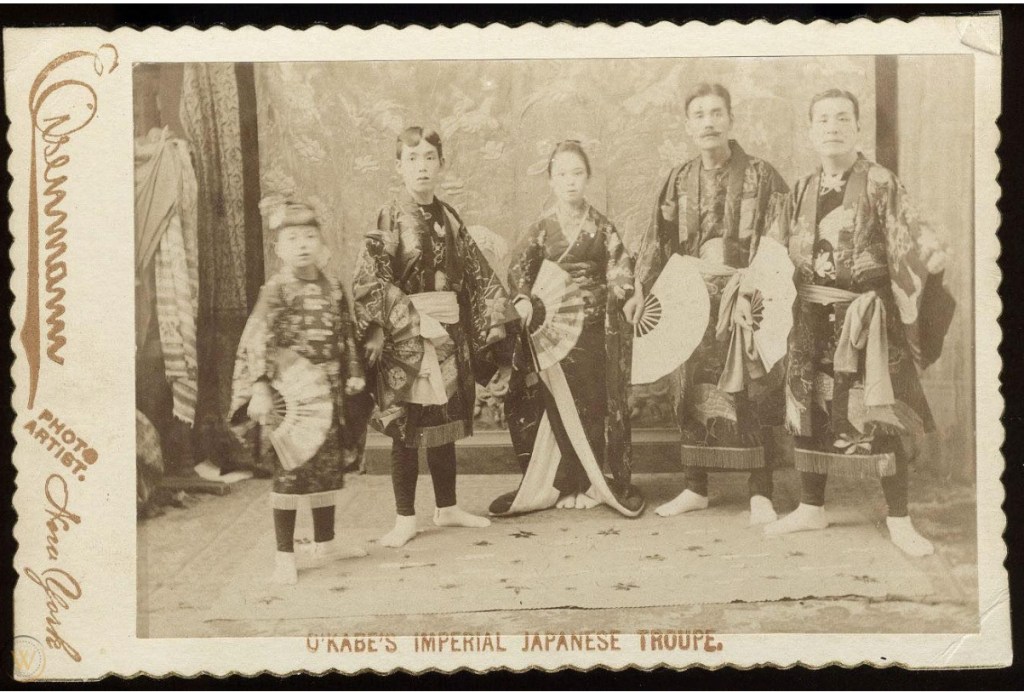
1892 August – Okabe’s Royal Imperial Japanese Troupe – five in number. Bamboo perch, boy and little girl, floor contortion little girl, wire walking boy, Japanese dance young girl, juggler, rope walking young girl, shoulder perch man and little girl, slide for life. Okabe, Matsunoski, Muyoshi, Ohanna, Oero. New York Clipper, 6 August p 16
1894 May – Okabe Kozo and 2 others (Koto Shimakura, Sute Yoshimura) depart Japan for USA.
1894 September “From the court of Prince Matsada Okabe” Five women and five men
1894 October – Prince Okabe and his remarkable performers
1894 November – Prince Okabe’s Royal Japanese Troupe in New York.
1894 December – Prince Okabe with his Royal Japanese troupe – six Beautiful Japanese ladies (Boston)
1895 March-November – USA and Canada Prince Okabe, 10 – 15 in number.
1895 May – Kozo Okabe (44), Jirokichi Nagase (46), Matsuji Kaneko (6), Hachiro Fukuda (11) and Tsuru Fukuda (9) depart Japan for USA
1896 March – November, USA and Canada
1897 February-August, USA
1898 January – For the first time on the continent. Hamburg
1898 February Austria (or Prague?) Sute Okabe with the Okabes.
1898 June – passports issued for New York for Okabe Kozo, Kiwa Oguri, Koto Shimakura, Sannosuke Tarumi, Jirokichi Nagase, Kotaro Deguchi, Eitaro Deguchi, Rikichi Deguchi (b 1886), Kumeji Deguchi, Juijiro Deguchi (born 1889), Kakujiro Hanei, and Kaji Hanei.
1898 July – December O’Kabes in New York
1898 August – September – 8 Okabes in Sweden
1898 October – Okabe’s Japanais Fantastics , in the ranks of which is “Yum Yum” the young female who was born armless. but who can do wonders with her toes. New York Clipper October 22nd, p 7
“J.T. Shimer, business manager of the Okabe Japs , writes : With an engagement of two months for Casino de Paris, Paris, I left New York Oct 18 last, in company with the Okabe Family, and, as I did not expect many offers for the company to Europe, my intention was to return to America early in 1898. Before the end of 1897 I received at lease twenty-seven offers, eighteen out of which I have signed at really good figures. Although we are wanted to America by various first class theatres, companies and summer parks, we will not be able to return to America before the end of 1899, perhaps early in 1900. We have already played Paris, Leipzig, Hamburg, Praag, Budapest, Moscow and Dresden, and are now in the Russian capital, playing at the best resort of the entire land. Have contracts for France, Sweden, England, Germany and Belgium. We are only seven persons, including myself and one assistant, so really there are only five performers, three of which are children, and we only give fifteen to eighteen minutes show. The salary we get here, too, although not much above our American salary , is plenty good enough to surprise other Japanese companies in Europe or America.” New York Clipper, 30 July 1898 p5
1898 Okabes in Hamburg
1899 March – December Okabes in USA. Prince K. O’Kabe’s Imperial Japanese Troupe
1899 April Okabe’s Royal Japanese Troupe. Thomas Sugimoto, General Business Manager New York Clipper, p 18
1899 April – in Germany
1899 July – in Switzerland
1899 September Austria
1899 October – November – in Germany – Muelheim – completely new magnificent decorations and costumes. 8 people. Rigochi doing hand stands.
1899 December – Okabe family of Japanese wonders arrive in Britain, from America, perform in Hanley, then at London Hippodrome from January 15th
“Next in interest after the performing lions comes, in my opinion, the performance of tiny Jap boy of the O’Kabe family of acrobats. He is very small and very chubby, and absolutely fearless ; he stands on the top chair of three, or it may be more, which are balanced on the feet of a man lying on his back. The little fellow shouts in a squeaky voice whatever is the Japanese for “Go!” the chairs are flung into a net spread behind, and the little fellow alights on the balancer’s feet. As final performance, he turns in the air and alights on his shoulders upon the upstretched soles.” Sporting Times 20 January 1900 p2
1900 January – Kozo Okabe, manager of a Japanese troupe of acrobats pleaded guilty to permitting six children under 16 years of age, who are in his troupe, to give public performances, and having taught and prepared them for the stage. He was fined $25 on each charge. The fine was small in consideration of the fact that Okabe promised to send the children back to Japan. (New York Clipper, 3 February 1900 p 4)
1900 February – performing in Portsmouth, 7 in number
1900 February – O’Kabe’s Troupe of Japanese have left for England to fill engagements. Mr O’Kabe will bring over another troupe on his return. (New York Clipper 10 February p 4)
1900 March – France
1900 April – Marseilles
1900 May – Switzerland
1900 September – Birkenhead with Prince Kikuta
1900 March – Marseilles
1900 April – Toulouse
1900 April – August Okabes in USA
1900 May Spain
1900 June – in Vichy
1900 August – Prince O’Kabe’s Troupe of Ten Imperial Japs USA
1900 December – Germany
1901 January – Switzerland
1901 February – March – Algeria
1901 February – 22-year-old David Schewzik is a naturalized Englishman, Russian by birth. He came to Zurich with the artist troupe Senkichi O’Kabe, who gave performances here in the Corsotheater. Immediately after his arrival, he went to the director of the Saalbau–gesellschaft, Mr. Architect Hermann Stadler, and explained to him that he was coming on behalf of O’ Kabe and was asking him for an advance of 1,500 francs.
1901 December – Birkenhead with Prince Kikuta
1901 May – 6 members. Lyon
1901 August – September – Germany, Netherlands
1902 January – seven Japanese jugglers. Ladies, gentlemen and two boys. Britain
1902 January – Aberdeen – Okabe Family Imperial Japanese Troupe from the court of Japan in their marvellous pot pourri act – Palace Theatre – special engagement at great cost.
1902 June – the Japanese jugglers Gin-Gi-Ro who recall the Okabes – Marseilles
1902 December – Germany
1903 March – Kiyoshi Hata of Okabe troupe dies aged 12 of meningitis in Norwich.

A better photo of the grave can be found here.
1903 August – Blackpool Winter Gardens.
1903 August – Okabe Sachi – Japanese slackwire walker
1903 October Senkichi Okabe (31) leaves London for Kobe on the Tamba Maru with Sukitaro Kikuda (20) (presumably same as Suketaro Kikuta of Riogoku troupe), Takataro Okabe (24) Umekichi Kimura (22), Ofuku Okabe (female 14), Osute Okabe (female 11), Kiku Kawakami (male 38)

1903 October – Okabe Family advertise in Music Hall & Theatre Review as being based in Tokyo.
1904 OKABE FAMILY Address—No. 39, Mikumi-machi, Nishima Hongo-ku. Tokio Japan Music Hall & Theatre Review
1904 November – Prince Okabe, San Bernardino
1904 December San Francisco
1905 May – May 1908 – Okabe Family, Okabe Troupe of Japanese Wonder Workers, Okabe Japanese Troupe. jugglers, Japanese slide rope. USA
1907 January O’Kabe troupe Illinois seven “rubber boned “artists. Little maid of four or five
1908 May – Okabe Family first appearance in Europe. Created one of the sensations of the Vaudeville world in America.
1908 August: The largest German theatre, the Albert Schumann Theatre in Frankfurt am Main, opened its fourth variety season on 1 August with a programme that has never been shown anywhere else in Germany in such a rich and varied way. So that was what happened. Before the outbreak of the Russo-Japanese War, the Okabe family was the most important and best-paid troupe of artists in the equilibristic-acrobatic field. When the war broke out, most of the Japanese artists had so much patriotism not only to serve the fatherland as soldiers, but also to sacrifice their hard-earned money on the altar of the fatherland. Okabe gave all his fortune to the fatherland, and had his five sons, who had earned him his money as artists, employed as common soldiers. The boys went into battle and were caught in the crossfire in front of Port Arthur. Okabe lost two sons in the siege, the other three returned home as officers, they had shown themselves to be the bravest soldiers. At their first German debut in Frankfurt am Main, they received an applause that was probably only a few artists have to their name. The powerful Japanese figures were happy to talk about their experiences during the Russo-Japanese War with much love and sympathy, and they are especially proud of the officer’s commission, which they earned through personal courage in the rain of bullets. Württemberger Zeitung 7 August 1908 p 10
1908 September – Berlin
1908 October – Belgium
1908 December – 8 Okabes in Strasbourg
1909 June – in Hamburg as Okabe Family – Okabe Senkichi

1909 August – Netherlands
1909 October – Equilibrism and somersault throwing. Gymnastic and balancing feats. Britain
1910 January – Britain, then Denmark
1910 April – Germany
1910 May – July – Switzerland, France
1910 October – Germany
1911 February – Toulouse
1911 March – France
1911 March – in Algeria
1911 April – Troyes
1911 May – France
1911 August – Germany
1911 November Austria
1912 January – Germany
1912 August – September in Britain – 8 in number
1912 September – in Glasgow – from Yokohama “This company have the distinction of having performed at a special performance for the edification of the late Mikado. They are equilibrists, topspinners, Risley act experts, and head and hand balancers, to say nothing of wonderful feats of contortion.” Scottish Referee 9th September
1913 March – May in England, July – August in Scotland
1913 September – France
1913 November – December – Belgium
1914 February depart London for Buenos Aires – Yoshimura Okabe female aged 49 (Sute Yoshimura), Kojima Okabe, male aged 27, Okabe Katagiri male aged 24 (Mineji Katagiri), Okabe Shimizin (Rintaro Shimizu) male aged 23, Okabe Kobayashi (Yamaji Kobayashi) male aged 22, Okabe Emori (Seijiro Emori) male aged 17, Okabe Kurozawa (Takejiro Kurozawa) male aged 14, Okabe Ekatsu male aged 15.
1914 June – O’Kabes arrived in Liverpool from Buenos Aires. Yoshimira, aged 52, female. Males – Mine 24 (Mineji Katagiri), Yome 22 (Yamaji Kobayashi), Kojina 28 (Kojima), Tatsu 23 (Tatsugoro Shimizu), Seijiro 18 (Seijiro Emori), Kurozawa 12. (Takejiro Kurozawa) Nicoli 11 female. Tour Britain June – August
1914 September – Yoshimura mentioned in Osaka Jiji Shinpo as being owner of Okabe za and famous in America. Her nephew Tanaka Totaro of Tenka chaya went to Europe.
Some members become Yamagata Troupe as below
1914 November – depart on SS New York from Liverpool: Iwao Takashi Yamagata aged 30, married, Mineji Katagiri 28, Yamaji Kobayashi 24, Tatsugoro Shimizu 25, Seijiro Emori 19, Ryunosuke Iizuka 22, Ryotaro or Rintaro Shimizu 16, Takaji or Takejiro Kurozawa 16, Kimi Shimoyama 16 (female).
1914 December – New York, then in Canada – ten in number, some quite young.
1915 Jan – Feb Okabes in USA
1926 July – Les Okabe – France
1927 Les Okabé, jongleurs japonais. France
1927 March – Miss Okabe – Belgium
1927- 1930 Miss Okabe, juggler, in Germany
1931 October – Miss Okabe, France
1933 July – Miss Okabe, Paris
We saw again at the Olympia the Four Hazel Mangan, their whirlpools acrobatic movements among the fluttering of the unfolded fabrics and, a piquant contrast, the fine juggler Miss Okabé, who has become a slender boy in strict Rastellian clothing. This new appearance suits Miss Okabé excellently, whose the bachelor look often struck us when she wore the dress. Nervous, free, agile as can be, it is a charming and skillful juggler that she gives us now the illusion of applauding; only his knotted curly hair is surprising and seems to detract from the clarity of a few sets of balls on the nape of the neck and around the head.
Will we have to go all the way and sacrifice this last feminine sign to the purity of work? In any case, Miss Okabé is an artist of rare value and the only woman we currently know practicing successfully this classical specialty. (Cine-Comedia 29 July 1933 p1)
1935 May – Miss Okabe, Marseilles
1935 November – Miss Okabe Marseilles
1936 Miss Okabe, jongleuse, France
 Ninjin