

Great Dragon name origins
May 1867 – advertising in San Francisco claimed that the appearance of the troupe was due to the special permission of Prince Eta-Koura-Shawa-no-Kame. Possibly an Itakura clan member – could be Katsukiyo, who was daimyo (and often called Prince) of Bitchu Matsuyama domain, now Okayama, and became a Shinto priest of Ueno Toshogu shrine. Or Itakura Katsumi, who was daimyo of Fukushima.
“Tycoon’s Great Dragon Theatre from the Emperor’s own theatre in Osaka” in USA, in Britain it was “from the Great Dragon Theatres of Yeddo and Osaca”
Most of Great Dragon Troupe who were in Britain were born in Yokohama or Edo/Tokyo apart from Hasegawa Manjiro who was born in Osaka and appeared in Britain by 1871.
Overview
In Britain August 1867 – October 1867, May – July 1869, then Paris, then returned to Britain in September 1869.
Supposedly 24-25 in troupe in USA/Britain in 1867. Actually mostly the Baldwin & Gilbert troupe of 15 people (probably led by Hotaka Chōjirō, butterfly trick performer) and Lenton & Smith troupe of 11-12 people, led by Isokichi.
13 in troupe after return to Britain in September 1869
1871 Merged with Tannaker’s troupes – continued with Great Dragon name until 1878. Then reappeared in Britain in July-Sep 1889.
Proprietors E.J. “Lucky” Baldwin & Ferdinand Gilbert, owner of the Melodeon/Olympic Theatre and Gilbert’s Museum and Menagerie in San Francisco, (April-July 1867), managers Edward Gustavus Bert and George Wallace Austria November 1867 then Edward G. Bert to June 1869, Manager/Secretary George Wallace, then Edward G. Bert from September 1869, then William Grant to January 1871, then Tannaker Buhicrosan from February 1871
Timeline
1867 March 1st – Blekman (as F Blackman), Elias Jackson “Lucky” Baldwin, Ferdinand Gilbert, A. Fischer, J.R. Marshall, G.W. Burgess and De Witt Clinton Brower travel from San Francisco to Yokohama on the Hermann. Arrive 12th April.
1867 late March – David Kirkwood arrives in San Francisco with the Stanley, departing from New Zealand, supposedly to Guam, under the name of Sangalier. Immediately sets sail for Yokohama.
1867 April – Baldwin & Gilbert obtain passports for 1 year (6 months for the two women) for 15 people to perform in France via USA. Brackets = family name not given in passport records, but assumed from later records:
1. (Hotaka) Chōjirō
2. (Hotaka) Kinjirō
4. Kosaburō
5. Kurakichi
6. (Kondō) Torakichi
7. (Kondō) Fudekichi
8. Shintarō
9. (Hasegawa) Harukichi
10. (Hasegawa) Kanekichi
11. (Ogawa) Mankichi
12. Kanematsu
13. (Ogawa) Torakichi
14. Moto (female)
15. Ei (female)
Kanagawa passport records for 1 to 10 above classify all as yoriko or foster children/apprentices to Shinjiro. Mankichi, is recorded as a foster child/apprentice to Kinzaburō and Kanematsu as his older son and Torakichi as his younger son. Moto is a foster child/apprentice to Tomigorō. Ei is a foster child/apprentice to Shinbei.
Younger members are: Kondo Torakichi. Kanematsu and Torakichi, sons of Mankichi. Kinjirō apprentice of Chōjirō. Kanekichi apprentice of Harukichi.
1867 May 1 – Stanley departs Yokohama for Hong Kong (New York Daily Herald), then San Francisco with the Great Dragon Troupe
1867 June 6th – combined Great Dragon Troupe arrive in San Francisco on the Stanley (renamed from the Sanglier) – 24-25 members according to the advertising: Kawaji Marukichi (B&G), Kikumatsu (Kanematsu from B&G?), Jōshūya Matsunosuke, Torakichi senior (B&G), Torakichi junior (B&G) Kosaburō (B&G), Kinzō and Gorō (1 person, Kinjirō B&G?), Godaijirō (Godayū B&G), Isokichi (L&S), Oshin, Chōjirō (B&G), Shintarō (B&G), Kurakichi (B&G), Kanekichi (B&G), Harukichi (B&G), Fudekichi (B&G), Bomji gore, Masakichi, Mitarō (L&S), Kars kee, Omotu (Tomo or Moto, L&S and B&G?), Ohatsu (L&S), Shingorō, Shinada Saburō, Ohta Gensaburō.
1867 June – New York Clipper describes Ka-wad-zee Maw-kilche as the leader of Gilbert’s troupe, shortly arriving from Japan. Also that Edward G Bert was leaving San Francisco for New York with a group of Japanese.
1867 June 10 “The Great Dragon Troupe of Japanese had a crowded house last night, and made a good impression. The juggler of the troupe is an artist in his line; he succeeds in making a number of balls go wherever he directs, by apparently impossible curves, and in the most satisfactory manner. In this troupe is a good top-spinner, good balancers, capital rope-walker, daring gymnasts, bright boy performers, and several female dancers. One performer introduced as “Miss-Japanese lady” walks on a strip of paper drawn tight by rollers, and at a signal the paper breaks and lets the performer fall to the stage. Making a toilet while balanced on a small rope seems to be a favorite pastime with one of the members of the troupe. The acts were announced in English by an attache of the theatre, and he took occasion to get off a joke last night; while announcing somebody the Jap. explainer overlooked him and broke out in the usual style but Mr. W. raised his voice to drown the Jap.’s noise, and said “Me first; I’m an American.” lt is announced that a change of performance will be given every night.” Daily Alta 11th June
1867 June 13 – Baldwin returns to San Francisco on Colorado from Yokohama, with equipment for the Great Dragon Troupe. 6 Japanese on board in steerage.
1867 June 13th – Sintaro Bungo the great sensation performer and Ese Kitche no Kamme the renowned Japanese Sampson, having recovered from the effects of their long sea voyage, will appear tonight in their thrilling performances. 4 nights remaining then leave for Paris on the 19th. Mr Gilbert. Great Dragon Troupe. At the Metropolitan Theatre, San Francisco
1867 June 17 Sintaro Bungo the Japanese Hercules will appear for the first time and lift one thousand pounds on his feet. Farewell benefit. Having recovered from their indisposition and the magnificent apparatus required for their performing the most thrilling feats having arrived by the Colorado.
1867 June – Omoto gives up child (3 or 5 years old) to George F Parsons, a reporter from the San Francisco Daily Times for adoption
1867 June 18 – attempted abduction of one of the women members in San Francisco
1867 June 18 – George Wallace, F Bleckman, EG Bert and the Great Dragon Troupe leave San Francisco on The Golden City, bound for Panama and then on to New York.
1867 July 15 – perform at Olympic Theatre in Broadway, New York as the Red Dragon Troupe under the management of EG Bert – “unanimously pronounced superior to all who have preceded them, performing feats of a monstrous and incomprehensible character” – combined troupe then leave New York for Europe. 24 Japanese, 30 Arabs. No names given.
1867 July – New York Commercial Advertiser – 11 Americans visited the Occidental Hotel at midnight and ate Japanese food. Apartment of Mr Blackman, husband of Oniota and manager of the troupe. Blackman is interpreter. Opium pipes were smoked after dinner. Principal members of the troupe were Fora Jasan, Harosan, Little Tommy, Ijodin and Gooai. 17 in the troupe including 2 ladies.
1867 August – Great Dragon Troupe arrive in Dublin, tour Britain. Advertised as being part of Royal Theatre of Yeddo or from the Tycoon’s Theatres in Yeddo and Osaca. Under management of Mr Wallace. Mr “Blackman” is the interpreter – probably Frederik Blekman.
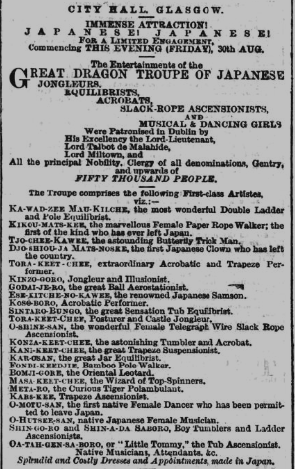
1867 August-September – perform in Glasgow and Edinburgh. Claims that 24 strong troupe include the inventor of the butterfly trick Tjo-Chee-Kawee (Hotaka Chōjirō?). Fudekichi, Godayu, Torakichi, Harukichi, Little Tommy (Oa Tah Gen Sa Boro), all mentioned. Grand Flight of Oa Tah on Ascending Slack Rope. Tjoje – Wonderful Magic Temple. Sintaro Bungo. Secretary is George Wallace.
1867 August – 14 September Marshall and Doyle’s “Flying Dragon Troupe of Japanese” continue to perform with the Arab troupe in the USA – Maine, Connecticut, Massachusets
1867 7-12 October – combined Great Dragon Troupe in Newcastle
1867 October – January (maybe to April) 1868 – Baldwin & Gilbert section tour Europe – Hamburg, St Petersburg, (24 strong), Wallace and Bert as manager, then Berlin, Leipzig, Dresden, Vienna
1867 October 30 advertisement in Neues Fremde Blatt in Austria that Great Dragon Troupe will be appearing in Vienna, after being in Berlin. Managers are G Wallace and G Bert.
1867 October – in Berlin, with Circus Renz. Two performers are ill. One dies. The troupe which recently performed here in the Circus Renz brought two sick colleagues with them, one of whom died in the Catholic hospital. In anticipation of the passing of their colleague, the Japanese had left behind sufficient funds so that the deceased would receive a decent burial . The funeral took place in the Dorotheenstadt Protestant churchyard. The coffin was brought from the Catholic hospital, followed by two members of the Japanese troupe – one of whom is the brother of the deceased. A beautiful monument with a Japanese inscription will decorate the grave of the first Japanese buried here. Proprietor is a German who served in the Japanese army.
1867 November 5th – Hamburg – Millou Mats-kee, Godai, brothers Tora and Tassa, Tjo-Chee-Kawee, Haro-san and Little Tommy, Oshine-san on the telegraph wire.
1867 November 11 – Hamburg – Wallace Direktor Yeddo Gesellschaft, Hotel de Bruffe. Great Dragon Troupe is in the Circus Renz. 13 people – 8 men, two women and three children.
1867 November 12 Hamburg benefit for Kikou Matskee and Oshine san.
1867 November 14 – Leipzig – Japanese Dragon Group from the Great Dragon Theater in Yeddo, the capital of the Japanese Empire, who, under their directors Bert and Wallace from San Francisco, are presenting a series of great art productions that have probably never been seen here before in the large hall of the Central Hall.
1867 November 28 – advertisement in Austrian press that will be appearing from 1 December. Had been in London, Berlin, Paris Managers E Bert and G Wallace
1867 December 2 – Vienna – Kikou-Mats-Kee, Harosan and the little Oa-tah
1867 December 26 – Vienna – first appearance of Omotu-san. Circus Renz – after serious illness. Before departure for St Petersburg. Also Osheinisan and Little Tommy.

1868 January – Great Dragon Troupe in Vienna. 4 men could be Kikumatsu, Hotaka Chōjirō, Harukichi, Godayū Two women would be Omoto and Oiye. Three children Torakichi, Yasokichi and Tomikichi. Tora and Tassan are 12 and 13 years old performing tricks with sharp Japanese knives in their mouths. (12th Jan Konstitutionelle Volkszeitung)
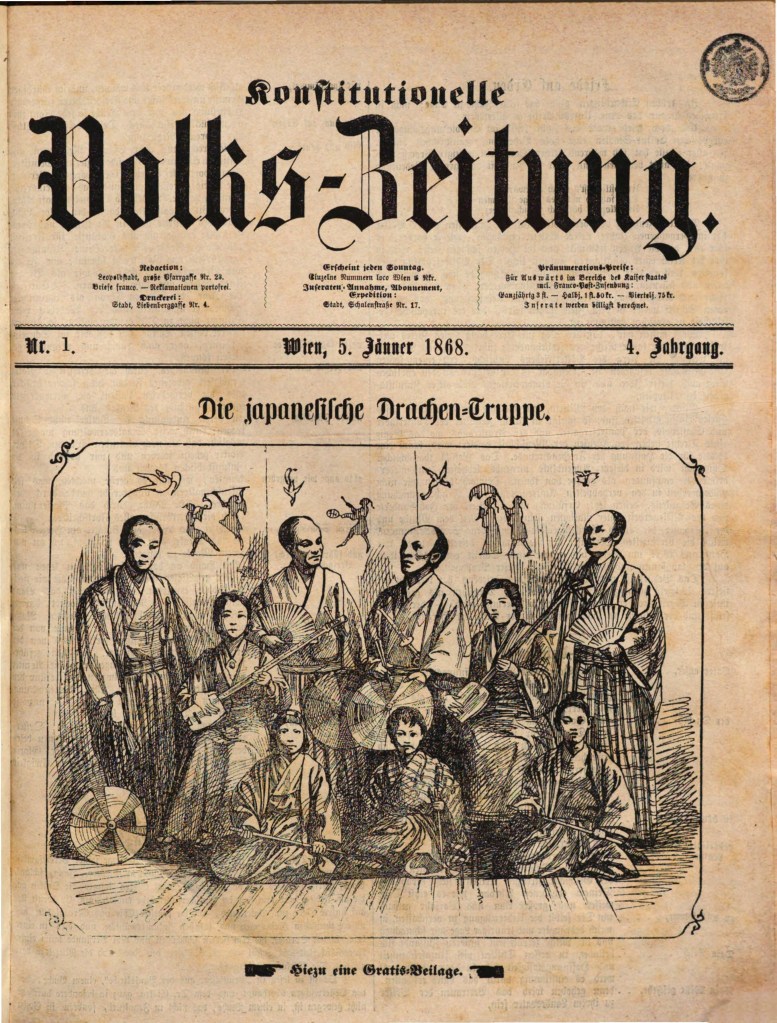
1868 February – Great Dragon Troupe in St Petersburg at Mariinsky Theatre. Kiku Matsuki balancing screens, Rinzo Goro juggling, playing flute, bowls of water and Godai, Tjo butterfly trick. “Two brothers, Tora and Tassa, make air jumps, with one hand resting on the ground, and in their mouths they hold a sharp knife across the blade. The last of these two brothers stands with his head on a pyramid made of wooden blocks, each no more than a palm wide, and makes various movements and turns with his body, as acrobats do on glass bottles, while holding a sharp sword across the blade in his mouth…In conclusion, he takes his pyramid apart one block at a time, standing first on one hand and then on the other until he stands with his hand on the last block. — Then a young woman dances on a stretched wire; the wire is wrapped in paper, it is lit, and the Japanese beauty calmly continues her dancing. Then Gamankari and his sons. – Sadakiki and Mikiki make kunshtik with a bamboo cane, a story that no one will believe without verifying it personally…You don’t know what to be more surprised at – whether the dexterity and courage of both boys or the fabulous calm of the father, his strength and ability to maintain balance. The same should be said about the following representations: the Japanese, Haro-zan, lies on his back, stretches his legs up, a basket of flowers is placed on his feet, and in it there is a ladder in the form of a triangle (see image); on this staircase little, seven-year-old Little Tomy, a true miracle of dexterity and vigor, performs his tricks, the rubber man.” Golos 18 February 1868 p 6
1868 June – Copenhagen
1868 July – Stockholm
1868 September – Baldwin & Gilbert troupe in Netherlands – Tora, Tassa, Kinzo-Goro, Godai, Tjo, Kars-Hee, Rihou Mats-Kee, Little Tomb, Mrs Djo-Ja-Mats-Noski.
1868 October – Torra and Tassa, “Mr” Kikou Matski balancing screens on his feet, Kinzo /King Goro juggling with skills and balls at the same time blowing the flute, balancing a bowl of water on his shoulder, tongue and nose and lets a ball run back and forth on a string. He also balances a large Japanese parasol stretched out by running around in a circle at the same time a metal ring, then a wooden plate, a ball and finally an egg on its curvature. Godai with specially made apparatus and red balls, juggling balls and a fan. Herr Tjo metal spinning top on a rope and on the edge of a fan. Young brothers Tora and Tassa perform air oscillations. Young lady dances on a wire rope, wrapped in paper, which is burned. Hamaikari and his sons Sadakiki and Mikiki performed a trick with a bamboo cane. Haro-san lies down on his back, stretches his feet up and carries a large basket of flowers on the soles of his feet, in which stands a large triangle formed of ladders, on which then stands little Tomy, barely seven years old. Dortmund Advertiser, 10th October 1868 p4
1869 February the Linzer Volksblatt records that Mr Bert and Mr Wallace, Directors of the Japanese of San Francisco, were staying at the Rothen Krebs guesthouse and Mr F Blekman, interpreter of the San Francisco Japanese troupe was staying at the Weizen Lamm guesthouse – in Linz, Austria.[1]
[1] Linzer Volksblatt, 5 February 1869, p 4
1869 5th May – Great Dragon Troupe in Portsmouth, then Brighton Concert Hall, Crystal Palace, London – Oide, Omotu(o), Ki-kou(n)-matsikee (Kikumatsu), Tora/Torra (Torakichi), Yarra/Tassa (Yasokichi), Professor Tjoze (Hotaka Chōjirō), Little Tommy, Haro-san (Harukichi), Godai (Godayū)
1869 May – Crystal Palace – Ki-kou-matsikee balancing paper doors. Tora and Yarra displayed a strength and dexterity in their gymnastic exercises. Professor Tjoze butterflies. Haro san ladder balanced on feet with Tommy.
1869 May – claimed to be leaving Britain en route for Japan in June, having just concluded a successful continental tour, and that it was the troupe’s first time in Britain. Any resemblance to Risley’s Imperial Troupe which appeared in June 1868 is “a very curious instance of the similarity of Japanese physiognomy.”
1869 June – contract with Edward Bert ended
1869 June-August – Paris, Cirque Napoleon – Karo-san and little Tommy, Torra and Jassan, Godai, Tjodjie, Miss Djo-shio-mats-nos-ke on wire, Kinso Goro. No mention of Omoto. (Figaro 11th July 1869 p1)
1869 August – Nottingham Mechanic’s Hall – Kikou Mats-Kee, Godai, Tjoje, Ha ro san, little Tommy, Oide and Omotu (music and wire walking), brothers Torra and Tassa
1869 August – A Mr Charles Wm Allen writes on behalf of the management of a troupe performing at the Mechanic’s Hall Nottingham is the biggest troupe of real Japanese, and has recently been at the Crystal Palace and played in from of the Emperors of France, Russia and Austria, King and Queen of Prussia and has no need to trade upon the reputation of any other troupe as per the accusation of the troupe at the Theatre Royal. Also their Little Allright is younger, and Taylor & Smith also have a Little Allright in their troupe. (The Theatre Royal troupe was Risley’s Imperial Troupe)
1869 September – Great Dragon Troupe return to London. Proprietor switched (from W.S. Gilbert?) to Edward Bert of San Francisco who had also been manager of the troupe in San Francisco. Same line up as May 1869.
1869 October – November – Hanley, Chester, Crewe, Congleton
1869 November – 13 members
1869 December – January 1870 Dublin. Say they will return to Japan.
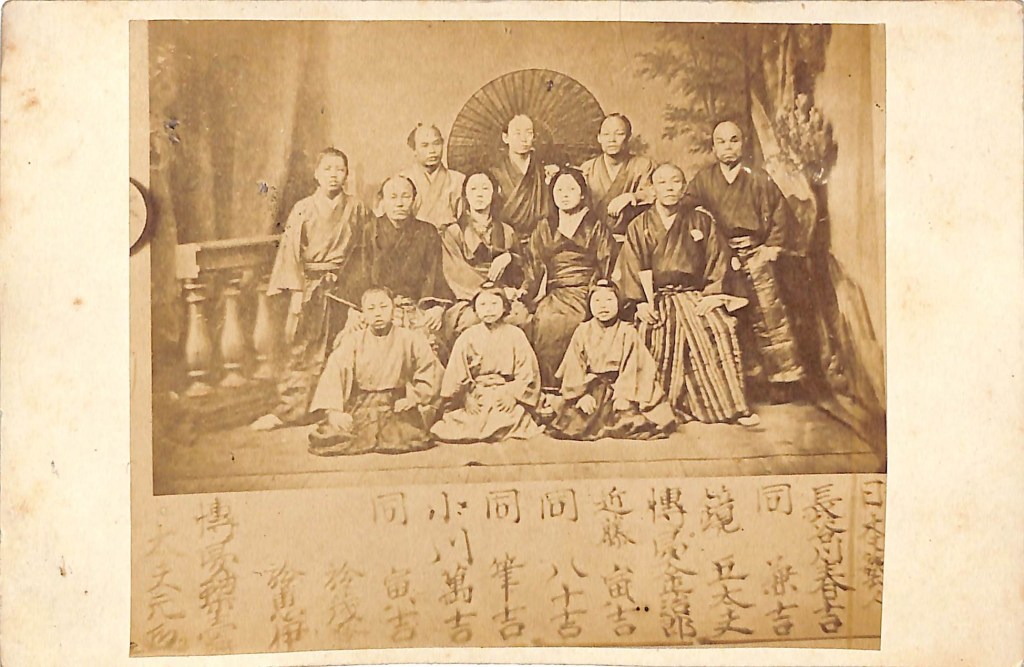
1870 February – in Ireland, troupe not individually named
1870 April – Hotaka Chōji and Oie pickpocketing case in Belfast, Blekman acts as interpreter. Last mention of Choji (Tojie)
1870 May – Glasgow (three years since last appearance) then tour of Scotland to November – William Grant is now proprietor and interpreter “has been resident many years in Japan”
1870 July – Hanskitchi, Boy Tommy, Godai, Torakitschi on the telegraphy wire
1870 September – claim to have a Little Allright, along with Godai (Dundee Courier)
1870 October – female wire dancer has accident in Banff
1870 November – Newsome’s Grand Circus – the Wonderful Japanese, including Little All Right. Tycoon’s Private Great Dragon Troupe from the Crystal Palace.
1870 December – Newcastle “The Tycoon’s Great Dragon Troupe” 13 in number
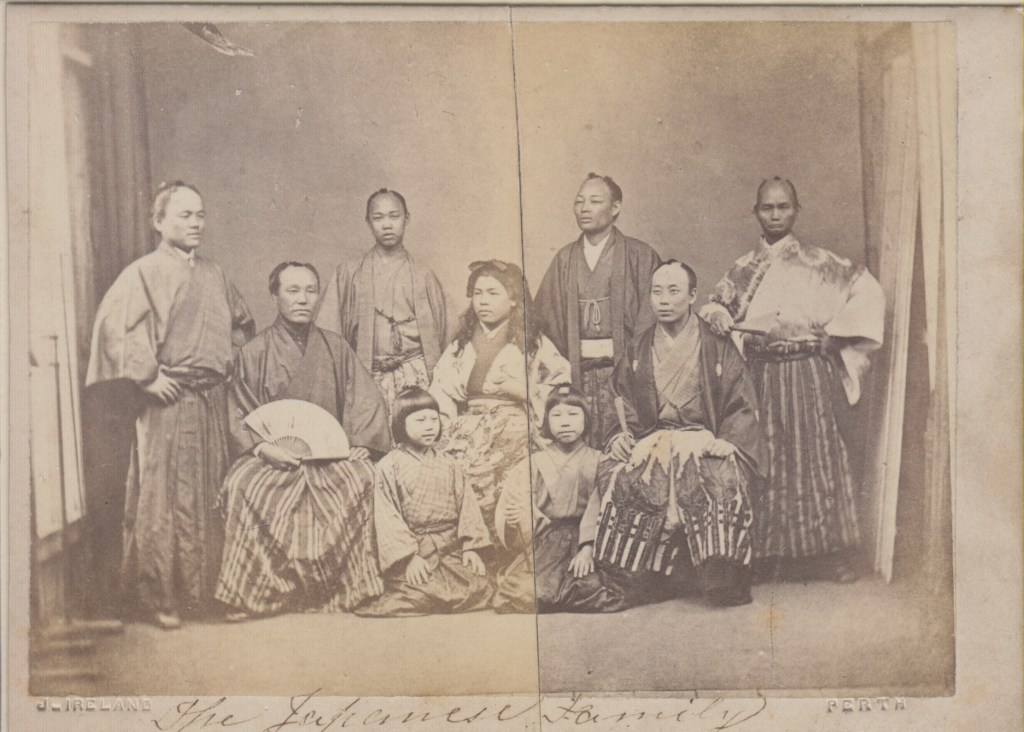
1871 January – William Grant, proprietor/ investor in Great Dragon Troupe in 1870 is declared bankrupt
1871 January – Great Dragon Troupe in Britain have 5 week engagement with Hengler’s Circus in Glasgow
1871 February – advertisement in The Era that Hasingawa Harosan (Hasegawa Harukichi) and Tannaker Buhicrosan are co-proprietors of the Royal Tycoon and Dragon Troupe
1871 February – 11 in troupe
1871 February and May – in Ipswich, when first set of photographs taken by William Vick?
1871 March “Japanese Troupe” in Spalding 14 people including Tommysan, Otakesan, Harrosan, Otorryanase, Torrakitchie, Otanny, Yasso, Godia, Bungrosan, Little All Right, Tommy the Wolf.
1871 April – staying in a Luton boarding house with Kondo Yassokitchi aged 18, Kondo Torrokitchi aged 13, Kondo Fudekichi aged 35, Hasegawa Harukichi aged 38, Hasegawa Tomikichi aged 11, Kagami Godayu aged 27, Kagami Katsugoro aged 45, Ogawa Torakichi aged 18, Frederick Blekman and Omoto.
1871 April – Loughborough – Tycoon Dragon troupe, 14 artists, Tommy the Wolf.
1871-1876 Tannaker continues to use the name of the Great Dragon Troupe, “Tycoon Dragon Japanese Troupe” but without Harosan after January 1873.
1872 January – William Grant, former proprietor of the Great Dragon Troupe tries to abscond to Yokohama as a chef on the Ocean Chief but is apprehended
1872 March – Blekman splits with Great Dragon Troupe/Tannaker
1872 March – Dragon Troupe of Siamese Juveniles in Britain
1872 April – Dragon Troupe of Siamese Juvenile Gymnasts at Crystal Palace – Gen Oska and Boy Wonder.
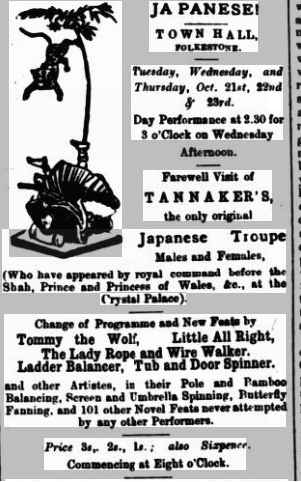
1872 April – Tannaker’s Dragon Troupe advertised as 12 performers – 2 ladies, 3 boys, 1 girl, 6 men. Little Allright, Tommy the Wolf. Rope and wire walking, tub and door spinning, ladder balancing, Crystal Palace, only troupe that has appeared before Royal Family by Royal Command. Share or salary. Manager 122 Wardour Street.
The Wonderful Japanese Troupe—The advent of these performers in St. George’s Hall, which we merely mentioned in last week’s Leeds Times, have during their three evenings, ending on Monday night, been remarkably successful, not only in drawing excellent houses, but in the singular dexterity and accomplished ease with which they went through their juggling exercises, and acts in which, for nerve-shaking, daring and danger, it is next to impossible to surpass.
All the performers appeared in their national costume, and this gave a singular aspect to all their proceedings, which was again heightened by frequent change of dresses, all of them apparently rich and imposing. On their very first appearance in bending their bodies backwards into semi circles, and throwing somersaults each with a sword in his mouth, their highly finished skill and ease became at once conspicuous.
The balancing and twining of the paper screen, five feet long on his bare feet, by Harrosan, was dexterously done, whilst the long pole balancing on the shoulder by Godaion, while little “Allright,” with the agility of a monkey, ascended to the very top, about twenty feet in height, and there went through several of his gymnastic tricks, caused many to avert their eyes. The tub-trick also was marvellous, Harrosan on his back, balancing, twirling and tossing it about with his feet, while Allright mounted to the inside, after which, one by one it was elevated by seven small tubs, the boy still maintaining his position, and then climbing outside, performed some strange deeds, when he afterwards crept back to his den inside, and then all the small tubs were kicked away, and the boy still in the huge tub, which alone weighed 63lbs, again dropping steadily upon the soles of Harrosan’s feet. The total weight thus sustained by the “legs” of the man, was said to be 135lbs.
Still more wonderful than that we considered the remarkable double ladder feat, also by Harrosan and Allright, in which the weight sustained by the former was 196lbs., and all on the soles of his feet, the horizontal near the top of the vertical ladder being the principal theatre where the comparative child carried out his dangerous physical manipulations, to the tenor of many witnesses.
Another excellent scene, Harrosan and the boy being the principals, was the transformation scene, in which the boy ascends the papered screen in a gay dress, and having broken in through and crept behind, again appears before the audience in the skin of a wolf, with a strange switching tail. The juggling and umbrella spinning by Godison, the butterfly fanning, and the bamboo swinging by Fudie, and many other scenes and performances, were equally excellent.
But by far the most thrilling feats were those of Miss Ottorasan, who, with courage and confidence equal to that of Blondin above Niagara, appeared on a telegraph wire stretching from the north and south galleries, and on that, without balance pole, but with the indispensable fan in one hand and the Japanese umbrella in the other, she time after time walked steadily across, returning backwards, then knelt, laid down on her back, swung easily and on one foot, and then wheeled round, and walked away as if on terra firma. Her feat of walking up the slanting rope at an angle of 45 degrees, and stretching from the platform to cross trees high above the front of the west gallery, seemed equally as dangerous as the wire. She, however, ascended slowly and carefully, and having reached a considerable altitude, went sliding backwards at a stretch, and, on Monday evening, when close to the platform, her foot slipped, but she caught the rope with her extended arm and was saved from injury. On the whole these acts of the lady may be said to be almost courting danger and death for the sake of lucre and sensationalism, and in much too high a degree.
The manager, who said he was of English descent but – naturalised in that far-off land, gave each evening a humorous explanation of the manners, fashions and customs of the Japanese, as compared with those of the English We understand that the troupe will return in a short time to Bradford, when they will be certain of a hearty reception as in this town they have never been equalled, though several such companies have preceded them. (Leeds Times, 4th May 1872)
1872 May – 12 performers including Tommy the Wolf, Otakesan, Harrosan, Otorryanese/Ottorasan, Torrakitchie, Otanny, Yasso, Godia/Godaiou, Tommysan, Bungrosan, Fuideson.
1872 June – December – clash between Tannaker’s Japanese Great Dragon Troupe and Siamese Great Dragon Troupe of juveniles. Latter includes Isokichi.
1872 July – Great Dragon Troupe at the Eastern Counties Grand Gala at Bury St Edmunds – 12 performers, Fudie (bamboo swinging), Gadiou (pole balancing), Miss Ottorrassan (wire walking), Harrosan (tub balancing), bending feats by Basso and Torakitschi, balancing by Godison, Tommy the Wolf, Little All Right.
1872 October – Great Dragon Troupe perform at the Subscription Rooms, Stroud, where photographs of the troupe are on sale, taken by William Vick of Ipswich (Stroud News 25th October p 5) Last mention of Bungrosan and Fuideson.
1872 December – last appearance of Siamese Dragon Troupe in Britain
1873 January – last appearance of Siamese Juvenile Troupe
1873 Great Dragon Troupe in South Africa children: Tokedo Wah hobe, Ole Match. Gen os ka, Tara nos ka, E so kitchie
1873 February – Godayu and Omoto’s son Little Godie dies in Sunderland.
1873 February – Stoke on Trent – Little All Right, a boy of five years of age met with an accident – balancing on a high ladder, fell, broke one of his ribs, severe bruises
1873 April – Tannaker’s Japanese, also known as the Great Dragon Troupe.


1873 June – Brentwood, balancing screens, bamboos, tubs, ladders Butterfly trick by a lady. Tommy the Wolf and Little Alright. Wire walking by a lady. Chelmsford literary institute
1873 July – Will perform same acts that performed in front of Shah of Persia at Crystal Palace on 30th June at the Chelmsford Gala. Chelmsford Chronicle – Friday 04 July 1873
1873 July – Alexandra Park – Tannaker’s Wonderful Japanese Troupe
1873 September – advertisement in The Era ” JAPANESE (TANNAKER’S) LITTLE ALL RIGHT AND TOMMY THE WOLF TROUPE as well as Tannaker’s Great Dragon Troupe of Japanese. Tannaker has only two troupes of real Japanese in this country. Claims both names are registered and that Tannaker’s New Entertainment “will shortly arrive”
1874 January – Siamese Juvenile Troupe in Australia
1874 February – December – Great Dragon Troupe touring England
1875 January – February – Touring England
1875 February – Little All Right, a five year old boy (but could be Tani, daughter of Tannaker and Otake) falls and breaks a rib – Stoke on Trent. “Set the ball rolling” on a debate in Parliament about children in public performances.
1875 March – May – Great Dragon Troupe touring Ireland
1875 October – November – Great Dragon Troupe touring Britain
1876 September – Tannaker advertises “Great Dragon Troupe” as 6 males and females, alongside the Great Jackitschy Troupe, 12 in number, Tannaker’s Little All Right and Tommy the Wolf Troupe 8 in number, Tannaker’s Japanese New Entertainment
1877 January – March – Godayou in Denmark but no mention of Great Dragon Troupe
1877 August – November – Great Dragon Troupe touring Sweden (Tannaker) – Godayou, Tomikichi – Advertising doesn’t name Great Dragon Troupe. Godayou is director.
1877 September – October – Great Dragon Troupe in Malmo
1877 December – 1878 April – The Great Dragon Troupe now performing on the Continent (advertisement in The Era, from Tannaker’s agent)
1889 July – August – Tannaker’s Great Dragon Troupe of Japanese at the Alexandra Palace. Tamamoto Chiyokechie (tight rope walker), Torra the Great feet balancer, Little All Right, Misuhara Gintarro block manipulator
1889 September – Woolwich – Great Dragon Troupe. Last mention of the troupe in the British press.
 Ninjin