
Yanagawa Itchōsai
The butterfly trick was devised by the Osaka juggler Tanigawa Sadakichi and brought to Tokyo by one of the most famous earliest practitioners of the butterfly trick – Yanagawa Itchōsai 柳川一蝶斎 I.
Butterflies are known as chō 蝶 in Japanese and practitioners of the trick incorporated chō into their stage names.
Itchōsai performed the butterfly trick in Edo/Tokyo from the 1820s onwards and was visited by the then Shogun in 1837. Yanagawa Itchōsai I is thought to have died around 1870.
The Elgin Mission saw the trick performed when they came to Japan in 1858 and there had been performances at the British Legation in Japan as early as 1860.
Little seems to be known about Yanagawa Itchōsai II other than that he was apprenticed to Yanagawa Itchōsai I and became Yanagawa Itchōsai II in 1880.
Yanagawa Chōjurō 柳川 蝶十郎 (1847-1909), who later became Yanagawa Itchōsai III, was originally known as Aoki Jisaburō, and maybe also have had the names Asanosuke and Asakichi. He was apprenticed to Yanagawa Itchōsai 柳川一蝶斎 I in 1863 at the age of 16.
John Reddie Black, a Scottish singer and later journalist who came to Yokohama in 1864, put on performances with James Marquis Chisholm which included Asakichi performing the butterfly trick.[1] Dr HS Lynn (Washington Simmons) may have learnt the trick from Asakichi at this time, and brought it back with him to Britain after his stay in Japan in 1863-4.
It is assumed that Asakichi was the Asanosuke who is recorded in the passport records for the Matsui Gensui Troupe tour of Europe in 1866-7, as there there is no record of an Asakichi in the passport records for the Matsui Gensui Troupe – but the reviews of the troupe name Asakitchi as the butterfly trick performer.
William Grant, the manager of the Matsui Gensui Troupe, referred to Asakichi as Chōjurō in his letters, but this name does not appear in the passport records either. Murata suggests that a few years after his 1863 apprenticeship began, Asanosuke/Asakichi was given the name of Chōjurō by the second Yanagawa Itchōsai just before he left for Europe with Matsui Gensui. [1]
If Yanagawa Chōjurō was the same Asanosuke in the passport records and the Asakichi who performed with the Matsui Gensui troupe, then he was, at the tender age of 19, accompanying his son Chōnosuke and daughter Nobu – according to the passport records of 1866. Perhaps Asanosuke/Chōjurō was actually Itchōsai II and Chōnosuke was the 19 year old apprentice – who was to become Itchōsai III.
Certainly this photo (courtesy of Robert Sayers), said to be of Asakichi and his daughter in Turin in 1867 suggests an older man. Whereas the engraving below from the Illustrated London News of February 1867 shows a younger, slimmer man.
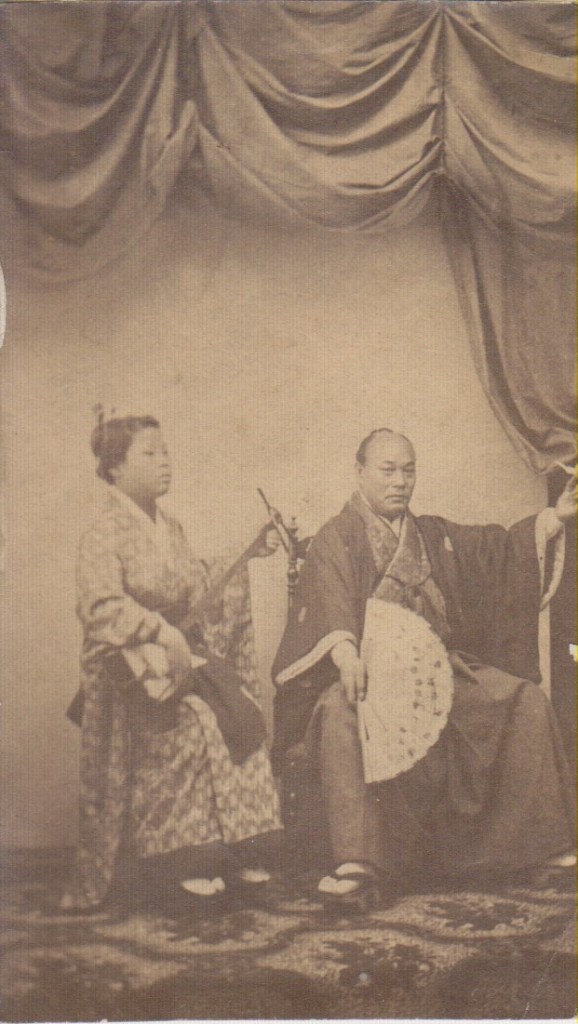

The Matsui Gensui troupe dispersed in late 1867 after their performances at the Exhibition in Paris in summer. According to David C.S. Sissons, Yanagawa Itchōsai III was the Chonoskee who appeared in Australia with the Lenton and Smith Great Dragon Troupe in December 1867.
So it is possible Asakichi switched contracts and passports from Grant to Lenton & Smith, without returning to Japan, and went to Australia in late 1867, reverting to the name of Chōnosuke. There is no sign of Nobu or a Chōnosuke junior/apprentice in the Australian tour records, however. So again a more likely explanation is that Asakichi was Itchōsai II and returned with Nobu to Japan in 1867, and it was Chōnosuke junior who toured Australia as Chonoskee, returning to Japan in 1869.
Another Yanagawa, billed as Echowsi, a juggler and conjurer, with the given name of Chōshichirō according to the passport records, and born in 1820, appeared as the leader of a troupe in Australia in 1873. Going by the age, this would more likely be Yanagawa Itchōsai II – or could be another Yanagawa entirely.
Whether they were Asakichi/Asanosuke or Chōnosuke, the next Yanagawa Itchōsai was designated the III in 1896.
Other butterfly fanners
Many European performers adopted the butterfly act such as Lizzie Anderson, Madame Nemo, Signor Bosco and D’Alvini.
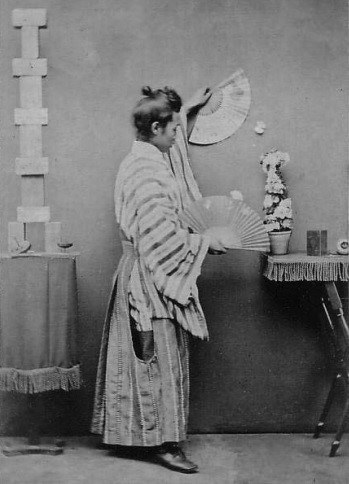
Amongst the Japanese troupes, Tannaker himself performed the trick in the early years, as did Tanaka Tsurukichi. It seems likely Godayū also performed it, and it may be him in the photo below (courtesy of Robert Sayers), in Jersey in 1873, although he looks a little too young to be Godayū, who would have been 30 by then, so it could be Yasokichi or Torakichi.
[1] Schodt p 129
[1] Kurata p 37
 Ninjin