
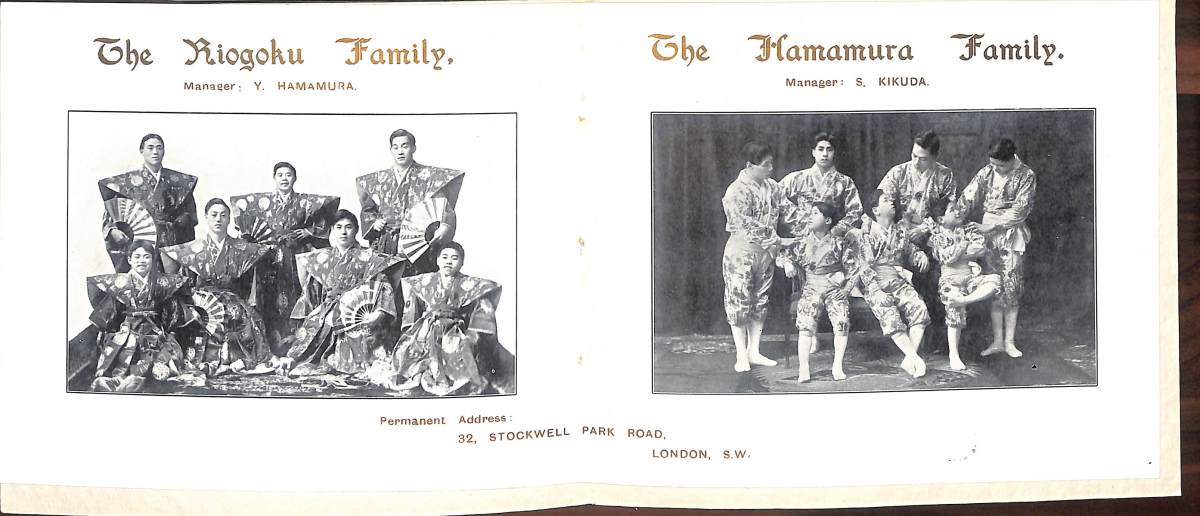
1900 April – Riogoku troupe – 10 people – in Stuttgart – Neues Tagblatt und General-Anzeiger für Stuttgart und Württemberg 14 April p 2
1900 May – in Lwow – 10 people
1900 December – Germany
1901 March – Germany
1901 April – 9 people – Mulheim “most precious silk robes and the most magnificent silk-embroidered blankets ” Imperial Japanese court artist.
1901 October – Prague
1901 December – The Japanese Riogoku troupe, whose 8 members are almost all ages from the age of six upwards – Leipziger Tageblatt 7 December p 14
1903 April/May – Halle, Germany
1904 August – 9 people – Dresden
1904 October – Dortmund
1904 Imperial Riogoku Troupe at Circus Busch in Germany – “it consists partly of disabled soldiers”, “the juggler Hamamura provides the centre of attraction”. “Ancient Japanese costumes are most costly”. (The Music Hall and Theatre Review p. 10 16 December 1904)
1905 January – Stuttgart – Teasing juggler Kikuta, with the Riogoku troupe. Schwäbischer Merkur 3 January p 16 Kikuta “who belongs to the Riogoku Family”
1905 August – Netherlands
1905 October – Manchester – 1906 Jugglers and equilibrists
1906 Kikuta, juggler, with Riogokus
1906 June – Riogoku Family – Manager Y Hamamura – Grand Opera House, York.
1906 August – 10 people in Germany
1906 October Stuttgart
1907 January – Hanover
1907 May S. Kikuta in Hamburg and Halle with Riogokus – Kotaro Oharu and Ishi
1907 December – 1908 August in Britain
1908 February – stage set cost nearly £3000 and took 10 Japanese women 20 months to make.
1908 May – Tiny girl acrobat
1908 July – Hamburg
1909 May – Berlin with the Tenka troupe – Berliner Börsen-Zeitung – 9 May p 8
1909 June – Jan 1910 7 performers, then Germany
1910 February – Hanover
1910 June – 1911 August in Britain
1911 April census – Yasuzo Hamamura aged 21, employer, married, O’Nui Soga, female, married, 18, Yosajiro Fujimoto, 16, single, Genjiro Fujii (no age given, but was 8 years old), Paddington. All music hall artists.

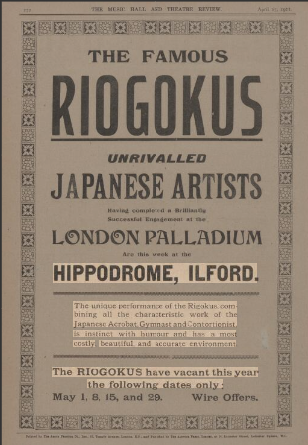
1911 April – Hamamura
1911 November – Karlsruhe
1912 February – Berlin
1912 March – Sweden – as the Hamamuras, but also mention the Riogokus – line up is Toki, Hamamura, Kikuda, Hiro, Katara, Kame, Shige
1912 March – Leipzig
1913 August – in Britain – were also in Algeria in this year.
1913 October – in Zeeland, Netherlands
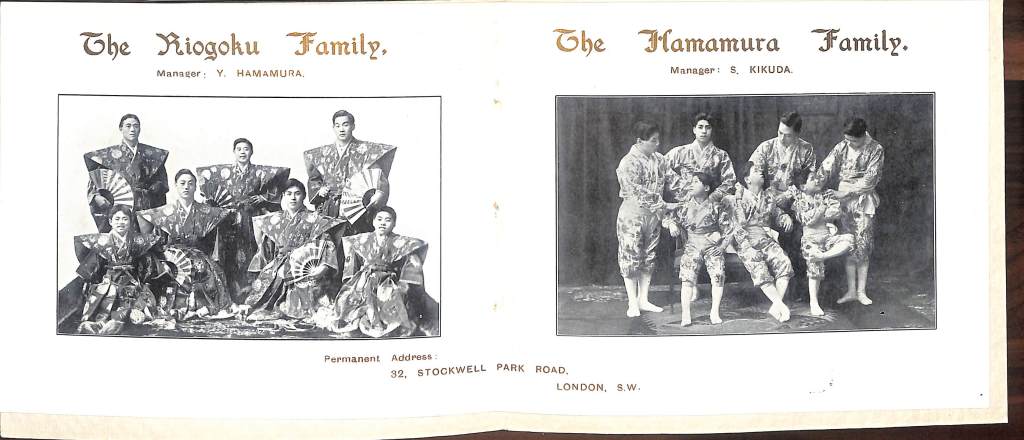
1914 January – in Mannheim – Royal Rigoku Family
1914 September – in Europe, according to Osaka Jiji Shinpo
1915 November – 1916 February in Britain
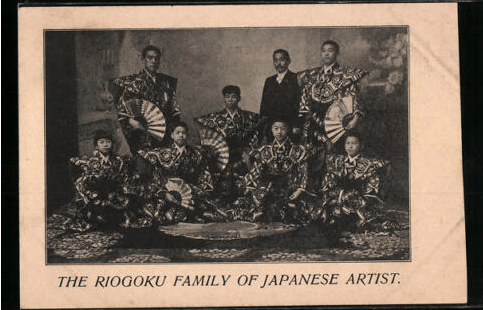

1916 February depart Britain – go to Australia via Calcutta with Wirth’s Circus – members are Kumeji Deguchi (b 1890), Keisaburo Hamamura (b 1899), Genjiro Fujii (b 1902) Sentaro Imai (b 1903), Usaburo Yamashita (b 1905), Masaichi Takahashi (b 1887), Shotaro Sakata (b 1878)
1917 – March – Sydney, Australia
JAPANESE ACROBATS WITH WIRTH’S
The Riogoku family of Japanese acrobats, who are opening on Saturday next with Wirth Bros. Circus, at the Hippodrome, are the younger generation of an historic Risley troupe of Japanese acrobats, the original Riogoku familv which goes back so many hundred years in show business. The wonderful troupe of Risley acrobats have now been in existence about 500 years.
Very few troupes have had such thrilling experiences as the Riogoku family. At the outbreak of war they were showing in the Hansa Theatre, in Hamburg, Germany, and on leaving the theatre that night for the last time they were attacked by civilians. They were immediately interned and thrown into the prison dungeons and were kept there for three months with only black bread and bad coffee to drink. The American Consul in Hamburg eventually got them released, after being interned for three months. They were sent through the Swiss border, and afterwards resumed their work at the Manchester Hippodrome, where the representative of Wirth Bros. engaged them. (Sunday Times Sydney, March 18th 1917)
1917 September – Geelong Australia
1918 March – final performances in Australia
1918 May – troupe arrives in New York from New Zealand, describing employer as Y Hamamura of Clapham, London
1918 June – in Europe according to Osaka Asahi Shimbun.
1921 in Paris
1923 in the Netherlands
1924 in Berlin with Hamamuras
 Ninjin