
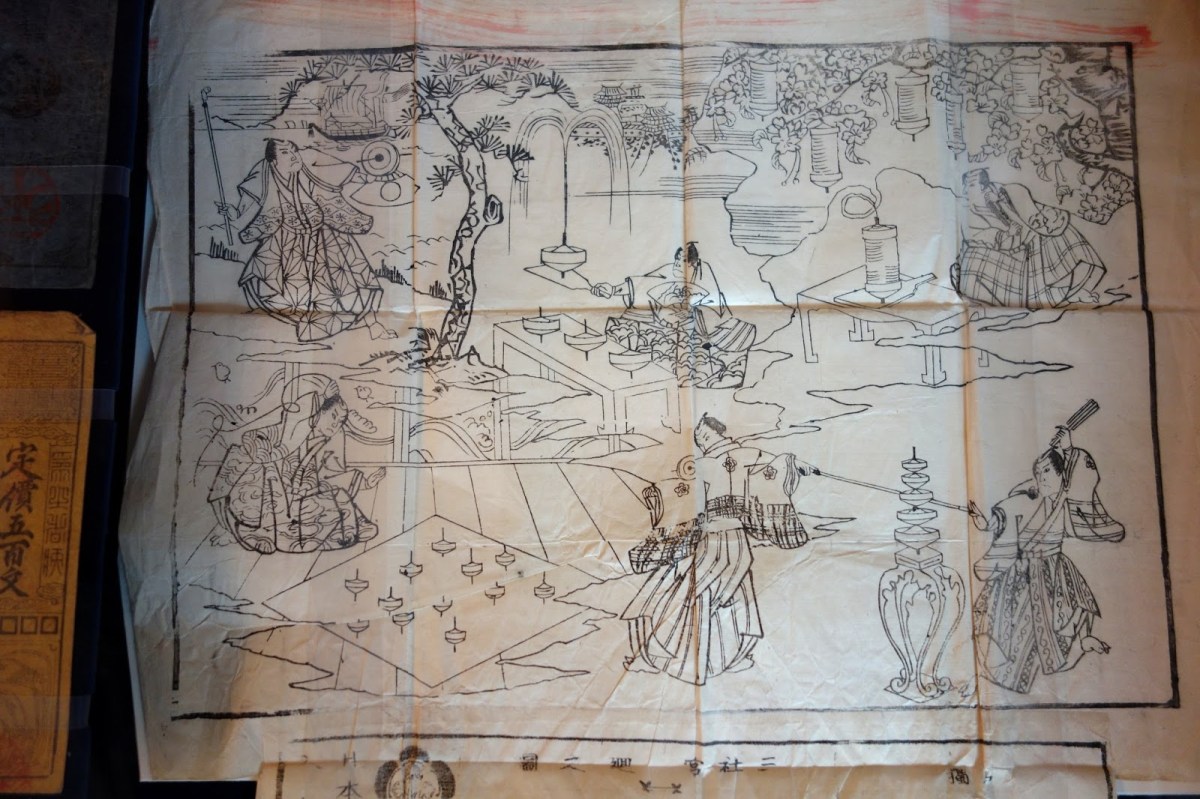
Matsui family records assert that the founder was Genchō, in the 14th century. The Matsui name first appeared in the 4th generation (17thc). The Matsui Gensui name became associated with top spinning in the 18th century and several Tokugawa shoguns were patrons. The Matsui Gensui house was primarily in Asakusa in Edo/Tokyo, but there was also a Matsui Kisaburō in Osaka and a Matsui Genjurō in Sukiya-chō in the 1820s-1840s.
1824-5 Matsui Gensui 松井 原水 XIII born in Edo, became 13th generation of the Matsui Gensui yashi (hawker-performer troupe) performing at Sensōji in Asakusa.
1829 Matsui Shinjirō or Matsugorō born in Asakusa
1834 Matsui Yoshigorō born in Edo, oldest son of Matsumoto Kanzaburō, a rich farmer. Adopted by Matsui Gensui XIV. Became Matsui Gensui XV.
1836 Matsui Kikujirō born in Edo – younger brother of Matsui Gensui XIII, son of Toyokichi.
1838 Matsui Shinjirō or Matsugorō becomes apprentice to Matsui Gensui XIII
1853 Saki, daughter of Matsui Gensui XIII born (stage name Komanosuke/i)
1857 Matsui Tsune, daughter of Matsui Kikujirō born
1858 Muroya Suketarō, later Matsui Gensui XVI, born. Later adopted by Matsui Gensui XV (Yoshigorō).
1859-61 Matsui Kunitarō (aka Kunikichi), son of Matsui Gensui XIII born. Later lays claim to being Matsui Gensui XVI
1863/4 Matsui Yoshigorō becomes Matsui Gensui XV after death of Matsui Gensui XIV
1865 Muroya Suketaro takes up top spinning at the age of 7, apprentice to Matsui Gensui XV
1866 William Grant and British born Edward Prior obtained 14 two year passports for:
Matsui Gensui XIII, his wife Haru (Hana?) (27, stage name Konomoto), his daughters Mitsu (who did not travel) and Saki and son Kunitarō aged 7 – from the third block of Tawaramachi in Asakusa.
Yanagawa Chōjurō/Asanosuke (Asakichi), his wife Kiku, his son Chōnosuke and daughter Nobu from Aioi-chō in North Hongo.
Passports as servants for the Yokohama group of Kosa(n)kichi (Torigata), Kamekichi (aged 23), Inosuke, Kakichi (stage name Kotaki) and Torakichi/Tarakichi (a child).
Below: Matsui Gensui XII, Haru, Saki and Kunitaro?

Photos of troupe on Bakumatsuya
1866 December 2nd – Matsui Gensui XIII sails from Yokohama for Shanghai, then Hong Kong
1867 February 2nd – Matsui Gensui troupe lands in Southampton on the Tanjore with Matsui Gensui XIII’s wife Haru, daughter Saki aged 13 and son Kunitaro aged 6/7 and a troupe of 12 performers in total. William Grant and Edward Prior were the proprietors and managers, Andrew Nimmo was the agent. Also J Mitchell.
Performed at St Martin’s Hall, just behind the Royal Opera House in Convent Garden. Top spinning (Matsui), bamboo climbing (Kotaki), butterfly trick (Yanagawa) then transfer to the Floral Hall, Covent Garden

1867 February – I went, the other day, to St. Martin’s Hall to see the Japanese jugglers. Some of their performances are extremely curious notably, the top-spinning and the butterfly-trick; but many are clumsy and rococo in the extreme. Much time was lost in making preparations which should have been arranged before the audience were admitted into the exhibition-room, and this had the effect of seriously interfering with the due enjoyment of the performance. I suspect that the tricks are too few in number to fill up the customary two hours in a legitimate way ; but it would be better to give a short, sharp, crisp entertainment of an hour’s length than a dull and tedious one of twice that duration. The top-trick and the butterfly trick are quite ingenious enough in themselves to send an audience home delighted, if the audiences temper is not spoiled by wearisome delays such those that preceded these performances when I was present. The acrobats are agile, but not more remarkably so than their British brethren of the London music-halls. It is only fair to the jugglers to mention that the principal member of their troupe is an invalid, and unable to join in the performances. The Theatrical Lounger, Illustrated Times 16 February 1867 p12
THE JAPANESE JUGGLERS. The troupe of Japanese jugglers now performing at St. Martins Hall consists of about a dozen persons of all ages and both sexes. Their personal appearance is more peculiar than beautiful; yet they have a bright, intelligent expression, and seem both good-humoured and good-natured. They have shaven heads, pigtails, flat faces, small eyes, and no noses to speak of. Some of them wear dresses of costly fabric, curiously embroidered in tissue of gold; and they all look if they had walked out of a japanned tea-tray of colossal proportions. The tricks and evolutions which the illustrious strangers went through, on first making their appearance in London, were not very numerous nor very varied in character, but they were performed with singular neatness and dexterity. Each performer wore a scarf while engaged in his feats of legerdemain and all the time he was so employed three or four of his comrades kept wailing in discordant voices, and playing, with more energy than harmony, upon instruments presumed be musical. Among the vocal artists the most remarkable was a very small child of doubtful sex, dressed gorgeously, who sang with astonishing fervour and gusto a melody set to some such tune as that which proved fatal to the life of an old cow. A spinning-top is one of the chief instruments of magic with these Japanese jugglers. They spin top in mid air, catch it spinning it comes down upon the top of a stick held in the mouth, and keep it spinning under circumstances of incredible difficulty. It looks like living thing, and obeys their behests as implicitly, spinning up and down a long stick which is flourished swiftly in the air, then along the out stretched arms and across the back the juggler, then upon the ridge of an open fan, and finally upon the edge of a sword. When the top totters or “swoons”, as boys call it, the whiff from fan restores its equilibrium. Both male and female performers delight in these spinning-top tricks, executing them with expertise and precision. The butterfly illusion is not the grub, naturalists might suppose, but simply a scrap of white paper ingeniously twisted to the shape and semblance of butterfly by Asi-Kitchi-San, who by means of couple of fans keeps it flying through the air and hovering over flowers with so accurate an imitation of nature that anyone at a distance might mistake the artificial for the living insect. Presently the wizard manufactures a second butterfly, and then the two go fluttering together, or settling down upon one object or another, just as butterflies may be seen to do that are born in a bower. The subtlety of touch and unerring accuracy of sight displayed in the execution of this feat make it one of the prettiest and most amusing of all. Finally, the wizard tears his radiant insects into pieces and scatters the fragments in the air, in tragic illustration of the evanescence of all lovely things. The acrobatic performances, however, are the most novel features of the entertainment, and will probably awaken the greatest interest. Frikell and Stodare have made Londoners rather fastidious in matters of legerdemain. There is more scope for variety in gymnastics, and here the Japanese do things both novel and ingenious. One of the company hangs his crooked knees from cross-bar erected over scaffolding at a great distance from the floor. While in this perilous posture, with his head downwards, holds in his hands a green cane stem some 10 or 12 ft. long. Up and down this stick one of his comrades runs with the agility of squirrel, swinging swiftly and fro, throwing himself into the most difficult of attitudes, and hanging on “by the skin of his teeth.” as the saying goes. At last the bamboo breaks at a knot, apparently by accident, causing some sensation among the audience for the safety of the acrobat, who, however, catches a rope that is flung to him and is landed right enough. The Theatrical Lounger, Illustrated Times, 23 February 1867 p 10


1867 February – A Japanese Entertainment.— The Japanese jugglers who arrived last week, have already got to work in London. Their mode of business is peculiar to themselves. The eleven performers clatter on to the stage, having upon their feet apparently trestles, and round their legs petticoats, without crinoline or other artifice to enable the wearer to walk freely. They stand in a row before the footlights, and then they suddenly sink down all together upon their hams, and bow their bodies forward, touching the ground with their foreheads; whereat, of course, the gravity of the Briton, impatient of “them rum furriners,” is overcome, as it is also when one of the “troupe,” still on his hams, bursts out, as if moved by an irresistible impulse, with some remarks in his native tongue, which may be complimentary or the contrary, and which remind one forcibly in sound and tone of a farrago of those ordinary street-cries to which every Londoner is accustomed, but which “ no feller can understand.” The “chief” too, from time to time, appears upon the stage to direct the proceedings, and in an extremely affable manner and with great volubility addresses the audience in his native language. There is now and then some native music (so called) written, one would imagine, in the key of Z minor, in comparison with which the marrow-bones and cleavers are melodious, and which, combined with the natural sombreness of St. Martin’s Hall, creates a disposition to fall upon your neighbour’s neck and weep. That is when the music (so called) is instrumental: when there is the addition of vocal, such as would be a fortune to the street-singer who knows the value of peace and quietness better than to go away for fourpence,” “ tears, idle tears” would not do justice to your feelings. A girl having taken an instrument (of torture) something like a banjo, and having carefully untuned it, is joined by a younger relative (gender unguessable by reason of the costume), who adds to her instrumental noise a vocal noise, called a song, which seems to resemble “Do you know the muffin man ?” in so far as it appears to have no natural end, but has to be stopped by the children’s parent who (probably when he can’t bear it any longer) brings it to a conclusion by beating together two wooden things like those weapons with which buttermen attack great masses of butter. This is one part of the entertainment. For the rest there are juggling, acrobatism, top-spinning, and the “butterfly trick.” The juggling and the acrobatism are certainly not superior, one would say, to what may be seen here any day in the week ; but the top-spinning is marvellous, and the butterfly trick” is very ingenious and elegant. Appearance is greatly studied. One acrobat gets himself up with a gigantic red wig, and looks like an imp in one of our pantomimes ; and if the acrobat who swung about on a bamboo-pole really meant (as it is reasonable to suppose he did) to act a chimpanzee to the life, he must be allowed to have been eminently successful, to the extent even of shaking the disbelief of those who deny man’s descent or ascent from the ape. Pharaoh had his chief baker and chief butler; and the Tycoon is said to have his “chief top-spinner.” This is Ga-en-see, who, if he failed once or twice, failed chiefly through his gear not being in proper order, and at last succeeded triumphantly. Considering the conversation he carried on all the time with his family, and the series of observations he took the unnecessary trouble to make during his labours to the audience, it is wonderful he did not make more failures. He made a top spin all over his body, on the edge of sharp sword, up and down and along a string which (if we properly understood his movements) he first greased by passing through his anointed hair; and still more wonderful, up and along, and round and down a succession of obstacles more easily comprehended at a glance than from verbal explanation. Suffice it to say that the top went uphill and through doors, and ascended a tower, and a ladder, and turned round corners, and careered along the flat, and “finished” down-hill. Asi-kitchi-sah took some common looking paper, twisted pieces into certain shape, and with the help two fans and some flowers, created quite idea of butterflies hovering about their favourite haunts. For, of course, every one had a fan – even the acrobat who did the chimpanzee the bamboo pole. (Suffolk Chronicle, 23 February 1867 p 10)
1867 April – Matsui Gensui troupe performed at Windsor Castle for birthday of Princess Beatrice, in front of Queen Victoria
Names given in London City Press as Garnsee, Asi Kitchi, Kotaki, Koomikichi, Koomanoski, Anakichi, Komiski, Anaski, Kos a kichi, Haro, Ahtatsoo
1867 May – back in London. Kosakichi is on stage for first time, having injured his hand on the journey from Japan.
1867 May – troupe is of 11 persons ranging in age from 8 to 50 (Birmingham). Kotaki on the vertical bamboo with Torakichi
1867 June – Liverpool – Gainsi Top spinner, Asakichi butterfly trick, (Torigata) Kosakichi rope walking, Kamaikichi (Kamekichi), Kotaki (Kakichi) and Korakichi (Torakichi) acrobatic gymnasts.
1867 July 4-6 Bristol with Charles Hengler’s Grand Cirque
1867 July 7th – Matsui Gensui troupe leave Liverpool for Exposition Universelle in Paris. Gainsi, Asakichi, Kosakichi, Koichi, Koomanoski, Koonikichi, Tatsingoro, Kocho, Kanakichi, Kamai-kichi, Kotaki, Torakichi

1867 August – in Paris – Jainsi, Asakichi, Kosakichi, Koichi, Koomanoski, Koonikichi, Jatsingoro, Kocho, Kanakichi, Kamaikichi, Kotaki, Jorakichi (La Liberte 2 August 1867) Theatre du Prince Imperial with Grand Cirque Americain,
1867 August – Matsui Gensui troupe moves on to Belgium – two children Matsi Koomaneski, Matsi Koonikichi, Yanagawa Asakichi, Maitucki (wire walking), Kotaki (Brussels)
1867 September 27 – Troupe Imperiale Japonaise du Taicoun – Cirque Napoleon France – Gainsi, Katoki, Asakichi, Jacob, Maitucki (on wire)
1867 October – in Liege, Belgium
1867 December – Asakichi’s son Chōnosuke arrives in Melbourne with Great Dragon Troupe
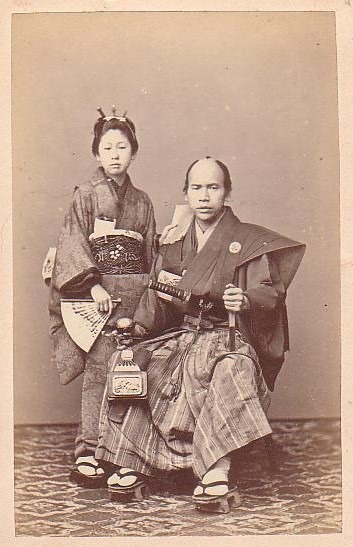
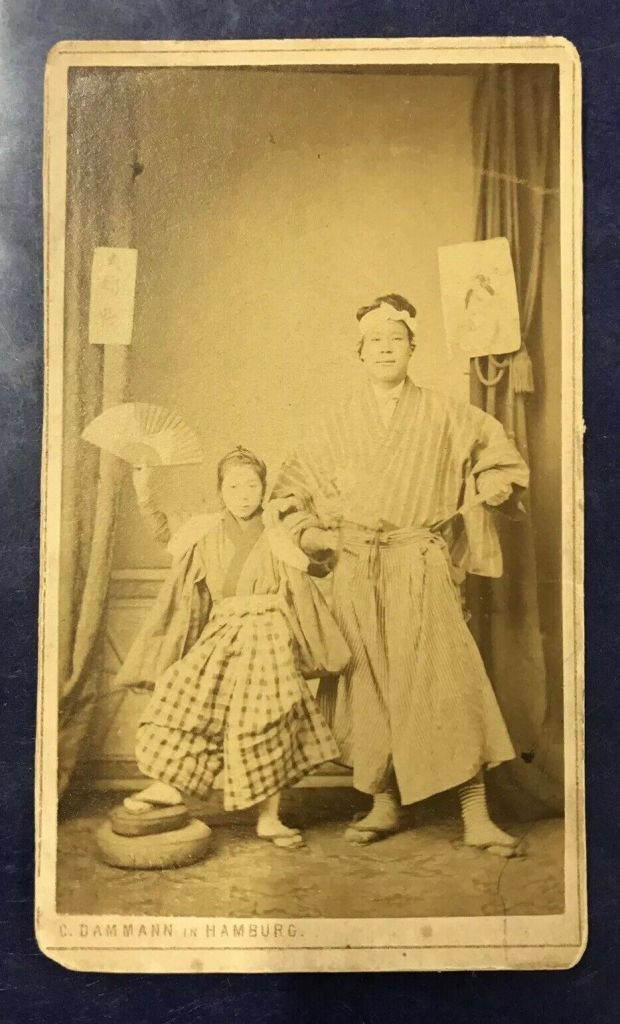
Photo below – Asakichi and his daughter Nobu (Sayers collection) in Turin, 1867? 1868?
1867 December – Professor Risley’s Imperial Troupe arrive in London with Matsui Kikujirō and his daughter Tsune and his pupil Matsui Shinjirō
1867/8 Matsui Sukegorō (later one of the Matsui Gensui XVIs) is born in Tokyo – birth name is probably Muroya Yonekichi.
1868 February – Matsui Gensui troupe in Hungary? An unnamed Japanese troupe drank too much strong alcohol before their performance and had to take two days off to recover
1868 April – The Theatrical Lounger writes about the “clumsy imposters who appeared at St Martin’s Hall some months since” (Illustrated News) when reviewing the Imperial Troupe
1868 April Matsui Kikujirō of Risley’s Imperial Troupe dies in London.
1868 April – Italy – a troupe member arrested for trying to rape a young girl
1868 May – The Theatrical Lounger receives a letter from Mr Prior protesting about his and Mr Grant’s troupe being called an imposter, saying the ladies were the first to have left Japan, before Risley’s troupe. The Theatrical Lounger says he meant they were not as remarkably talented as they claimed.
1868 July – Matsi Giansi, Asakichi, Yacopo, Kameschi, Kosakichi, 2 female musicians in Nimes (L’Opinion du Midi, 15 July 1868 p 3)
1868 September – France – Matsui Gensui XIII tries to claim second year of pay owed by William Grant. Grant could not pay and fled in the middle of the night.
1868 October – Matsui Gensui XIII signs a contract with a French impresario, saving money for passage home
1868 December - the Japanese troupe that was at the Cirque Napoleon “have returned to France” Le Pave 28 December
1869 June – a troupe of around 12 Japanese, including men women and children in Mons, Belgium. Journal de Charleroi 9th June p 2
1869 July – Le Cirque Imperial Japonais – same who were in Paris Exposition – under the direction of the Godefroid/Godfroy brothers – Kiainsi top spinning, Ka-me-chi and son – pyramid of Yedo, Mlle Ko-sa-ki-chi and Jacobo, ladder and wire dancing (Journal de Charleroi 11th July) Asakichi aged 50 is in Charleroi Belgium with his third wife No-A-Ba, a 16 year old female.
1869 August 12th – Journal des Baigneurs says that 7 have died of the troupe that performed in Paris. The 7th is No-A-Ba, wife of Asakichi, who died in Belgium and also their daughter.
1869 October – Matsui Gensui XV/Matsui Yoshigorō departs Japan for a tour of Hong Kong, India, Germany, Britain and USA with Thomas King’s Royal Tycoon’s Private Troupe
Photo below from Pitt Rivers Collection of Carl Dammann photos. Possibly of Matsui Gensui XV/Matsui Yoshigorō, Moto, Osawa and Kinjuro (Pitt Rivers) Headshots here also seem to be of Osawa, https://collections.peabody.harvard.edu/objects/details/596441
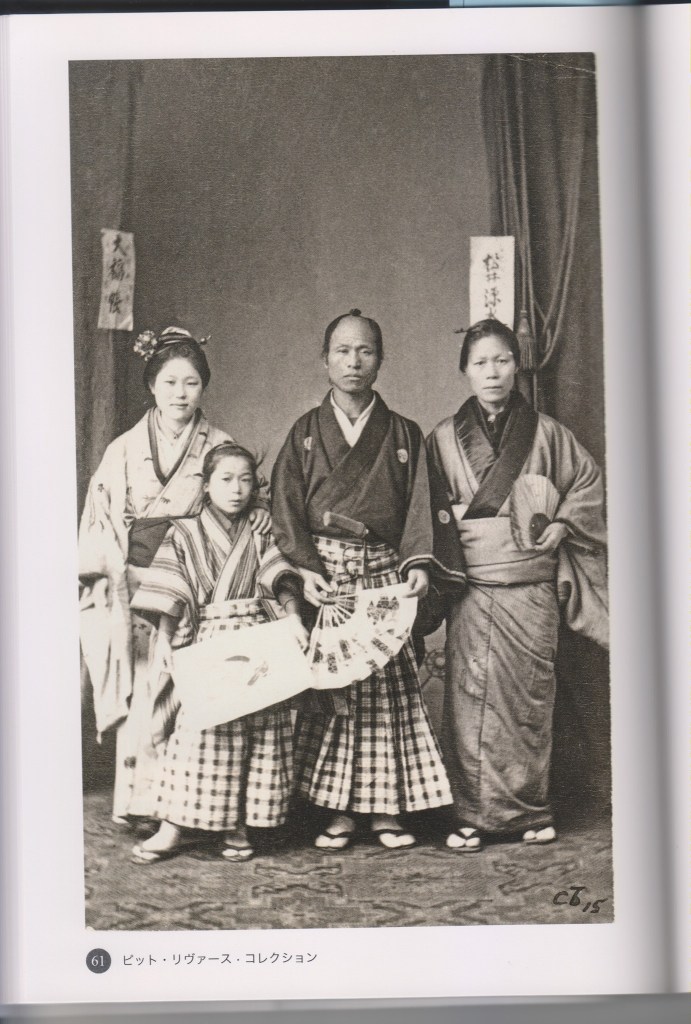
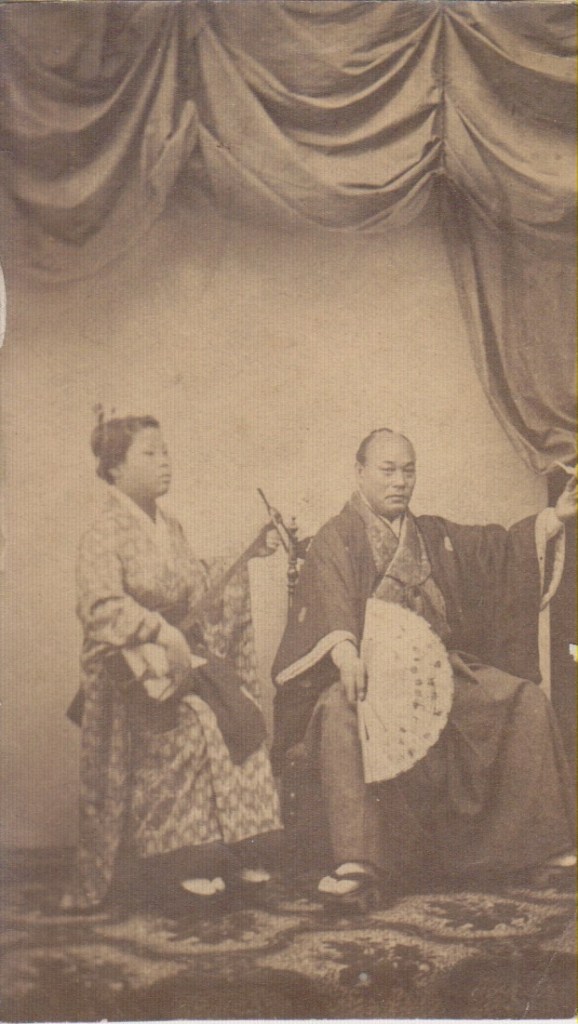
Photo below of Kinjuro? Naminosuke? (Robert Sayers collection)
1870 January – March 12 – Matsui Gensui XIII returns to Japan with family
1870 July – King’s Royal Tycoon’s Private Troupe appear in London.
1870 August – Oh Ra Jo, the Tycoon’s Private Top Spinner appears with the Royal Tycoon’s Private Troupe at the Alhambra, London.
1870 November 4th – Matsui Gensui XIII dies at the age of 46 in Japan.
1871 May – King’s Royal Tycoon’s Private Troupe leave Britain, to tour the USA and continental Europe
1872 May – Matsui Gensui XV asks Thomas King for return fare and payment in France, refused so travels to London to ask Consul Terashima Munenori for £150.
1872 August – Matsui Gensui XV departs Britain
1873 February Matsui Gensui XV returns to Japan.
1876 August – Kosakichi returns to Japan with Fanny Birzle and child and apprentice – Torakichi?
1877 Matsui Gensui XV finishes 7 year tour of Europe and America according to Toshinbun January 29th 1890.
1884-1887 Matsui Gensui XVI (Kunitarō?) tours overseas, mainly performing sword unsheathing
1888 article written in Tokyo Eiri Shimbun implying Matsui Gensui XV died in 1886. http://blog.livedoor.jp/misemono/archives/51898389.html
1890 Matsui Gensui XV is performing in Japan as Matsui Genyūsai 源遊斎 according to Yomiuri Shimbun 14th September 1890. The article says that he had just returned in June 1890, after touring China/USA/Europe since 1883. http://blog.livedoor.jp/misemono/archives/51898389.html
1890 Matsui Gensui XV suffering from palsy/paralysis
1896 Matsui Gensui XV retires at the age of 62, handing over to Matsui Gensui XVI (Suketarō) aged 38
1901 March 31 census – Sukeguro Matsui, Boarder aged 34, staying with Usaburo Nishihama aged 36, theatrical artiste, Chiyo his wife aged 30, Ichi his son aged 25, Jonosuke Aoyama aged 23 = The Nishihama Matsui Troupe.
1901 April – performed with the Fukushima Troupe and Maruichi/Kagami Sentaro for the Japan Society (according to Kashima Sakuramaki, 1901). Top spinning, umbrella dance, ball and sticks
1903? Matsui Gensui XVI (Kunitarō) dies at age of 46
1907 Matsui Gensui XV dies at the age of 74
1910 April Yonekichi Muroya arrives in London with the performers for the Japan-British exhibition
1910 May – October – Matsui Gensui XVI (Sukegurō? Suketarō?) performs at the Japan-British Exhibition in White City http://www.tokyomagic.jp/labyrinth/matsuyama/gintaro-05.htm

1910 December – Gensui Mutfui, the champion top spinner, direct from the court of Japan – The Palace, Jarrow
1911 March Matsui Gensui XVI (Sukegurō? Suketarō?) tours Britain performing top spinning acts in Ipswich [1]
1911 April – census – Matsui Gensui (Sukegurō?) is staying at the house of a draper’s assistant in Chester Le Street, aged 43, single, born in Tokyo.
1911 June – Matsui Gensui performing in Shields
1912 July Yonekichi Muroya arrives in Liverpool from Callao, Peru, with Pattaski Nakagawa, Manjiro Nakagawa, Ichitaro Naito
1912 August – Matsui Gensui performs in Coventry.[2]
1912 November – The Royal Matsui Troupe of Japanese Entertainers including Gensui Matsui, the most marvellous top spinner in the world, perform at Motherwell’s New Century Theatre
1913-1916 Tour Britain as The Three Royal Matsuis – displays of conjuring, balancing and top spinning.
1913 March-April – Matsui Teisui famous top spinner performing in Australia
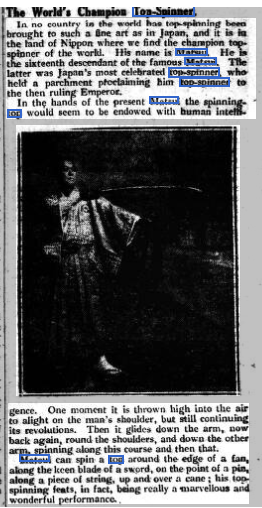
1918 December – Matsui XVI – The World’s Champion Top Spinner – article in Sheffield Weekly Telegraph and then in Australian media 1919
1919 Matsui Gensui XVI (Suketarō) dies at the age of 61 in Japan?
1922 May – Matsui Gensui, top spinner, appears in London with the Okayama troupe.[3]
1922 October – Matsui Gensui (Sukegurō?) dies in London, aged 55 of TB, living in 6 Argyle Street, Pancras, died at Marloes Road, Kensington. Grave number 456 8V St Pancras Cemetery.
1948 Matsui Gensui XVII dies
[1] Music Hall and Theatre Review, 23 March 1911 p 14
[2] Coventry Herald, 9 August 1912, p 12
[3] The Era, 3 May 1922 p 15
See also Street Performers and Society in Urban Japan 1600 – 1900 : The Beggar’s Gift – Gerald Groemer
 Ninjin