
Member of the Maruichi/Masukagami guild of Daikagura – a subgenre of lion dancing troupe, which moved on from religious rites to include music, juggling and acrobatic drumming
1817 Born
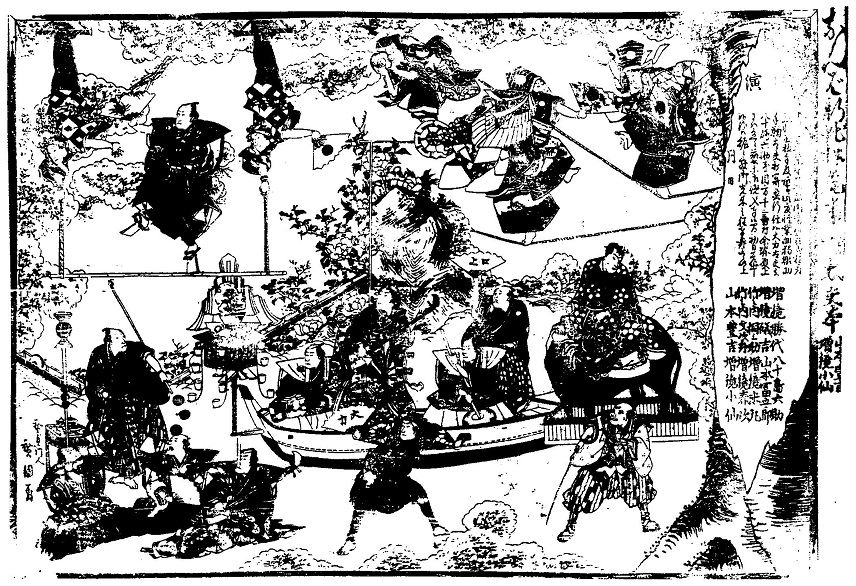
1848 daughter Otomo born
1851-2 performing in Namba, Osaka
1867 April – Lenton & Smith section of the Great Dragon Troupe leave Yokohama to tour Hong Kong, Philippines, Java, Singapore, Penang and Calcutta. – not clear they actually travelled to Asia with the troupe. Contract for troupe was between Isokichi and Lenton and Smith. Isokichi and Metaro only given a passport for a month
1867 April – returned to Japan?
1867 May 3 – Stanley leaves Yokohama for San Francisco
1867 June 6 – Ese Kitche no kawee – Japanese Sampson in the combined Great Dragon Troupe arrive San Francisco
1867 June 13th – Sintaro Bungo the great sensation performer and Ese Kitche no Kamme the renowned Japanese Sampson, having recovered from the effects of their long sea voyage, will appear to night in their thrilling performances. 4 nights remaining then leave for Paris on the 19th.
Travelled from San Francisco to Sumatra to join Lenton & Smith troupe?
1867 August – “We do not know whether we should admire more the graceful, nicely conceived and artistic feat of making paper cut-out butterflies fly with a fan, or the youthful Che-o-Kitchie, who, gliding down a swinging smooth bamboo with a single push of his foot, suddenly becomes motionless, or the clever magic tricks of Eso-Kitchie and Gungero, who do not bore the spectators with their incessant showing of things, the plot of which is destined to remain a riddle, but who simply give proof of extraordinary skill, all with as much simplicity and grace as ridiculousness. (Sumatra Courant)
1867 December – Eso Kitchie and the Great Dragon Troupe (Lenton & Smith section) arrive in Australia. Omoto said to be his daughter.
1868 January – arrived in Melbourne from Calcutta – eight men and three women and one boy. Director – Eso kitchie, juggler and top spinner Gengero
1868 January – “was for 20 years director of the Dragon Company in Yeddo. All communications with the others pass through him, and it is by him that the performances are arranged, and the duties of each performer apportioned.” The Argus, Melbourne, 17 January 1868 p 6
1868 February – “First appearance” of “Eso-Kitchie the equilibrist in new and extraordinary feats”, Ballarat
1868 April – “old Esokitchie, – who did some astonishing things with an umbrella and a number of balls, wheels, discs, and squares.” Sydney
1868 May – “Eso-Kitchie again made his appearance in his scene of Japanese equilibria, making rings, balls, and square pieces of wood run round the top of an open Japanese umbrella; he was loudly applauded throughout this performance as also in his dexterious tricks with balls and small cups, which he threw into the air and caught in several different ways in a wicker basket arrangement. This part of the entertainment was really clever and very amusing and deservedly called forth rounds of applause” Tasmanian Times
1868 July – “First Appearance of ESO-KITCHIE, The Japanese Cicerone, 20 years Director of the Great Dragon Company in Jeddo, in his great scene of COMIC JAPANESE EQUILIBRIA.” Melbourne Argus
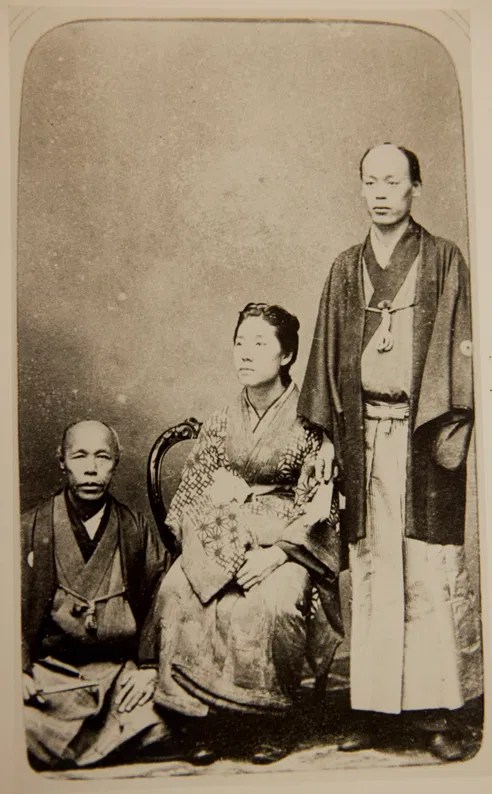
1868 September – Ballarat – possibly some or all of photos below taken then. Isokichi is the older man. Mitaro, Omoto/Otomo, Chiyokichi, Katsujiro (female role), possibly George Gibson


1868 November – New Zealand – itsatadee? dance Cuts-who-gero, Mitaro and Omato. Bungero, Gengero, Sagero and the Cicerone Eso Kitchie
1869 February – Lenton & Smith Great Dragon Troupe tour of Australasia ends.
1869 September – Isokichi is reported to be helping Phil Kirby arrange a further troupe
“The late company is distributed in all parts of Japan, but our stately old friend, Eso Kitchie, has given Kirby much assistance : he does not do any show business now, and has retired into quiet life. Cuts-who-gero is about still, but will not perform again. Gingero, Metaro, Sagero, and the rest of Eso Kitchie’s troupe, are in Yeddo, performing at the Imperial Theatre there.” Letter of October 1869 addressed to John Smith in Australia. The Herald, Melbourne, 3 December 1869
1869 October – Isokichi, aged 52, from Yokohama, is on the employment record for Thomas King’s Royal Tycoon’s Private Troupe who tour Hong Kong and then India, then Germany and then Britain.
1869 December – “We hear that Eso-Kitchie, the venerable leader of Lenton and Smith’s Japanese troupe, during his stay amongst us, took copious notes, and these are to be published in Yeddo by the Government” (Mount Alexander Mail, 6th December 1869)
1870 July – Thomas King’s Royal Tycoon’s Private Troupe arrive in Britain. Not clear if Isokichi is with them (not on the passport records)
1870 November – Isojirō, Isokichi’s brother has 1 year passport for troupe for Shanghai. Frederick Page, the employer states 10 people to go to China, Europe, Australia.
1871 January – Isojirō and nine other performers depart Japan for Shanghai
1871 January – Eso Kitchee billed as “The Royal Tycoon’s Private Top Spinner” in Ashton with the Royal Tycoon’s Private Troupe.
1871 February – Eso Kitchee billed as “the inimitable comic Japanese juggler and equilibrist” and Oh Ra To as the Royal Tycoon’s Private Top Spinner in Brighouse
1871 February Fujikichi of Royal Tycoon’s Private Troupe dies in London
1871 February – advertisement in The Era that Hasingawa Harosan (Hasegawa Harukichi) and Tannaker Buhicrosan are co-proprietors of the Royal Tycoon and Dragon Troupe of 15 artists.
1871 March – April Eso Kitchee the inimitable Japanese juggler. No mention of Oh Ra To. Manchester, Sheffield.
1871 May/June – Royal Tycoon’s Private Troupe finish tour of Britain, start tour of Europe and the USA.
1871 September – Eso Kitchee in Arnhem with Royal Tycoon’s Private Troupe
1872 January – Royal Tycoon Troupe of Japanese juveniles in India
1872 March – Royal Tycoon Troupe of Japanese Juveniles in Britain
1872 May – Matsui Yoshigorō of the Royal Tycoon’s Private Top Spinner troupe (probably Oh Ra To) asks King and Isokichi in France for the return fares for himself and 3 others but no money forthcoming.
1872 July – Great Siamese Dragon Troupe in Brighton – “Eso Kitchee” “with his great juggling act”
1872 July – After the “Great Dragon Troop of Japanese Artists” in 1867 and the previous year the “Royal Tycoon Japanese Artists” had performed their extraordinary, beautiful, beautiful, wonderful, astonishing, excellent, entertaining, amusing tours here, never before seen here, It was certainly not an easy task for the new company, which gave the first of a series of 15 performances yesterday evening under the name of “Mikado Troop” on Koningsplein – the eyes of the audience, somewhat spoiled and blasphemed by that point. , still to fascinate. Nevertheless, these gentlemen and ladies artists succeeded beyond expectations. The experiments in all kinds of balancing arts were truly admirable. A new Little All Right did not have to be inferior to its predecessor flying nicely. However, her beauty is such that she will enchant and conquer the hearts of Chinese and other viewers with the same ease. This will be easier for the young lady who accompanied the agile developments on the tightrope of the famous Eso Kitchi on her Japanese musical instrument.
The tent is spacious and well distributed. If the chairs and chairs do not become unfaithful, no one need fear falling or collapsing, as no scaffolding or amphitheaters have been installed. Java bode 19 July 1872
1872 August – Shimizu Seijirō 48, Shimizu Fujisaku 51, Shimizu Fukutarō 13, Shimizu Chomatsu (Chiyomatsu) 9, Shimizu Anzō 31, Kagami Kichigorō 35, Kagami Otokichi 13, Kagami Harukichi 12 leave Japan for Hong Kong, Manila, San Francisco, Singapore, Malaysia, Zanzibar, Australia, Java
1872 September – Yedo troupe perform at Lusitano theatre, Hong Kong – Miss Kitchi slack rope, Little All Serene balancing.
1872 September – “The Dragon Troupe of Japanese Gymnasts are engaged, and go through a performance which combines the daring, the wonderful, and the pleasing. There is one lady in the party, and she performs the pretty butterfly trick with remarkable grace and neatness. She also produces the usual quantity of variegated streamers from the ashes of piece of paper, held over a lighted candle ; and ends by liberating a pigeon from some place of concealment whlch the uninitiated fail to discover. The rope walking of Taro Noska is something to see ; and the fame of the Japanese for tub and ladder balancing is fully sustained by the juveniles Le Match, Gard, and Wah Hobe, with the adult gymnast Gen. Oska.” Royal Music hall, London. Morning Advertiser 20 September 1872 p 3
1872 November – December – Yeddo Troupe in Australia – Kami-Sami female on swinging cord. Yama Moto (juggling and magic)
1873 January – Mikado troupe in Dutch East Indies
1873 July – Great Yedo Troupe – Little All Right, Foo Ko Gero, Miss Okin (tub balancing), Choa Kitchi (juggling), Sagero (single bamboo, broken screen), Oto Kitchi, Kin Taro, Itchi Taro (elastic wonders), with James Elliot as manager – in Batavia
1873 August joined by Moto Kitchi (female) and Esco Kitchi (rope walking) Samarang, Indonesia.
1873 Great Dragon Troupe in South Africa with E So Kitchie Tokedo Wah hobe, Ole Match. Gen os ka, Tara nos ka.
“A Japanese troup of jugglers, rope walkers, and Athletes have come out in the “African,” and after performing in Cape Town, will make a tour of the Colony.” Fort Beaufort Advocate, October 25 1873 https://www.eggsa.org/newspapers/index.php/fort-beaufort-advocate/fort-beaufort-advocate-1873-4-october-december
1873 December – Iso Kitchi is director, Gordon is under Director, in Makassar, Indonesia – benefit for Moto Kitchi
 Ninjin