

A trio which became a pair of performers – Kamejiro Yoshida b 1896, Hirokichi Fujii b 1900, Toyokichi Kashikura b 1901
“Both were in their ‘teens when they went to England for training as acrobats, and spent two and a half years learning the various tricks and turns which now constitute their repertoire of comic gymnastics.” Daily News (Perth, WA : 1882 – 1955), Tuesday 26 March 1935, page 4
‘The art of stage gymnastics — we do not like to be called acrobats— takes years and years of disciplined training to conquer—broken bones and broken spirits end many careers. We start as little boys with plastic bones and muscles and work nine or ten hours a day for years on end before we are even fit to take our bows to an audience as the flyweights juggled around in mid-air. ‘Bisley,’ the art of juggling a partner on top of the feet while lying in a horizontal position takes a year or two of solid practice to learn; others never learn. Our most difficult act as a feet to feet somersault. One man lies on his back with his legs raised at an angle of 90 degrees. A man stands on the upturned soles and does a somersault, again landing on the feet. That trick has cost me four broken arms, a broken shoulder and a broken head.’ The West Australian, 3 April 1935 p4
“Now, I’ll let you into another secret; we are not brothers, neither is our real name Kiraku. The one who wears glasses is my partner, and his name is Kame Yoshida. But we are like brothers, so we call ourselves the Kiraku Brothers, for ‘kiraku’ is a Japanese word meaning ‘happy-go-luckv,’ and that’s about what we are.” The Daily News (Perth, WA : 1882 – 1955), p. 8 (LATE CITY). Retrieved May 6, 2024, from http://nla.gov.au/nla.news-article83995749
1907 Master K Yoshida (under aged of 12), juggler, arrived from Kobe with S. Ohno, juggler and Masters Y Fujimoto, T Nakamura, jugglers
1910 Hirokichi Fujii arrives in London with his uncle of the Hamamura troupe Kumeji Deguchi with Nakane Misaburo, Kozo Yoshii, Hamamura Keisaburo, Matsui Shigejiro, all under 12 years old. “Circus”
1913 – Toyokichi Kashikura arrives in Britain, aged 10, with Yasujiro Hamamura, possibly to join the Hamamura or Riogoku Troupe
1914 were in Germany when war broke out. Interned for 2 months. Gave a large number of performances for soldiers in hospitals. Daily News (Perth, WA : 1882 – 1955), Tuesday 26 March 1935, page 4
1921 April census – Toyokichi Kashikura b 1901 living with Lillie Jackson Blanchard, b 1900, Kamyiro Yashida (Kamejiro Yoshida) b 1896, Hira Lichi Fayer (Hirokichi Fujii) b 1900, all in employ of Mr Deguchi. 12 Albert Park, Bristol
Deguchi also registers Kashikura, Yoshida and Fujii as living with him in Blackpool.
1926 April – the Kiraku Brothers in some clever acrobatics – Holborn Empire
1926 July – Margaret Maeda, nee Blanchard, marries Hirokichi Fujii in Lambeth, London
1927 the Kiraku Brothers brought the art of Japan into their balancing act
1927 February – Three Kiraku Brothers sailed for South Africa
1927 June – Kiraku brothers return from South Africa
1927 November – Fujii, Yoshida and Kashikura depart for Buenos Aires
1928 – all three resident in Stockwell Park, London
1928 May – return from Buenos Aires
1928 July – Kiraku Brothers, described as the three modern Japanese wonders – Regent Theatre Great Yarmouth
1928 December – At the bottom of the bill are “The Three Kiraku Brothers,” a trio of Japanese acrobats who are clever and humorous. Tumbling and somersaults are their speciality, and the neatness and nonchalance with which they execute their “stunts” keeps interest throughout. Exeter Hippodrome
1929 November – Fujii, Yoshida, Kashikura sailed for South Africa
1930 March – Fujii, Yoshida, Kashikura return to Britain
1930 July – An unusually clever turn is that provided by the Kiraku Brothers, probably two of the cleverest acrobats seen in Coventry for some years. Lying on his back, one of the brothers uses his feet to carry out juggling tricks with his partner, who is turned into a human ball, being spun and twisted in midair in amazing fashion.
1931 April – the Kiraku Bros., two clever Japanese acrobats
1932 June – the very clever acrobatics of the Kiraku Brothers are enhanced by the air of Asiatic impassivity in which they are done.
1933 February – The Kiraku Brothers do not appear on the bill as “head liners”, but these Japanese acrobats were given a wonderful reception. The word acrobats does not adequately describe their class of entertainment, tor they are geniuses who seem to defy the law of gravity and the three dimensions. For instance, one of them lies on specially designed couch and, with feet and legs in the air, uses his partner in the way old-time acrobats used to juggle with gaily-painted barrel. This human barrel is gyrated at a dizzy speed, and a false move would send him crashing into the parterre. One of them did series of “standing somersaults” at a breathless pace, and another clever item was the moving across the stage in long-arm balance—“ walking on his hands ’’— at about the speed of rifleman’s quick-step. (Belfast)
1933 August – Kiraku Brothers are two Japanese of the modern school of acrobats.
1934 September – The famous Japanese Kiraku Bros. amaze all with their acrobatic dexterity, while the rare opportunity of seeing a Jap as a clever comedian is also given. (Bournmeouth)
1934 October – The Kiraku Brothers, those quaint Japanese acrobats, have discovered new and even more ingenious stunts since I last saw them
1935 January – Yoshida marries Violet Edna Lloyd in Lambeth
1935 February – Fujii and Yoshida sailed for Australia. Sons of a Japanese farmer. Going to go to Japan afterwards for a holiday.
Interview with Fujii in the Mirror (Perth) 30 March 1935, page 14
BROKEN BONES AND BAD FALLS
Are Part of a Gymnasts’ Hard Life
That the lot of the expert gymnast is oftimes a dangerous one, is made clear by Hiro Jiju, one of the Japanese acrobats now appearing at the Ambassadors. Few people outside the profession have the slightest idea of the extent of training required by a gymnast before he can make his bow to the audience for the first time. It requires years of hard training and thousands of hard knocks and falls, and many broken bones.
I was bom in Gefu, in the province of Ken, in the early months of 1900, says Hiro Jiju and goes on further to add: At the age of seven I spent twelve months in bed, and at one time was given up as dead, and yet, two years later, I was in London learning to be a gymnast. I was taken from Japan to England by my uncle, who ran the well-known Hamamura troupe. It was with this troupe that I made my stage debut. On arriving in London I was placed under the tutorship of a Jap. who ran a school of 45 boys. The first lessons we had were the ordinary ‘physical jerks,’ but when we had gained confidence we started to learn hand balancing and walking on the hands. After hand-balancing we were taught a very important trade secret — how to fall without hurting yourself. Yes, there’s a great art in knowing how to fall, and if I hadn’t learned it I should be dead and buried now, for on four occasions I have fallen from the top of the scenery to the stage, a height of approximately 30 feet. And yet I once fell from a height of three feet and broke my left arm in four places! There is a reason for this, in falling 30 feet you have time to think; In falling three feet, you haven’t. There’s the difference!
The secret of falling without hurting yourself is to fall with the knees drawn tightly against the stomach. The hands should be clasped round the knees as tightly as possible, too. The body should be tensed so that on striking the ground the whole of the body has the rigidity of a board. The breath should be held at the moment of impact, and if you do it properly you will gauge it so that you will strike the floor just above the small of your back. I was taught to fall by being thrown by my instructor when I least expected it. If I didn’t fall properly I hurt myself. I soon learned. Jumping is another very essential part of the Japanese gymnastic training, and we practised jumping day after day, year after year, until we were properly proficient.
‘Risley,’ that is the art of juggling boys on the top of the feet while lying in a horizontal position, takes at least a year to learn. Then there is what we call ‘Tombo Tombo,’ which is turning five or six back somersaults without using the hands. This trick takes two or three years to learn. The art of gymnastics, or ‘karawaza’ as we call it, needs infinite patience and practice. You must expect broken- limbs and sprains if you decide to become a gymnast, for the gymnast who has escaped them has yet to be born. I think I have sprained every part of my body since I started in the business, and am still doing so.”
From the above it can be gauged how patient and how hard working the Kiraku brothers must have been to bring their act to its present state of perfection.
1935 August 8th last performance in Australia
1935 September 26th – Fujii and Yoshida returned to Britain, c/o Variety Artists Federation, Charing Cross Road
1936 May – The Kiraku Brothers, Japanese acrobats, have been the stage since they were children, and in the last 26 years have appeared in 28 different countries and performed many times before Royalty (Sheffield)
1936 September – The Kiraku Brothers describe themselves as the happy Jappy chappies, or the East’s gift to the West (Hull)
1936 September – The Kiraku Brothers, who used each other for juggling purposes, gave a first-rate display of Japanese acrobatics (Aberdeen)
1936 November – The Kiraku Brothers, a skilful pair of Japanese athletes—they dislike to be called acrobats (Hastings)
1937 March -The Kiraku Brothers, two very skilful Japanese who, among a host of other tricks, do some amazing things with their feet. (Worthing)
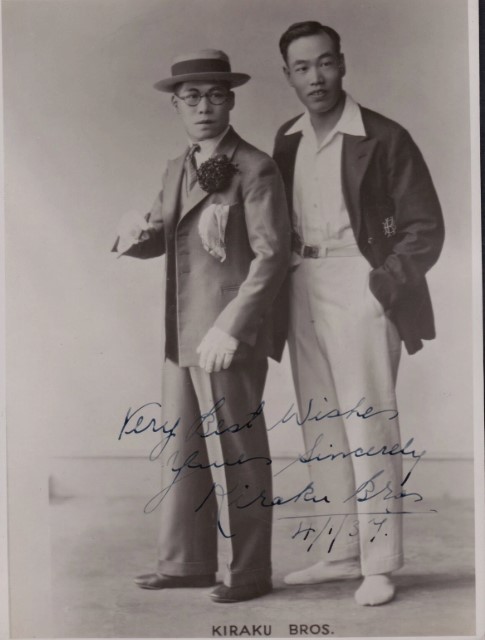
1937 August – Aladdin pantomime at Leeds – Chinese policemen are to be played by two Japanese, the Kiraku Brothers, comedy equilibrists
1937 September – Clacton – “Happy Jappy Chappys”
1939 Register – Fujii in Rotherham as travelling music hall artiste, Yoshida also in Rotherham in different lodgings. Kashikura living in Lambeth, single, music hall artist. Violet Yoshida in Lambeth, 178 Stockwell Park Road with Mr & Mrs Torii, lampshade makers, Mr & Mrs Mizuta, music hall artists.
1940 October – last appearance as the Kiraku Brothers in Britain – Morecambe.
1940 November – Violet and Kamejiro Yoshida depart on Fusimi maru from Ireland for Japan.
1941 9th December Fujii is interned
1942 June – Fujii’s appeal refused
1943 May – Fujii’s appeal refused
1946 Violet returns, without Kamejiro. Has been living in Japan during war.
1968 Fujii dies in London
1968 Kashikura dies in London
2000 Violet dies in London
 Ninjin