
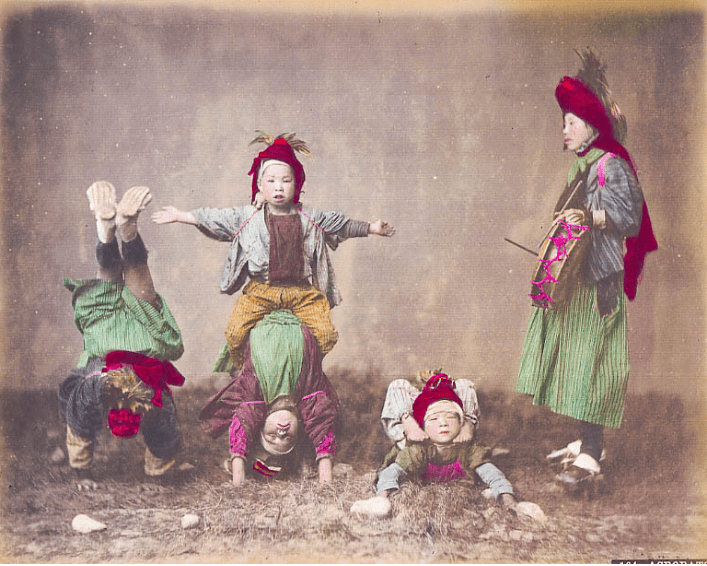
Origins/status
Kakubeijishi or kakubeejishi (pronounced kakubeh eh jishi not “bee” like the insect) were another subgenre of lion dance, similar to the daikagura. They are thought to have originated in Echigo province, Niigata prefecture.
The origins of the name are unclear.
One theory is that someone called Kakubei carved the original lion masks.
Another is that a farmer called Kakubei who was born in Tsukigata in Echigo province invented a variety of acrobatic feats in which he trained the young children of his village from 1394. He took them out of the Echigo province and this proved so successful that more than 200 children went from Tsukigata to tour the country.
“It is claimed however, that Kakubei adopted his feats from some of the ancient Indian plays or even that they had their origin in the pre-historic age of Japan.” (We Japanese, Fujiya Hotel Ltd, 1950, p342)
Another theory is “that a man called Kakubei was once killed but bit off his murderers’ toe during the fight. The killer escaped unidentified and so the children of Kakubei came up with a plan to find the man who killed their father, by searching for someone with a missing toe. They invented the Kakubeijishi practice that included a lot of handstand routines, so they could look at peoples toes without drawing any suspicion.” Mapping Contortion in Japan 3
“Another theory is that children who had lost their families were trained to become actors of the Kakubeijishi troupe in order to gain money and support the village that was suffering from annual floods of the nearby river, which caused the loss of the harvest. Therefore, the children traveled around the country all year round to perform and to earn money.”

Utagawa Hiroshige II Kakubeijishi in Edo. Wikimedia.
They never established an officially endorsed Edo-based organization but claimed legitimacy from their Echigo roots and that shishi dancing began in India and China and was a part of Japanese religious life. They started to appear in Edo festivals from the late 18th century.
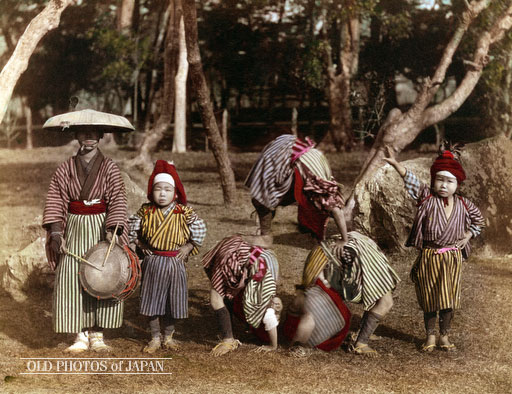


Act and costume
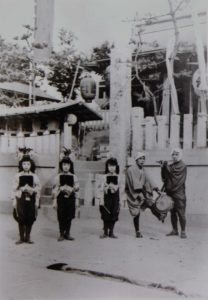
The original act in Tsukigata involved a minimum of 4 children dancing and performing contortionism, accompanied by 2 drummers, one of whom gave instructions, and one flautist. Training started from as young as 3, with performances starting at the age of 8 and continuing to 14 for girls and 15 for boys.
The costume was unisex, with trousers and a bodice covering the top. A red veil is worn – usually covering the face during the dances but often pulled back when doing the contortionism and tumbling. A wooden shishi/lion mask is worn on the top of the head, topped with chicken feathers. The reason for the chicken feathers is not known.
In the 18th and 19th century many of the kakubeejishi moved to Edo (now Tokyo). They were absorbed into the daikagura troupes, becoming the upper half of foot equilibrism acts such as the Risley act or tub balancing acts. They would also ascend bamboo poles balanced on the understander and then descend using their feet. They also performed block balancing.
The children of unrelated families were contracted for a stint of 3 to 5 years. The training was so harsh, children in Niigata were threatened with being given away to a shishi troupe if they did not behave.
History in Japan
In 1874 the Meiji government proclaimed that all children purchased for the Echigo-jishi troupes were liberated but their use continued.
From 1900 to 1911 compulsory education was introduced for children and child exploitation was prohibited.
In 1919 a writer lamented that kakubeijishi troupes were no longer based in Echigo but instead were Tokyo youngsters who had been given away as babies by impoverished parents.
By the time a prevention of cruelty to children law was introduced in 1933, the kakubeijishi had died out.
In 1936 the art was revived in Tsukigata and then again after the war from 1956.
Performances can be seen to this day at the Tsukigata festival in June. There is also a small museum dedicated to materials about the Kakubeijishi. https://www.shironekankou.jp/performing_arts/
History abroad
1867 Japanese passport record # 33 is for Kakuzo, a kakubeejishi from Yokohama for 2 months to China
It seems likely that the younger children in troupes (“five boy contortionists”) such as the Royal Tycoon’s Private Troupe were recruited as kakubeijishi and not actually related to older troupe members.
For example
Kintarō (Arthur King Tarro b 1864)
Ogawa Torakichi b 1853
Tamamoto Chiyokichi b 1856
Umekichi (Toyokichi stage name, b 1849) and Fujimatsu (b 1857, stage name Fujikichi) within Risley’s Imperial Troupe were kakubeijishi, with Sadakichi as the understander/bottom man. Were said to be Rinzo’s “children” brought to Edo from Echigo by their father when younger. Apprenticed to Kikujiro. Presumably they are the same people as Sentarō/Shintaro and Yonekichi (who are recorded in the 1871 England census as born in 1854 and 1853 respectively) who are mentioned in the 1867-9 line up for the Imperial Troupe in Britain.
1901 Maruichi Sentaro describes Okabe Takataro (b 1879) in London as a kakubeijishi. Returned to Japan from Britain with Okabe troupe 1903.
The transformation acrobatics that Tommy the Wolf performed with Tannaker’s troupes, where he turned into a wolf also sound reminiscent of the lion dances and fox transformations.
See pp169 – 75 in Street Performers and Society in Urban Japan 1600 – 1900 : The Beggar’s Gift – Gerald Groemer
 Ninjin