
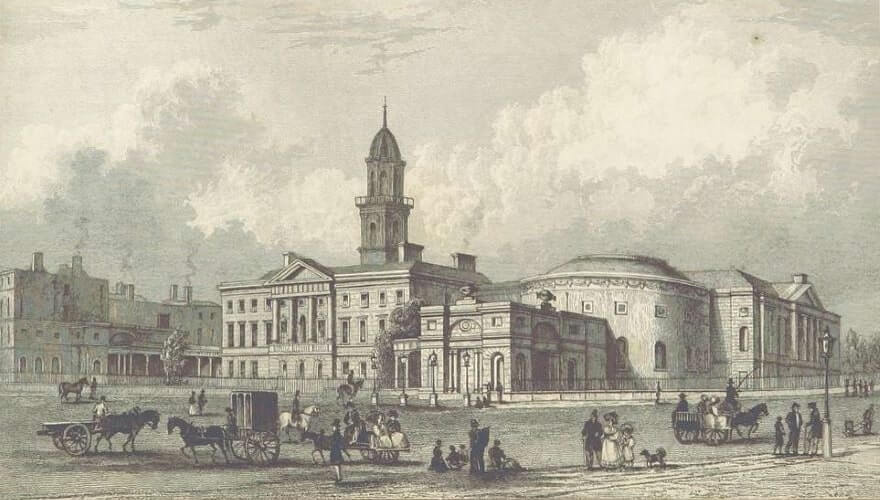
1865 October – Dr HS Lynn performs the Japanese butterfly trick (as taught to him during his recent sojourn at Nagasaki) at the Round Room, Rotunda, Dublin.
1867 8-20 August – Great Dragon Troupe (15 or 16 – advertised as 24) arrive in Dublin, playing and staying at the Round Room, Rotundo. Butterfly trick, ladder trick, tub balancing, walking on paper. Named performers – Godai, Little Tommy, Sintaro Bungo, Kinzo-Goro, Fondi-Keedjie, Harosan, Metaro, Tora-Keitche, Bombi-Goree, Masa-Kutchee.
“Attracted considerable attention” with their perambulations around the city. They are stated to belong to the Royal Theatre of Yeddo.
Then go on to Drogheda, Newry, Belfast (same line up as in USA), Dundalk, Drogheda.
THE JAPANESE DRAGON TROUPE. These distinguished, mysterious, and most marvellously dexterous band of Orientals made their first appearance in public In Europe last evening, in the Round Room of the Rotundo, before a densely crowded assemblage of ladies and gentlemen.
The orchestra was the scene of the exploits of “The Dragon Troupe,” and was most tastefully decorated with Japanese lanterns, screens, and other specimens of native art-industry, for which the strange and isolated people of a great eastern empire are so distinguished. The furniture, ornaments, and the several appliances used by the “Dragons” In the performance of their several tricks, were remarkable for their neatness and beauty of design and execution.
On presenting themselves, the Celestials were most cordially received, and they recognized the compliment paid them by bowing their heads to the ground, as a mark of their reverence and respect.
They are all true types of their race, and appear to be the living subjects of the pictures to be seen on very old china, particularly the ladies of the troupe, who, if we are to judge by the luminous colours In their garments and the evident importance they attach to dress, they are not less indifferent to the fascinations of fashion in costume than their European sisters. The dresses of the male “Dragons” are extremely rich, and in the fabric rare in texture, most curious designs are interwoven. If these strange people performed none of the wondrous feats which they accomplish with inimitable ease and dexterity, they would be well worth seeing as curiosities of the human family.
Their tricks are things to be seen and not described, and embrace things that demand muscular power, and the most minute and unaccountable precision in manipulation, We must confess that we were more taken by surprise, than at anything we had heretofore seen achieved by wizards, or the long line of conjurors who had performed here for the last twenty years.
In the course of the entertainment the male and female Japanese introduce some of their native music, which is the most original, primitive, and discordant that can be well imagined, but it has its value because of its being genuine, and calculated to give an insight into the social habits of a race becoming every day of more interest to us through the medium of a newly-established commerce.
To enter into any details of what the “Dragons” do would involve much more space than we can at present afford, but we would strongly recommend the lovers of the curious and the wonderful to pay the Japanese jugglers a visit by all means.
Freeman’s Journal, 10 August 1867 p 3
THE JAPANESE ENTERTAINMENT. These wonderful performers of feats hitherto unknown in this country are still drawing immense numbers to their nightly entertainments. Last evening, after the whole troupe had introduced themselves, and made their own peculiar obeisance to the company, two young boys performed a number of extraordinary tricks, with swords in their mouths, and tumbled in a manner that required great agility and great practice. After this one the troupe walked upon a thin piece wire suspended from two props, and so much at ease did he appear in his dangerous position that he put on, while standing one foot, a whole suit of clothes. Another Japanese had a jar placed upon his legs, which he turned around with extraordinary velocity. After some time a child entered into the jar, and was gradually elevated. He then came out, and stood upon his head, and suddenly was let down, and caught in the arms of the man who was supporting the jar and boxes on which he had ascended. The same person who did this afterwards balanced a long ladder on his feet, and the boy ascended to the top of it. Another member of the Japanese company assumed the appearance of a dragon, and ascended along bamboo pole, on which he rested with his stomach, and then swung himself. The butterfly trick was again repeated, and these animals of man’s creation were made, like their prototypes, to rest upon flowers and rush into a small bowl, from which they emerged after short time. So crowded was the room last evening that there was not a seat vacant, their performance afforded great satisfaction, and received well-merited applause. Saunders’s News-Letter 14 August 1867 p 2
THE JAPANESE. It having been stated in a morning contemporary that one of the troupe of Japanese playing in the Rotundo had fallen from a bamboo pole and was seriously injured, we have made inquiries, and find that the lad referred to was not seriously hurt, and that already he is almost quite recovered under the skilful treatment of Doctors Irvine and Speedy. We understand that the Japanese have met with such patronage —well-deserved, in every way—that, contrary to their original intention, they purpose remaining in Dublin until the middle of next week. The troupe, accompanied by Mr. Blackman, their interpreter. and by one of the firm by whom they are engaged, visited the Hibernian School yesterday. They were received by Colonel Wynyard and Major Speedy, who conducted them through the refectory, lavatory, schoolroom, dormitories, and other parts of the establishment. The boys of the school, who were dressed out in holiday attire, were marshalled before them, and the bands played several tunes. The Japanese appeared to be greatly interested in what they saw, and listened with attention to the explanations of what was going on afforded them by their interpreter. Dublin Evening Mail 17 August 1867 p 2
“The whole company, consisting of over twenty individuals, including the two females, Omoto and Aye, have their local habitation in the large room behind the Round Room in which they perform.
Jodge, the butterfly-man, may be observed, “on his hunkers,’’ gravely divesting turnips of their outer integuments for the purpose of concocting one of those incomprehensible messes to obtain which he has carried his talents into strange lands. Haro and Sontaro, “the balancers,” are preparing to put some fish and rice, which are the favourite food of this people, through a culinary process, which appears to demand all the resources of their science, while on a slightly elevated platform at one end of the room, which appears to represent the sacred home of the troupe, as it is scattered over with some slight mats and bed covering, which looks like substantial sheets of brown paper, another Japanese has very deliberately reduced himself to the condition in which our original parents were before they applied themselves to the sartorial arts. We could not perceive that this act created the same degree of excitement which it would have if performed amongst us less civilized beings.
The ladies went on dressing their hair with their wonderful skill and taste, and the turnips were peeled and the fish prepared for cooking just as If nothing extraordinary had happened. A few of the troupe were engaged, if we could judge by the faint, sickly odour, in smoking opium from small porcelain pipes. These latter were the only silent ones of the party, all the others keeping up a lively interchange of chat, which was very humorous, no doubt, but the point of it was lost upon us, as we have the modesty to confess that we do not speak Japanese.
Not so with Mr. Blackman, the interpreter, who said some really good things, including threatening to punch the head of one of the party, who at a subsequent period opposed some difficulties to a photographer in the matter of posing for a picture. Indeed, from the interest displayed by them all in the success of this picture, and the intelligent, eager, vivacity with which they watched the result, when the operator had withdrawn his head after its mysterious disappearance within the bag attached to the camera, it was evident that the Japanese have none of the characteristic stolidity of most eastern people, and that they, instead of the Persians, should be called the Oriental Frenchmen. Notwithstanding, however, there were strong evidences of the little direct influence which intercourse between the East and West can exercise over the former. They are natural born Conservatives in everything, including the to us modem question of the compound householder. This latter fact is strongly instanced in this slight notice of their menage, as we were permitted to witness it in the Rotundo.”
Penny Despatch and Irish Weekly Newspaper 24 August 1867 p 5
1868 May – Munster, Waterford- Monster Japanese Circus and Hippodrome
1868 June – Wicklow – Great Hippodrome and Japanese Circus – had visited America in 1866 and 1867
1868 October – The Great Japanese Circus Company, in their spacious tent, Upper Wellington Street, Dublin. Exhibited daring and somewhat marvellous feats.
1869 December – March 1870 – Great Dragon Troupe return to Dublin, 9 in number (20 in Waterford, 10 or 12 in Clonmel, 15-20 in Cork), at the Round Room, Rotundo – “largest number of genuine native artists in Europe”. Full national costume. Butterfly trick, daring balancing, gymnastic feats, Japanese music, top spinning. Brothers Torra and Tassa. Harosan and Little Tommy, Mdlle Omotu, Kikou-Mats-Kee, Godai, Tjoje, Oide. Then Kilkenny, Waterford, Limerick, Clonmel, Cork, back to Dublin then to Belfast.
1870 April – Hotaka Joji and Oei pickpocketing case in Belfast, Blekman acts as interpreter
1870 April – Ballymena – thirteen in number.
1870 May – Londonderry
1875 March – Tannaker‘s Great Dragon Troupe in Belfast.
1875 April – Tannaker’s Troupe at the Pillar Room, Rotundo. Ladder act, butterfly trick, magic box. Little Allright. Tommy the Wolf. Japanese goods and curiosities on view.
1875 May – August – Londonderry, Coleraine, Sligo, Ballymena, Galway, Ennis, Cork, Drogheda, Limerick, Clonmel, Kilkenny, Waterford
1881 January – The great Tycoon Japanese Troupe of oriental specialities – five in number. Royal Alhambra, Belfast.
1881 October – The return of the Tycoon Troupe of Real Japanese – Dublin – Dan Lowrey’s Star Music Hall.
1884 January – February – Tycoon Japanese Troupe – Alhambra Belfast.
1884 April – Great Tycoon Japanese Company – the original troupe that appeared at the Crystal Palace in 1865 – Gingero, Hosakitchee, Komakitchee. Bamboo balancing, perch, Japanese trick ladder, Komakitchee the Japanese monkey, Japanese tumbling act. Belfast. No further mention of this after April – so it may have been a one off burlesque or parody, rather than the authentic personnel.
1884 September – Third appearance in Ireland of Singaro’s Japanese Troupe, Star Music Hall, Dublin.
1886 July – the Torikata Japanese Troupe, from the Japanese Village, Star Theatre, Dublin. Great Tub Acts. Pole Balancing. Chair Sliding. Swinging Bamboo. Great Ladder Feats. Wire Walking. Rope Sliding. Top Spinning.
1888 March – Japanese jugglers – Belfast
1888 May – O’Terra, the Japanese marvel. Japanese pigeon tamer. Belfast
1888 August – troupe of Japanese acrobats – Dublin
1888 September – Yokohama troupe of Japanese jugglers (not actually Japanese) Dublin
1889 January – Mitzuta Troupe of Japanese – in ballroom scene of Cinderella, Gaiety Theatre, Dublin
1890 December – Tycoon Japanese Troupe at Ginnett’s Olympia, Hippodrome and Circus, Cork.
1891 June – Tycoon Japanese Troupe, Hibernian Band of Hope annual fete, Dublin
1892 April – Fusi Yama and Yototsu, sword performers and balancers. Belfast
1895 March – Tycoon Japanese Troupe, Belfast and Star Theatre, Dublin
1895 July – October – Lloyds Circus – the marvellous Japanese troupe – Sligo, Kilkenny, Londonderry, Ballymena
1896 August – Japanese Juggling and Conjuring Troupe – Cork
1896 December – Imperial Native Troupe of Japanese – The Mitsutas – the most wonderful troupe travelling – Alhambra, Belfast
1898 January – Ginnett’s Circus, Mitsutas and Prince Jansetji, a Royal Japanese juggler of wonderful merit
1900 January – Mitsuta troupe of Japanese equilibrists.
1903 June – Akimotos in Belfast and Dublin (Tivoli Theatre)
1903 December – Lukushima Troupe, Tivoli, Dublin
1904 January – Akimoto Troupe in Belfast
1904 December – Prince Kokin in Belfast, Empire Theatre
1905 March – The Andos, Japanese band of most capable acrobats, jugglers etc.. who were received with loud cries of “Go the Japs,” gave magnificent display, and received the enthusiastic applause of all present – Belfast Telegraph 21 March 1905 p 3
1906 February – first appearance in Ireland of Riogokus, family of Japs in a peformance emphasizing Japanese energy, daring and skill – Empire Palace Theatre Dublin (was Dan Lowrey’s Star, then Music Hall, then Olympia), Irish Independent 20th February 1906 p 4
1906 March – April Tokio Troupe of Japanese Artistes in a clever and daring performance. Palace Theatre Belfast
1906 May – Andos – Palace, Belfast
1906 December – Andos – Tivoli Theatre, Dublin
1907 August – Prince Kokin at the Hippodrome, Belfast
 Ninjin