
British gymnast Tom Lenton and Australian impresario John Washington Smith, American impresario
(passports for March 1867 to March 1868, seem to have been extended to March 1869)
1866 December – Lenton arrives in Yokohama, meets up with John Washington Smith and Phil Kirby. Goes to Hong Kong.
1867 February – returned to Yokohama with Phil Kirby
1867 March – Lenton and Smith obtain passports (numbered 21 to 32) with the help of Portuguese resident of Yokohama Mr de Roza, to go to China for
1. Isokichi
2. Mitarō
3. Katsujirō
4. Chiyokichi
5. Tomo,
6. Bunjirō
7. Chōnosuke
8. Genjirō
9. Ohatsu
10. Seijirō
11. Shichigorō (dies in Java)
12. Yasuke.
1 year passports apart from Isokichi, Katsujiro and Mitarō (1 month) although the contract with the troupe is for two years. First four address given as House of Shōgorō. Second 4 address is Isokichi’s daughter. Final 4 address given as Genjiro’s wife. Classified as servants
Passport 20 is for 1 month to China for Rinzo, from Yokohama, house of Kumajiro. Passport 33 is for Kakuzo, a kakubeejishi from Yokohama for 2 months to China.
1867 April –Lenton and troupe leave Yokohama for Shanghai on the Ganges, with Phil Kirby. Then on to Hong Kong, Manila, Singapore, Java, Rangoon
1867 April – As we understand it, during their trip to China and Japan, Mr. Smith and Mr. Lenton engaged a Japanese acrobat and magician troupe, consisting of 1 man, 1 woman and 2 boys, who will come to Java under the direction of Mr. Lenton and will perform never seen before tricks here, including the Topspinner and the Butterfly, which at the moment arouse the enthusiasm of London. The Japanese troupe is currently performing in Hong Kong. (Batavian Trade Journal 3 April)
1867 May – John Washington Smith with Lenton & Smith troupe in Java and Singapore. Great Dragon Japanese Troupe – GYMNASTS, ACROBATS, JUGGLERS, TOPSPINNERS, TIGHTROPE DANCERS, SORCERERS and BUTTERFLY WATCHERS. FOURTEEN in number with Two JAPANESE WOMEN, the first ever permitted to leave their country. This troupe will shortly arrive here (probably by the first Mailboat in JUNE). The public is reminded that this is the only IMPERIAL TROOP that ever left Jeddo. (Java Bode 25th May) Surabaya
1867 May in Samarang
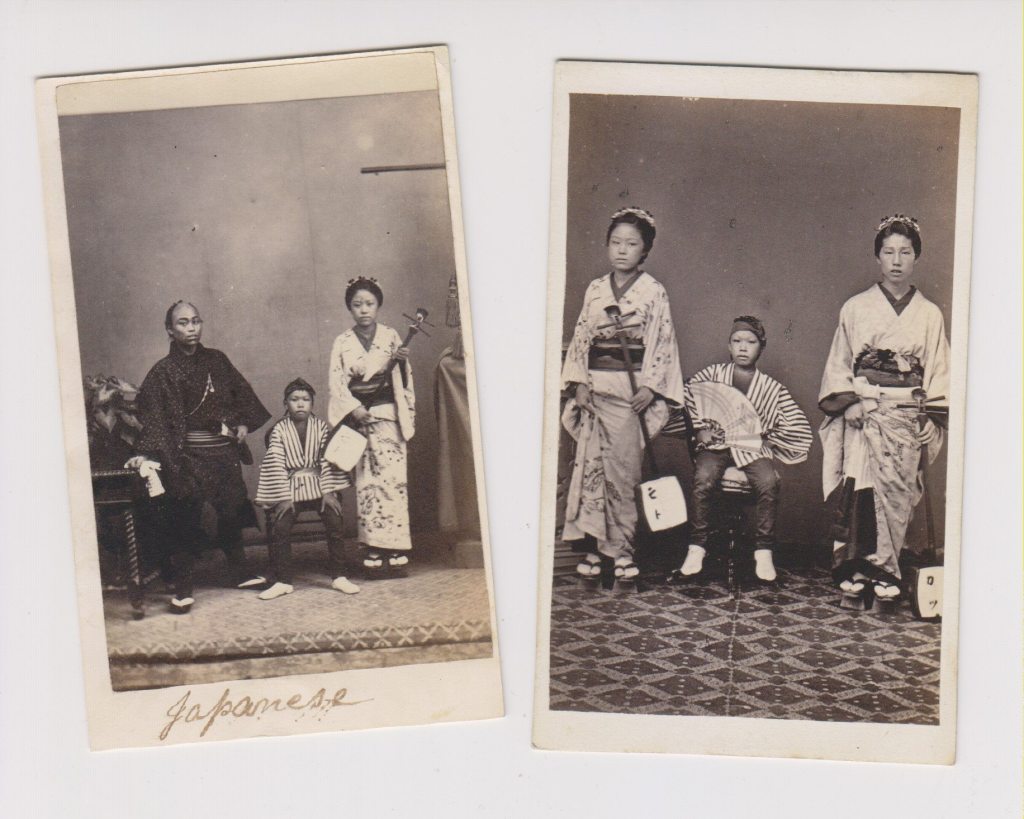
Above photos from Robert Sayers collection. Right hand photo, left hand label says Moto, right Katsu. Back of right hand photo says studio was in Surabaya. Rug and furniture differences between the two photos. Katsu may be Katsujiro, actually male? Man in left photo may be Chōnosuke – note he is carrying a fan or maybe two for the butterfly trick. Boy in the middle probably Chiyokichi.
1867 July LENTON & SMITH’S GREAT IMPERIAL DRAGON TROUPE Japanese Artists, of JEDDO, including Twelve Men and Three Women, co-opted for the enormous cost of $12,000 – Samarang, Java Bode
1867 July – Cuts-who-gero, Shingoro and Bungero mentioned in advertising – Java Bode
1867 July – debut of the beautiful Oh-What-Sue, child prodigy Che-o-kitchie and wizard Sicka-di
1867 FIRST TIME OF Cuts-Who-Gero, in her dangerous tricks on the POINTED BAMBOO of 12 feet. GEN-GE-RO in his Magic tricks, among which, for the First time, the Magic Fountain. (17 July Java Bode)
1867 July photographer H.M. Van Dorp advertising “Japanese types” from the Lenton troupe.
1867 27 July to 3 August – arrive in Samarang, stay at Hotel Pavilion. 12 Japanese men and 3 women from Batavia.
1867 August – Sic-e- die, Chingoro, Bungegoro, Che-o-kitchie
1867 August – “We do not know whether we should admire more the graceful, nicely conceived and artistic feat of making paper cut-out butterflies fly with a fan, or the youthful Che-o-Kitchie, who, gliding down a swinging smooth bamboo with a single push of his foot, suddenly becomes motionless, or the clever magic tricks of Eso-Kitchie and Gungero, who do not bore the spectators with their incessant showing of things, the plot of which is destined to remain a riddle, but who simply give proof of extraordinary skill, all with as much simplicity and grace as ridiculousness. Then there are two others, who by their astonishing feats show how long a Japanese can bear to lie on his back, until he has acquired the skill of balancing the most clumsy objects, such as barrels, tubs, umbrellas and screens, on the same pitch, throwing them up with his foot and catching them, or making them spin round with incredible speed. I pass over the most amusing and also very interesting performances with the Japanese spinning tops and with a jug, which as it were blindly follows the commands of its balancer, to end with praise for the Japanese Belle (?) Cuts-Who-Gero, who does the strongest tricks on the slack rope without a balancing stick, and among other things performs a dance, which not only testifies to her skill, but is also interesting because of her similarity, also as far as the music is concerned, with that of the ordinary native dancers, with this advantageous difference that the dancer does not shout along.” Sumatra Courant
1867 August 24 – “The Japanese artists have arrived here: there will be only 7 performances here, because Mr.
Lenton is pregnant with the plan to hasten with his company to the Paris exhibition, in order to catch a few more drops of the rain of frost that is now falling on the industrialists there, who understand their times and know how to strike while the iron is still red hot. If the entrepreneur were a Dutchman, he would probably agonize over the expenses of the mail journey until the favorable moment was over, and he, like Pieter Spa with his hat over his head, can slink home without having accomplished anything.” Java Bode
Java from Singapore – 4 men and 1 women of the Lenton troupe, McFarlane, 11 Japanese and 1 child of the Lenton trope (Nieuwe Rotterdamsche courant 28 August)
From Samarang to Singapore – Ferrari, two gentlemen Herbert, Lenton and family, Smith and family, Blackwall, Kirby, Ford, de Vries.
1867 August 28 – Mr. J. W. Smith, “manager” of the combined Lenton-Japanese Troupe, writes from Singapore, 23 August: We have been particularly unhappy at Samarang: two of the Japanese artists had a fever. Two suffered from thigh pain. “Shin-go-ro” the “ladderman” died here at Singapore on the 7th; he was buried in the European cemetery and many followed the funeral procession. On the 2nd we leave for Singapore. Bataviaasch handelsblad
1867 September – Lenton arrives in Calcutta.
1867 October – Lenton & Smith troupe in Penang with Gengero and his magic bottle, Cho-nos-kee, Gen-ge-ro playing flute while Chie okit-chie balances on bamboo and Cutswho-gero – Genjirō, Chōnosuke, Katsujirō and Chiyokichi
1867 October/November – Japanese troupe in Calcutta – do not get good audiences. Times of India – Friday 08 November 1867
1867 November 25th Avoca leaves Galle for Melbourne
1867 December 16th – arrive in Melbourne on the Avoca – 11 Japanese, Mr & Mrs Smith, Mr & Mrs Lenton, Mr Ferrari, Mr Kirby and Mr Herbert
1868 Jan-Oct – Lenton & Smith Great Dragon Troupe tour Australia.
1868 January – arrived in Melbourne from Calcutta – eight men and three women and one boy. Director – Eso kitchie, juggler and top spinner Gengero, pedal balancer Bungero, Butterfly’s Chonos kee, tub and ladders Sagero, slack rope Cats who ger o, walking on pointed bamboos Omato, perch and swinging bamboos Metaro and Che Okitchie, female perch performer – Ohatsue, attendant on circle
1868 4th January – March – Chonosuke – butterfly fanning, paper, umbrella tricks, Sagero balancing ladder on which Chiyokichi climbs. Bungero balancing feats with paper screens that a boy makes holes in while climbing, then becoming a beast in a mask. Bungero balancing tubs on which Chiyokichi climbs. Cuts-Who-Gero (NY-AC-CO onnayaku?) lady rope and paper walking. Gengero balancing bamboo poles which a boy climbs up while Gengero plays the fiddle. Gengero also does tricks with boxes and bottles and is a top spinner. O Hatsue his wife on the long bamboo or perche. Pretty girl of 14 who gives out photographs. 11th January first appeareance of Eso-Kitchi in various performance with cups, balls, eggs, umbrellas. 20th January Metaro, gymnast of Yeddo and versatile Fakeer. Yaske from 22nd – Japanese wizard and Fire eater. 23 January Omato pointed bamboo walking, Japanese paper. On Ra Or Vo in attendance.
1868 May – Australia – Described as 11 persons of 8 males and three females, two of whom are married women, the youngest of them being a very nice looking girl of 14 or 15, who has been a matron for upwards of three years. They appear to be most intelligent, and very anxious to obtain information as to the climate, customs, &c., of the countries through which they travel. They are under the immediate control of a chief or head of the party, and are accompanied by an interpreter. Wherever they have been they have drawn bumper houses, and there is no doubt but that they will do the same here. The bills and advertisements will show what they offer to the public.
Messrs. Lenton and Smith are the proprietors, and call their entertainment ” The Imperial Dragon or Troupe of Japanese ;— The following are the names of the Japanese :— Males—Eso-Kitchee, director ; Metero, swinging Bamboo ; Chee-noo-kee, Fakeer ; Gen-ge-ro, Juggler ; Bun-ge-ro, Pedal Balancer; Jars-kee, Ladder man; Che-o-kitchee, boy wonder; Cust-woo-gero, a female rope dancer ; O-No-To-a, a female musician; O’-hat-Sue, a female top-spinner ; and Sagero, a servant to the troupe. (The Tasmanian Times 11 May p 2) Then says 12 male and female artists.
1868 May – for Hobart from Sydney, Great Dragon Troupe P. Kirby Interpreter.
1868 May – Chiyokichi performing with Metaro on swinging bamboo. Sagero horizontal ladder.
1868 July – Omato/Omoto “wife of Metaro the bamboo swinging man” gives birth to a baby boy Ivanim/Iranim on board the Penola, during the troupe’s passage to Adelaide. His birth is recorded under the name of Penola Inimee/Juimee Metaro in Australia. “perhaps, the best looking (according to European notions) of the women of the troupe.”
July 1868 – from Jeddo, Osaca, Kanagawa, Simoda, Yokohama. Floral Tea House at Kava Saki (Kawasaki?). In their quaint and curious Hi Ko Nos. Bungero performing Hishida
Below is possible photo of Omoto on the left (looks similar to photo above) with Isokichi and Mitaro from Sisson’s papers. Middle photo is from Helen Lambert album, in Australia – it has been attributed to Lyster & Smith troupe in 1871, which did not have Omoto in it and does not fit the dates of Helen Lambert being in Australia (August 1867 to August 1870). Photo on right possibly Omoto, Katsujiro, Chiyokichi, Isokichi and Mitaro and unidentified Western male from Robert Sayers’ collection, taken in Bardwell’s studio, Ballarat, Australia. Great Dragon Troupe were in Ballarat Jan-Feb and Sep 1868. Tannaker’s troupe were in Ballarat Aug-Sep but the line up does not match his troupe of 3 men, 3 women. Were all three photos were taken in the same session? Middle photo has differences in shade of kimono edgings and bowtie. Right hand photo the women are wearing geta.
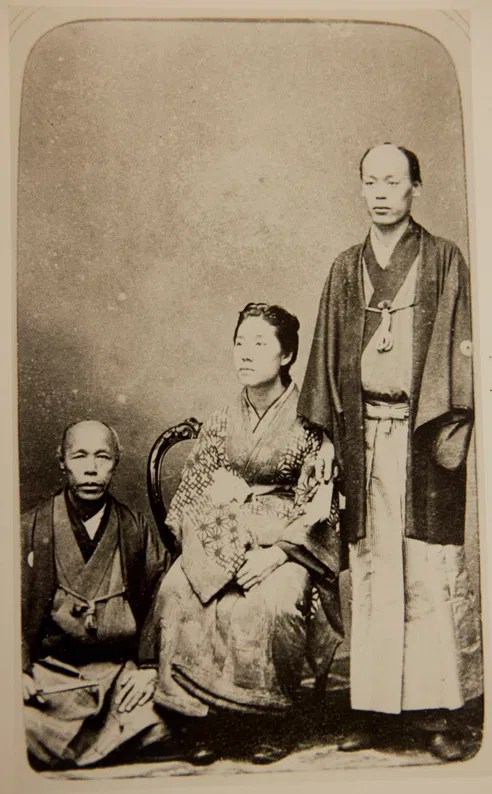


1868 September – Omato and her South Australian baby Ivanim are meant to appear in Ballarat on 2nd Sep but don’t
1868 October – Lenton & Smith troupe depart Victoria on the Otago for New Zealand with Mr & Master Kitchie aged 30 and 10, Mr Mitaro aged 19, Mr Bungero aged 21, Mr Sagero 18, Miss Cutswhogero 17, Mr Narshee 22, Ms Omoto 20, Ms Ohatsue 21, Mr Gingero 19, Mr Chonosuke 24.
1868 November – New Zealand – dance Cuts-who-gero, Mitaro and Omato. Bungero, Gengero, Sagero and the Cicerone Eso Kitchie
1869 Feb – Lenton & Smith Great Dragon Troupe end tour of New Zealand, return on the Hero – Mr and Mrs Lenton, Mr H Lenton, Masters Frank and John Lenton, Louis Ferrari, 11 Japanese and 2 Europeans of the Japanese troupe. Presumably one of the 2 Europeans was Phil Kirby
1869 March – Sydney to Melbourne on the Rangatira – Mrs Lenton, Master F Lenton, Master J Lenton, Mr Ferrari. Have commissioned Mr Kirby the interpreter and Gingero to engage another and still cleverer troupe to appear in Australia. The engagement of Gingero is necessitated by no foreigner being allowed to penetrate the interior of Japan.
1869 Mar – Lenton & Smith troupe leave Sydney for Shanghai on Huntly Castle – Eso Vitchie (Isokichi), Che O. Vitchie (Chiyokichi), Metaro, Sagero, Cho Nos Kee, Beenyero (Bungero), Yas Kee, Emato, Ohatsue, Cuts-Who-Gero, Gingero, P. Kirby.
1869 April Mr Thomas Lenton who has dissolved his partnership with Mr John Smith, takes upon himself the responsibility of introducing the next company of Japanese to this colony, and with that view is making his arrangements to depart for the East by the outgoing mail. He will be accompanied by Mr Herbert Skelton, Masters John and Frank, and Mr Gibson, as agent. They will make for Japan, there to await the arrival of Mr Kirby and Gingero from the interior, with the new company. Herald p. 3 17 April
1869 April – Mr & Mrs Lenton depart Victoria for Pont de Galle for Yokohama with Mr G. Gibson, Mr Herbert and two boys.
1869 April – partnership with John Washington Smith dissolved by mutual consent.
“all the Japs. have arrived here safe and sound, and thoroughly disgusted do they feel with their own country. One could re-engage them on almost any terms – in fact they would leave their own country on the slightest inducement. The rope-walker wants to engage himself with me as a house servant, and all the others would do anything rather than go to the old business in Japan. Kirby is trying very hard to get up a new company. He has been in Yeddo and has sent a man to Osaca to get him something quite new, which he probably might do, but it will take time to collect a good company. As Mr De Roza is assisting him, if a company is to be obtained Kirby will do it.” (Possibly George Gibson, letter to John W Smith)
 Ninjin