

“Der Hang” – used by William Peppercorn from 1867 to 1873. He then went by the name of D’Alvini.
William Peppercorn was the son of an artificial florist, William Peppercorn (1822-1908), and Angelina Giovanelli (1820-1881 – daughter of an artificial florist Gregori Giovanelli who was born in Tuscany in 1777). He was born 1845 in Clerkenwell and baptized at St Mark, Myddleton Square in February 1846.
Angelina’s brother Alfred Giovanelli (1838-1921) was a clown who headed the Giovanelli group of pantomimists active in Britain from the 1860s to the 1890s. Another of Angelina’s brothers, Edward, was proprietor of the Highbury Barn pleasure gardens and built the Alexandra Theatre in London.
Peppercorn was apprenticed as a child to Powell & Clerk’s circus, with whom he stayed until he was 18, as a bicycle rider and gymnast, travelling around the world.
He later claimed to have gone to Japan, with Sanger’s Circus (in HJ Burlingame’s book of 1891 Around the World with a Magician and a Juggler), which was where he had the idea of bringing a troupe to Britain and it was with this troupe that he learnt juggling and legerdemain. These acts sound like the Matsui Gensui Troupe – many members of whom would have been active in Yokohama if Peppercorn was there in the early 1860s.
There is no record of Sanger’s Circus ever having visited Japan. The Sangers did start to claim they had a Bedouin Arab and Japanese troupe, from March 1867, just after the Matsui Gensui troupe started to perform in London.
It seem more likely that Peppercorn was with the Western circus troupe that Professor Risley took to Japan in 1864. Perhaps Peppercorn was one of the “Italian Brothers”, who were gymnasts in the troupe.
Risley had a contortionist on his troupe called D’Evani, a British man originally named John Evans (b 1833), who had “frenchified” his name, which could have influenced Peppercorn to do the same, as D’Alvini.
Risley’s circus fizzled out in Yokohama in the summer of 1864 and many members left Japan, which would fit with Peppercorn having returned to Britain in time to marry Eliza Jane Powell in September 1866.
Risley also brought some members of the Matsui group on tour with his Imperial Troupe, to the USA and Europe and then to Britain in December 1867. The Matsui Gensui Troupe arrived in Britain before the Imperial Troupe, in February 1867. D’Alvini only started performing in Britain as Der Hang, a Japanese top spinner and performer of butterfly tricks after the Matsui Gensui Troupe left for France in July 1867.
D’Alvini claims he brought back a troupe of 14 Japanese men, women and children, to tour Europe, for five years, and then sent them back to Japan, after which he organised another troupe of European Japanese. The Risley Imperial Troupe had 18 members, 12 of whom were performers. The Matsui Gensui Troupe had 14 members who were issued passports, although 3 did not leave Japan. The Japan side arrangements for the Matsui troupe were made by Glasgow-born William Grant, a young man of very similar age to Peppercorn, who had been in Japan since 1862, working as a ship broker. Perhaps Peppercorn and Grant met in Yokohama, and then worked together on the logistics, financing and management of the Matsui troupe.
Peppercorn’s description in an interview in the Chicago Daily News of 1886, of appearing in San Francisco first, with the Tycoon troupe, then directly on to London confuses the matter further – Risley’s Imperial Troupe appeared in San Francisco in January 1867 but then spent several months on the east coast of the USA before going to Paris for the Exposition Universelle and then on to London.
Tannaker’s Tycoon Troupe did not go to San Francisco at all in the 1860s. Peppercorn could have been referring to the Tetsuwari Troupe, which was meant to appear at the Paris Exposition in 1867, via showing in San Francisco in December 1866, but the troupe never made it and instead continued to tour America in 1867. It was by that point partly owned by a San Franciscan impresario, Thomas Maguire. Maguire also helped finance Risley’s Imperial Troupe that year.
Or Peppercorn may have been conflating the Matsui Gensui Troupe with the Great Dragon Troupe, which performed in San Francisco in June 1867, and then came to Britain in August 1867 – October 1867, then May – July 1869, and then returned to Britain in September 1869, then combined with Tannaker’s Tycoon Troupe in 1871.
Whatever the case, Peppercorn cannot have left Japan with any of the troupes in 1866-7, as he was in Britain at that time.
There is a blank in the British newspaper records for “Der Hang” from February 1868 to January 1869. He then appears as Derhanusyn/Dherongyada in Tannaker’s Tycoon Troupe for a year to May 1870.
He later appeared with the Great Dragon Troupe in 1873 and then for two more years from 1874-5 with Tannaker, before performing independently from 1876 through to his death in 1889 as D’Alvini, a Japanese juggler and equilibrist and “Jap of Japs”.

TIMELINE
1856 – 1859 Dehrang & Stebbing – gymnastic performances, in Australia
1862 Oct – Mons Dehrang, juggler, Apollo Hall, Melbourne (Magical Nights at the Theatre – Charles Waller p 32/The Age 7 October 1862 p 1) Chinese juggling and balancing.
1864 March – Risley arrives in Yokohama with his Western circus.
1864 July – Risley’s circus members leave Japan
1866 30 September – William Peppercorn, artificial florist, son of William Peppercorn, artificial florist, aged 21 married Eliza Jane Powell aged 20, daughter of a carpenter, at Holy Trinity, Hoxton. Residing at 15 Eden Place, Ivy Lane.
1867 February – June – Matsui Gensui troupe perform in Britain, then depart for France
1867 June – Der Hang appeared with Quaglieni’s Italian Cirque in Newcastle. “The Japanese juggler will introduce the Marvellous Top Spinning and Butterfly Illusion”
1867 July – Glasgow – Der Hang, the extraordinary Japanese juggler
1867 July – Der Hang – “wondrous Japanese juggler” – Quaglieni’s Italian Circus in Dundee “late of the celebrated Japanese troupe” – which suggests Matsui Gensui’s troupe, which had just finished performing in Britain.
1867 August – Blackburn – Newsome’s Circus – Der Hang wears the Star of the Legion of Honour, which if applied to deeds of dexterity, he has well merited.
1867 September – Liverpool – Decided Hit of Der Hang – the great Japanese top spinner
1867 September – daughter Jessie Eliza born
1867 October – Baldwin & Gilbert part of Great Dragon Troupe leave Britain to tour Europe
1867 November – Aberdeen – “his performances are almost incredible and have to be seen to be believed” Quaglieni’s Grand Italian Cirque – The inimitable Japanese top spinner!!! – butterfly illusionist!!! and wondrous juggler!!!
1867 December – New York
1868 January – Hull “Top Spinner to the Tycoon”
1868 November – Tannaker’s Royal Tycoon Troupe arrive in Britain.
1869 January – Newcastle “Der Hang’s butterfly trick is astonishing”
1869 February – first mention of the “Yeddo fly wheel” – as part of Tannaker’s Royal Tycoon Troupe’s performance.
1869 May – Great Dragon Troupe reappear in Britain then go on tour in Europe again
1869 July – Carlisle – Der Hang the Wonderful Japanese Top Spinner and Manipulator. The Marvellous Feat of Shooting a Match off the top of a Man’s Head. Egg-Spinning Extraordinary. The Yeddo Fly-Wheel
1869 September Great Dragon Troupe reappear in Britain
1869 October – Ada Emma Peppercorn born – dies a few months later
1869 October – Tannaker is indisposed and a “Derhanusyn” performs with the Tycoon Troupe of Japanese performers in Sheerness. “Derhanusyn also gave some strange performances with the “firewheel” dagger throwing, balancing a large metal ball on the point of a spear, the ball being caught after being thrown up to a considerable height. Another of his feats was making a common towel stand upright of itself, and balancing it on his nose and chin in a variety of ways.”
1869 November – Chelmsford “The performers consisted of five Japanese—two men and three girls—and one Englishman. Whether the Englishman was intended to be palmed off as a Japanese or not it is hard to say. We only know that his style and title on the programme was “Dherongyada,” and that he adopted, partly, Japanese costume in dress. The deception, however, if deception it was, was amply compensated by the great dexterity and ability with which he performed the several feats allotted to him.”
1870 May – William Grant in charge of Great Dragon Troupe
1870 May – Ulverston – Orantoroto – an Englishman who did the butterfly trick
1870 June – Der Hang just completed 12 months’ engagement with the Royal Tycoon Japanese Troupe, is now at liberty with his marvellous performances – shooting a lighted match off the top of a man’s head, out of his hand, wonderful egg and top spinning, never before seen in this country. Address 65 Berwick Street, Oxford Street, or Messrs Parravicini and Corbyn, agents.
1870 July – Huddersfield, Der Hang, great Japanese juggler
1870 August – Der Hang the marvellous manipulator
1871 April census – William Peppercorn is living with Jane and their 3 year old daughter Jessie, occupations for both William and Jane given as artificial florist, at 15 Eden Place, Hoxton.
1871 July – Leonard Peppercorn born, dies a few months later.
1871 September – the Great D’Alvini, on the invisible tight wire, introducing the bowls of fish, hat spinning, juggling, walking the wire in a sack and amidst a shower of fireworks. Mons De Vere, 63 Coppice Row Clerkenwell. (The Era 24 September, p 16)
1872 July – Earlswood – Der Hang the great juggler
1872 November – Brighton – Monsieur and Madame Der Hang, The Great Oriental Top Spinners and Balancers
1872 December – Der Hang and Minnie Hang, who were elegantly costumed, exercised their skills as top spinners and balancers – and produced a pretty effect with twirling lighted torches – Middlesex theatre, London
1872 December D’Alvini & Clarke go to Egypt for seven weeks. Parravicini and Corbyn are agents.
1873 January – Bath, Wales (no mention of being Japanese)
1873 February – Oriental Wonders Mons and Madame Der Hang, in their new and chaste entertainment, of marvellous balancing, top spinning and double fire manipulation; especially engaged with the Great Dragon Troupe of Japanese for three weeks. Now appearing at the Victoria Rooms, Sunderland
1873 March – Sheffield, then Birmingham. “wanted, a boy of 6 to 8 years”
1873 April – Birmingham “oriental enlivening entertainment”
1873 May – Herr and Minnie Der Hang, Middlesex Theatre London
1875 December – D’Alvini’s Classical, Oriental and Japanese Entertainment. Great Block Manipulation Just finishing two years tour with Tannaker’s Japanese Troupe.
1876 January – D’Alvini, the Imperial Japanese in Scotland. New Oriental and Japanese entertainer and Great Block Manipulator, late principal of Tannaker’s troupe. 16 Canal Road Hoxton.
1876 February – Mons and Madame D’Alvini (Japanese jugglers)
1876 Starts advertising as “Jap of Japs”
1877 Continues to refer to himself as Japanese juggler or equilibrist
1877 June – D’Alvini and Son/and Little Oracke. Just arrived from Jeddo. The Great Nepom Pom Losick Pom.
1877 Performs in Spain
1878 Performs in France, Spain, Portugal
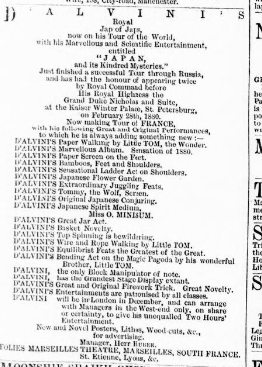
1879-1880 Tour of the world as “Jap of Japs” “Japan and its Kindred Mysteries”
1880 June Folie Bergeres Paris les jongleries japonaises D’Alvini
1880 Aug-Sep Austria D’Alvini
1881 April census – Eliza is living in Hoxton with her mother and her daughter Jessie. Artifical florist.
1881 April-May in France
1883 Performs in Spain “Jap of Japs”
1884 in Trinidad, Barbados
1885 in St Lucia, Jamaica, Antigua with Tom O’Kitchie, the missing link
1889 died July 3rd in USA, of abscess on the brain and typhoid leaving an “estimable wife with four small children” – which suggests he may have remarried (The Era, 20 July 1889 p 15). (HJ Burlingame’s book of 1891 Around the World with a Magician and a Juggler, published by Clyde Publishing Co, Chicago, says he died in 1891, in Chicago and is buried Oakwoods cemetery. Cemetery records and The Era state it was 1889)
Illustrations credit and more details here https://www.juggle.org/dalvini-juggler-and-magician/
 Ninjin