
身分 Status and history
Daikagura were originally a two-man shishi (lion/mythical beast) masked dancing team with a drummer and a flautist who performed at shrine festivals. They were supposed to frighten off any evil spirit blocking a holy procession.
Daikagura can be written as 太神楽 or 大神楽 depending on the region of Japan – but another theory is that the “dai” is also written as “代” or substitute – that the lion dance was substituting for the Shinto gods.
Kagura 神楽, meaning holy dancing, was said to originate from when the sun goddess Amaterasu hid in a cave, disgusted by her brother Susano-o’s violent and rude behaviour, causing darkness to fall upon the earth. Another goddess, Ame no Uzume, managed to lure Amaterasu out of the cave by the laughter of the other gods at her dancing.
The Atsuta shrine (in Aichi prefecture) daikagura were the first to travel to Edo in the 17th century, and then the Ise shrine daikagura followed.
By the 18th century the Edo based Ise shrine and Atsuta shrine daikagura “relied on their bakufu sanctioned, semiautonomous Edo occupational associations.”
There were around 12 houses or groups (kumi) in the Ise and Atsuta organisations by the mid-18th century. Headships in the Atsuta daikagura were rotated annually. They retained their townsperson mibun (status) and submitted family registries to city administrators. Their occupational status was handled by the magistrates of temples and shrines.
By the 19th century they were performing in tea houses, variety halls and kabuki theatres.
The Kagami/Maruichi troupe were from the Atsuta shrine originated group.

Acts
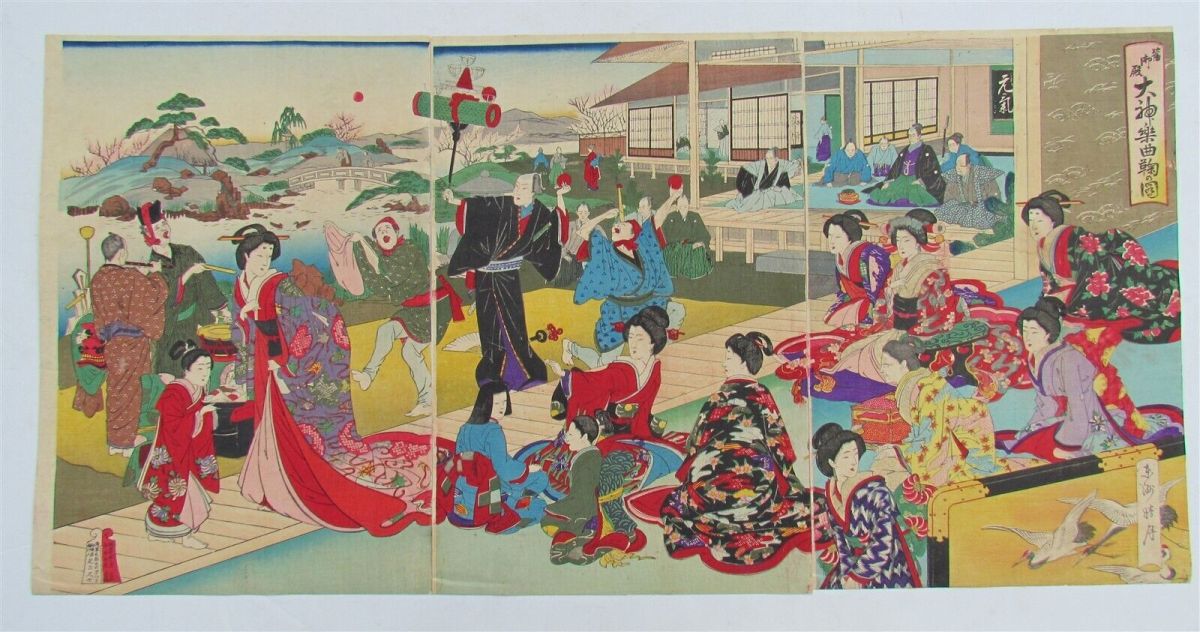
By the 17th century many daikagura had added juggling of drumsticks and also kagomari – juggling with balls and a basket like tube on a stick – to the lion dancing. Later additions were plate spinning and using parasols on which a variety of rings and bowls were spun.

Daikagura in Britain
Masukagami Isokichi, leader of the Lenton & Smith part of the Great Dragon Troupe, which included Kagami Katsugoro and Kagami Godaiou
Maruichi Brothers (Kagami Sentarō)
Daikagura in Japan
Videos
Ise Shrine Daikagura
See pp162 – 69 in Street Performers and Society in Urban Japan 1600 – 1900 : The Beggar’s Gift – Gerald Groemer
 Ninjin