Karuwaza is a general term covering what in the West would be called acrobatics – such as juggling, wire walking and perche acts. Karu 軽 means light, or agile, waza 業 is trick or business. A secondary meaning is “risky business”.
Acrobatics are said to have been brought to Japan from China in the seventh century. Records from that time show that popular arts (both acrobatics and conjuring) from China were known as sangaku 散楽.
During the Muromachi period (1392–1573) a form of acrobatics – largely wire walking and paper walking – called “spider dancing” 蜘蛛舞 (kumomai) was sponsored by aristocrats and military leaders as a type of religious entertainment and incorporated into kabuki. When women (who were usually courtesans) were banned from performing in kabuki in the 17th century, these roles were taken over by young boys aged 11 to 15.
During the early Edo period (1615-1868), Japan became increasingly urbanized and commercialized and acrobatics began to be performed in urban areas as a kind of commercial enterprise for the enjoyment of all classes of society.
When performed by outcastes in the Edo era, juggling and acrobatic feats were known as 放下(hōka, symbolizing “release” and something “below”). According to some, because of the religious connections of many performances, this may also refer to Zen Buddhist monks “releasing” themselves into earthly relations, to a low level in society.
In Britain
Many of those Japanese performers who settled in Britain and elsewhere in the 19th century were tightrope/slack wire walkers (often men dressed as women), feet equilibrists and jugglers – they may also have started their careers as children who were kakubeejishi:
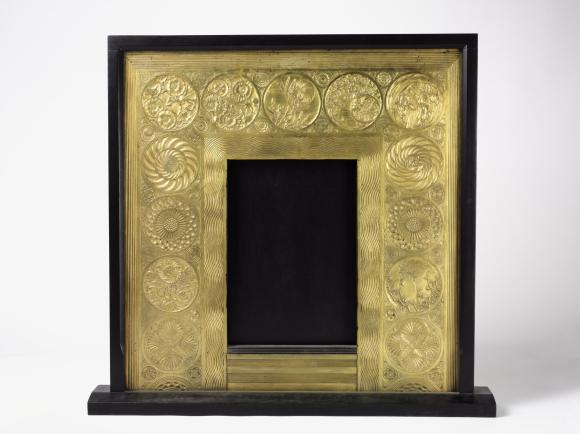
Thomas Jeckyll was born in 1827 in Wymondham, Norfolk, to Maria Ann (Balduck) and George Jeckell, a curate. Although he never visited Japan, he became a leading light in spreading japonisme in Britain through his architecture and metalwork designs.
Thomas Jeckyll fireplace from around 1873 – Victoria & Albert Museum
He set up an architectural practice in Queen’s Street Norwich in 1853, between the castle and the cathedral close. Through his cousin Peter Bloomfield Jeckell junior, who was living in London, he became friends with artists such as James Abbott McNeill Whistler and George Du Maurier. He moved his practice to London in 1857 but continued to undertake work for Norfolk clients and maintained his membership of the Norfolk and Norwich Archaeological Society.
The first evidence of Jeckyll’s interest in Japanese and Asian art were the wrought iron gates that he designed for the Norwich iron manufacturers Barnard, Bishop and Barnard, that were exhibited first at the Exposition Universelle, Paris in 1867. The bottom panels of the gates feature stylized Japanese flower and bird motifs. These gates are now at the Austrian Museum of Applied Arts.
Gates designed by Jeckyll featuring the traditional Japanese pattern “seigaiha” (blue sea and waves) can be seen at the Sprowston Manor Hotel and Golf Club and also in the entry porch and garden wall of High House Thorpe St Andrew.
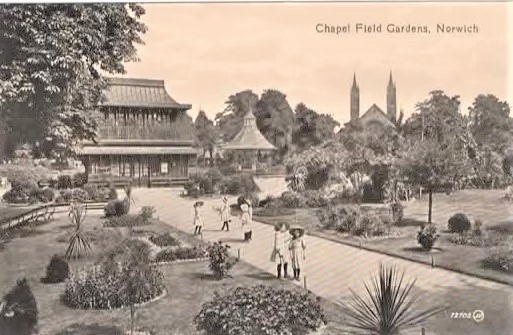
Unfortunately not many of Jeckyll’s Japanese influenced buildings or architectural details survive – the Boileau Fountain which had seigaiha panels and the Chapelfield Gardens Pagoda in Norwich have been pulled down.
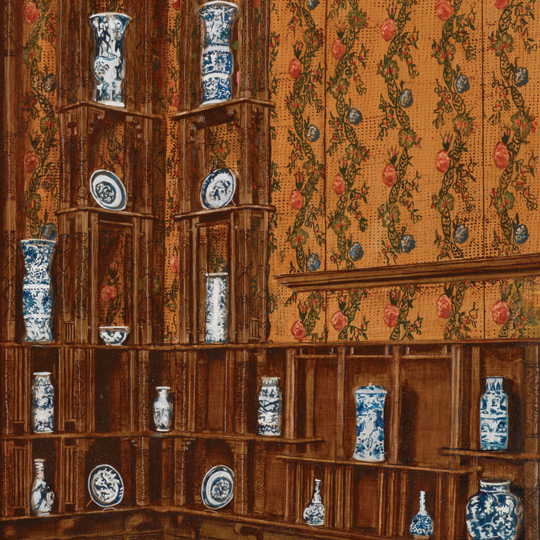
His most famous design was for The Peacock Room in London for the shipping magnate Frederick Richards Leyland. It was meant to be a dining room, in the porzellanzimmer style with shelving for Leyland’s collection of Chinese blue and white porcelain. Jeckyll hung it with panels of antique leather decorated with red roses said to be from a Norfolk Tudor Hall, made to celebrate Catherine of Aragon’s marriage to Henry VIII.
Jeckyll succumbed to the mental illness that had been troubling him intermittently for some time and had to stop his work, entering Heigham Hall, a private asylum just outside Norwich in November 1876. Whistler took over, overpainting the leather panels to create a unified design in blue and gold.
Peter Nelson, 1876
Jeckyll never recovered sufficiently to create any further designs and died in 1881. Barnard, Bishop and Barnards began “endlessly recycling his popular and profitable designs” in iron, with the result that you can still easily buy Japonisme style antique fireplaces and ironmongery designed by Jeckyll and manufactured by Barnard Bishop and Barnards to this day. Examples, photographs, advertising and designs are also on display at the Musum of Norwich Bridewell.
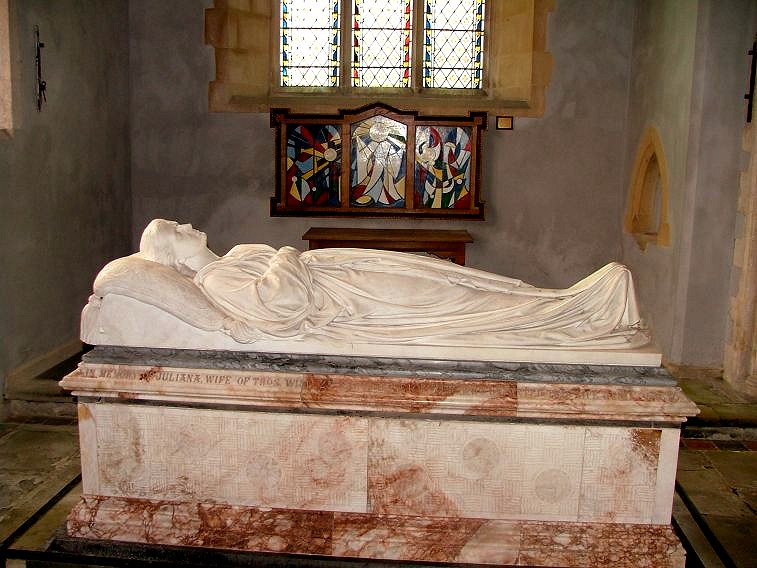
Should you be in North Norfolk, you can also see the monument to Juliana, Countess of Leicester, in St Withburga’s church on the Holkham Hall Estate, where the marble panelling on the base is distinctively Jeckyll and Japanese.
For more on Jeckyll, and plenty of photos, see Jeckyll and the Japanese Wave on the wonderful Colonel Unthank’s Norwich website.
Frederick Ringer was born in 1838, the third son of John Manship Ringer and Ann (née Smith).
John Manship Ringer was a grocer and merchant who was born in 1798 in Blofield, Norfolk of John Ringer and Elizabeth Manship. His younger brother William Smith Ringer was also a grocer, in Wells. John Manship moved to Norwich around the time of his marriage to Ann Smith in 1831.
Initially John Manship Ringer had a grocery and lived in St Martin’s at Palace Plain from 1831 to 1838, with his parents, John and Elizabeth. He announced his arrival in the Norwich Mercury as follows:
TEA, SPICES, & GROCERY, CORNER OF THE PLAIN, ST. MARTIN’S PALACE. J. M, RINGER HAS the pleasure to announce his Friends and the general community of Norfolk and Norwich, that he has taken premises as above, when it will his ambition and study, to vend articles of such quality as not need a long list of extravagantly low prices to recommend them to the notice of his patrons.
J. M. R. has had long practical experience in the Tea and Grocery Trade, considers himself acquainted with the best Markets, will be satisfied with fair remunerating profits, pledges himself strict personal attention, and relies with confidence on a liberal public for support.[1]
His first son, John Melancthon Ringer (the strange middle name may have been a reference to a German Lutheran reformer of the 16th century) was born in 1832 and baptised at St Margaret’s Baptist Chapel in what is now Three King Lane off Pottergate.
In March 1835 John Manship and Ann had a second son, Sydney Ringer, who would go on to become a distinguished clinician, physiologist and pharmacologist, at the University College Hospital in London, best known for inventing Ringer’s solution. Sydney was also baptised, a year later, at St Margaret’s Baptist Chapel.
The business also seems to have been expanding, and in December 1835 Ringer placed a classified advertisement for “a steady active young man”, as an assistant, for JM Ringer, tea dealer and grocer.[2]
Pratt and Ringer
In April 1838 John Manship announced in the local papers that he had formed a partnership with William Pratt (1800 -1865), a cheese factor and wholesale grocer. Pratt had been in a partnership with William De Caux senior (1779-1841) and junior (1805-1881), and was married to Priscilla De Caux, daughter of William De Caux senior. The De Caux family had come to Norwich around 1640-1660, from Normandy, and were almost certainly Huguenots, fleeing the persecution of Protestants.
Priscilla died at the young age of 27, in February 1835 “after a lingering decline of more than 2 years”. William De Caux senior retired from the partnership in July of the same year, announcing that he would continue to assist Pratt with the purchasing of cheese.
The business had a warehouse on Wensum Street since 1829, and Ringer moved his family to De Caux Court, on Wensum Street, after the formation of the partnership. His father, John and mother Elizabeth continued to live on St Martin at Palace Plain and the premises were run by their grandson, the 20 year old Samuel Browne. Samuel Browne’s sister, Caroline, was married to Thomas James Pratt
Just before the move, Frederick Ringer, John Manship’s third son, was born, on 3rd April 1838, in St Martin at Palace parish. There is no record of his baptism however, nor of John and Ann’s only daughter, Emma Jane, who was born in 1840.
From 1838 onwards Pratt & Ringer placed many advertisements in the local Norwich papers to the grocery trade announcing the arrivals of cargos of North American, Canadian and Dutch produce such as beef, pork, hams, cheese.
The Ringer family fortunes took a turn for the worse five years later, however. In 1843, Emma Jane Ringer, John Manship’s only daughter, died on January 31st, of scarlet fever, aged 3.
In April of that year it was announced in the local papers that Pratt & Ringer was being dissolved, due to very ill health of John Manship Ringer and his retirement.[3] On July 1 1843 John Manship Ringer died, aged 44. A notice in the Norfolk Chronicle stated “As a man and a Christian his uniform and consistent deportment gained him universal esteem”. [4]
According to the 1851 census, Frederick, aged 13, was living with his mother and brother Sydney in Colegate Street, with two servants, so clearly they were still able to maintain a reasonably prosperous lifestyle.
Frederick’s eldest brother John was an apprentice to a grocer in Newland Street, Witham. Presumably Frederick continued at school, and by the 1861 census, Frederick Ringer had become a pupil on a farm in Aston, Hertfordshire, aged 23.
Shanghai and the tea trade
Frederick’s older brother John Melancthon Ringer had moved to Shanghai by 1862, working as a tea inspector for Rothwell Love & Co.[5] He eventually became a partner in a leading foreign business enterprise there, Drysdale, Ringer & Co, which was a driving force in the development of projects such as the Shanghai Waterworks.
It would have been an exciting but dangerous time to be in Shanghai. The Taiping Rebellion had been rumbling on since 1850, and in 1860 there was an attempt to take Shanghai and again in 1862. Perhaps John Melacthon’s Eastern adventures made a career in farming seem rather dull and unappealing by comparison, as a couple of years’ later Frederick had given up the apprenticeship and moved to London to join the tea trade. His older brother Sydney was already practising at the University College Hospital there, so it may have been that they lived together for a year or so.
The Ringer family have a silver trophy inscribed with “West Brompton Cricket Ground, foot races, 27 June 1863, the gentlemen of the tea trade only, Won by F Ringer Esq. 250 yards”. Bell’s Life in London and Sporting Chronicle reported on the races as being of “several young gentlemen connected with the tea trade” with Mr F Ringer the winner of 250 yards.[6]
Frederick Ringer was also a keen rower, and as a member of the West Brompton Rowing Club he took part in further running races in September 1863, coming second in the 250 yards. Ringer also acted as a master of ceremonies. [7]
It must have been shortly after this that Frederick joined his older brother- possibly he was the Mr Ringer on the January 4th 1864 ship to Hong Kong, as reported by the Homeward Mail in December 1863.
Thomas Glover
In 1865 an F Ringer was recorded as a tea inspector in Kiukiang working for Fletcher & Co.[8] It seems he was headhunted around that time by Thomas Glover, who had opened a branch office of Glover & Co in Shanghai and brought Ringer to Nagasaki to expand tea production in Japan. Political disturbances in northern China had affected tea production there and as a result, exports of tea from Japan quadrupled from 1864 to 1866.
On 2nd November 1868, Edward Z Holme and Frederick Ringer, along with former Glover & Co employee John C Smith announced their decision to take over the tea-export business conducted to date by Glover & Co and to launch a new business enterprise – Holme, Ringer and Co.
Ringer’s house built in 1868, acquired by Ringer in 1874, where he lived from 1883
Ringer acquired the rental rights to No 33 Oura in Nagasaki and took over the operation of a large godown. It had brick kamado fireplaces where the raw tea brought in from the countryside was dry fired over hundreds of shallow pans. They faced strong competition from Chinese merchants, however. Tea declined in importance for the Holme Ringer business, as they diversified into other business such as tobacco trading.
Ringer became active in the local business community, putting pressure on the Japanese authorities in the 1870s, to dredge the Oura river and maintain roads, walls and gutters.
Sport and shooting
Foreigners could only visit the interior of Japan with a passport, for reasons of health, and Ringer regularly asked the British consult to assist with him in gaining approval for his tours inland. He visited hot springs and also collected natural history specimens, including birds which were stuffed and donated to the Norwich Museum.
Ringer and other foreigners also shot birds in the region for sport, which was a new concept in Japan. Many of these snipe and pheasant were also turned into food for foreign dinner parties. [9]
Frederick Ringer became involved in sporting activities in Nagasaki, particularly the boat races and athletics which were started there. He was also the Honorary Secretary and Treasurer of the Nagasaki Amateur Dramatic Corps. The admission fee collected at the door of their musicals and plays was used for the upkeep of a theatre at No 31 Oura.
In 1883, at the age of 45, Frederick Ringer married Carolina R Pye, the 26 year old widow of Edmund Pye, late of Amoy, China and returned to England with her on honeymoon – his first time back in 19 years.
Ringer’s donations to the Norfolk and Norwich Museum
In 1882 Frederick donated a specimen of glass rope sponge from Japan to the Norfolk and Norwich Museum along with “Seventy-six specimens, including species of birds from Nagasaki, South-west Japan ; amongst which are the following :—Phasianus soemmeringii (copper pheasant), P. versicolor (green pheasant) Oreocincla varia (White’s Thrush), Cisticola schoenicola (grass warbler) Butorides macrorhyorchus (striated heron) Aix galericulata (Mandarin Duck), Anas Formosa (Baikal Teal), Buteo japonicus (Eastern buzzard), Pandion haliaetus (western osprey), and scops semitorques (Japanese scops owl).”
He gave 43 specimens of birds of prey to the museum in 1884, including eleven species from Nagasaki, [10] and in 1885 he donated 4 specimens of Accipiter ninus [Eurasian sparrowhawk – nisus rather than ninus] and 7 other birds of prey. [11]
In 1887 the Norfolk and Norwich Museum committee voted to give thanks to F Ringer Esq of Nagasaka Japan for 15 birds’ skins.[12]
An 1888 meeting of subscribers of Norfolk and Norwich museum noted that “the more perfect a collection became the more difficult it was to fill up the few gaps which remained. One was a specimen of the largest owl known, from Japan, named after the discoverer, a Norfolk man, Captain Blackiston. Mr F Ringer of Nagasaki had promised to obtain another specimen in the wild state”
Thomas Blakiston was an English explorer and naturalist who was born in Hampshire, not Norfolk, and was in Japan in the 1860s to 1885 when he then moved to the USA. He collected an owl specimen in Hakodate in 1883 – which was named Blakiston’s fish owl.
In the 1900s, Ringer began to donate artefacts other than stuffed birds to the Norwich and Norfolk Museum – such as Japanese gold and silver coins, a magic mirror and a necklace.
The Norwich Mercury noted in 1902 “the case of Japanese curios, presented by Mr. F. Ringer, of Nagasaki, Japan, native of Norwich. The Japanese specimens will be found in a case between the embrasures on the southern side of the Keep. A number of gold coins are attractive for more reasons than one. The older examples are in the true Oriental style, while the more modern specimens show the influences of the Occident. One of the older coins is a large oval gold piece, minted 1601, and bearing the signature of the Japanese Chancellor of the Exchequer. The alloy consists of 79 per cent, of gold and 21 per cent, or silver, and the face value of the coin is £25. Four other coins well minted and milled date from 1872. Their Japanese value is 20, 10,5,2, and 1 yen, the English equivalent being £4, £1,8s., and 4s. These coins contained excessively large quantity of gold in the alloy, and the result was that foreign speculators bought them wholesale, shipped them to other countries, and had them melted down, as the intrinsic value of the metal in each was worth much more than their face value. There are examples of paper money worth one-twentieth of a penny issued in 1807, when the value of one was sufficient to feed family on rice for week.”
“Numismatists are acquainted with many strange forms of currency, but probably few are stranger than the Chinese silver shoe here exhibited. It was taken during the looting of Pekin in 1900, weighs 41bs., and has a value of £10. To maintain the value of this coin, weighing more than a quarter of a stone, there is a small silver makeweight the side. In the left hand bottom corner of the case are two Chinese coins—if such they can be called—at least 1,000 years old. One is shaped like razor blade, and is plain; the other like a knife, with Chinese characters thereon. Both are of copper, with hole in the handles for stringing. Genuine specimens of the first issue of Japanese postage stamps will interest philatelists, and there are also a number of coins of minor value.”
“But the exhibit which will undoubtedly occupy the largest place in popular esteem is a Japanese magic mirror. It is made of highly burnished bronze, and when a strong direct light shines upon it, in the reflection is a plain image of Buddha. This mirror is about 300 years old, and English savants have confessed themselves entirely unable to explain by what property apparently plain mirror reflects image of Buddha. It is example of the marvellous craftsmanship with which the metal workers of the East have always been able to astound the nations of the West. The top right hand corner of the case contains bead necklace said to have been worn 2,000 years ago the royalty and nobility of Japan. It consists of alternate straight and crooked beads of dull glass, evidently of extreme antiquity. The one piece of metal in it is a small circlet of gold and copper, in which the process of annealing was imperfect, and the copper portion has slightly corroded, while the gold part is quite bright. Beneath it is Japanese bank-note, bearing a representation of their famous Queen Jingo Kogo, who reigned about 190 a.d. She is wearing a necklace of the same pattern as that exhibited. Although the specimens this case are not very numerous, they are exceedingly choice, and show the kindly interest taken one of the far-away sons of Norwich in the place of his nativity.”
In June 1907, the Eastern Daily Press noted another donation from Ringer:
“A CASTLE MUSEUM TREASURE. Mr. – R Lydekker. F.R.S., of the British Museum, rates in this week’s issue of “The Field”)—By the courtesy of the authorities of the Norwich Castle Museum, I have recently had an opportunity of inspecting a gigantic skull of a grampus or killer (Orca gladiator), preserved in that collection, which I believe to be a record in the matter of size, at all events, so far as this country is concerned.
The animal to which it belonged was taken off the south-east coast of Korea, near Urusan (north of Fusan), by the steam whaler Volga, in 1905, and the skull itself was presented to the Norwich Museum by Mr. Fredc. Ringer, of Nagasaki, Japan.
Measured from between the occipital condyles to the extremity of the muzzle, along the palate, the total length of this skull is 46 inches. The largest specimen in the collection of the British Museum appears to be one taken many years ago off the Essex coast, the length of which, according to Gray’s Catalogue of Whales and Dolphins, is 53 inches. These dimensions are, however, considerably exceeded. according to the same work, by the skull of a skeleton in the museum of the Royal College of Surgeons the length of which is stated to be 41 ½ inches. That skeleton, according to Sir William Flowers’s Catalogue of Mammalian Osteology in the museum of the Royal College of Surgeons, is from a killer taken in the year 1759 off Gravesend. The skeleton, as mounted, measures a little over 21 feet, but the animal itself is stated to have measured 24 feet. If the latter dimension be correct, the Norwich skull apparently indicates an animal of between 25 feet and 30 feet in length, which is probably the largest on record. Sir William Flower was inclined to doubt whether these whales ever reach so much as 24 feet, but Mr. Beddard, in his book of whales, gives the limits of length at between 20 feet and 90 feet. although it is doubtful if he had any definite record of a specimen of the reputed maximum.
The skull to which the above notice refers is exhibited in one of the cases containing the collection of skeletons in the Museum; it is truly of gigantic proportions, the jaws being massive. and armed with 48 formidable teeth of one inch in diameter. It is said that the killer does not hesitate to attack the largest baleen whale, and that these leviathans of the deep are completely paralysed by the presence of these wolves of the ocean.
Mr. Frederick Ringer, the donor, is well-known in Norwich, being in fact a native of the city, although for many years resident in Japan. His gifts to the Museum have been of a generous nature, and include an exceedingly valuable series of old Japanese gold and silver coins, as well as a complete suit of armour richly embellished with gold, while the bird cases testify to the Mr Ringer’s zeal in representing the avifauna of his adopted country.”
Keeping order, culturally
According to Burke Gaffney in his book on the Holme, Ringer firm, Frederick Ringer began to impose rules in the 1880s, as his business and employee numbers expanded, that “all Japanese employees maintain their integrity by wearing only Japanese clothing and footwear, and similarly, that foreigners refrain from unsightly forays into Japanese culture and society.”
He also seems to have frowned on interracial marriage, despite such marriages of his friends and even his former boss, Thomas Glover. It seems this was not meant to be a form of racial discrimination, rather to keep order.
He lived in a purely English style in their house at No. 2 Minimiyamate, with his wife and their children, Frederick, Lina and Sydney. The servants prepared European meals in a separate kitchen, cleaned the furniture, polished the silver and kept the imported roses and begonia bushes pruned.
Holme Ringer brought all kinds of Western influences and technology into Japan, ranging from insurance, shipping, whaling and fishing, waterworks, telephony, flour milling, petroleum storage and less successfully, hotel management.
Judging by the will he drew up, shortly before his death in 1907, he wanted his two sons to carry on the business, but it was clear from consul records that neither could actually speak Japanese at any level of fluency. Freddy had attended Edinburgh Academy, returning to Japan in 1905 and Sydney had been at St Paul’s School in London.
It is clear Freddy must have committed some kind of indiscretion on his return, possibly breaking the cultural order, because despite being the older son, his father’s will made it clear that the younger son Sydney was the preferred son to inherit the business. He was also not happy with his daughter, who had eloped with an older man. She was to receive the head office premises, on the condition of her divorce from her husband. She did indeed divorce him, in 1925, charging him with three counts of adultery.
Frederick Ringer’s death and legacy
After a summer in their villa by Lake Chuzenji, Frederick and Carolina returned to Norwich, via Canada. They stayed at the Royal Hotel at the top of the Prince of Wales Road. Ringer’s health deteriorated rapidly, and he died in the presence of his wife and son Sydney, aged 69. He was buried, as requested in his will, in the Rosary Cemetery in Norwich, next to his parents and baby sister.
“By the death of Mr Frederick Ringer, Nagasaki, Japan, November 29th, 1907, the [Norwich] Museum has lost generous friend, who had for many years evinced a warm interest in the Museum of his native city, and added large number of interesting and valuable specimens the collections. A case in the Keep, labelled “Ringer Collection,” containing a large series of early Japanese gold coins, many of which are exceedingly rare and of considerable intrinsic value, an illustration of the importance of Mr. Ringer’s gifts to the Museum.”
My pandemic project has been to research the Japanese performers who came to Britain in the 19th century. They were the first (as far as we know) Japanese people to “bury their bones” in British soil.
I have three aims in writing up my research in podcast and perhaps ultimately book format:
To give more agency to the Japanese performers, particularly the women and children, as a counterbalance to what has been researched and written in English on the flamboyant Western men who brought them out of Japan
To look at their motives for leaving Japan, for settling in Britain and the impact on later generations of their families. Also to look at their loves, careers and brushes with the law, and what this might tell us about immigration and cultural integration today.
Their cultural impact on the arts in Britain, and what we mean by authenticity and originality.
The first Japanese to set foot in Norwich were the Japanese acrobats of the Royal Tycoon Troupe, in 1869. Their struggles over how to spell their names in English, whether to switch to an English name and what to name their children will be familiar to anyone who has tried to settle in another country and wrestle with how far to integrate and how far to be proud of their own identity.
When I returned to the UK from five years in Japan, at the age of eleven, I started at a girls’ private school in Bristol. Despite the fact that many of the girls were boarders with parents living overseas, the constant need to explain myself led to chants of “Pernille-it’s-Danish!” in the playground and remarks that I looked a bit Japanese – despite my fair hair and blue eyes.
It was even worse at the state co-ed middle school I moved to a year or so later, when my schoolmates discovered that not only did I have a funny name, but as a result of only speaking English to my parents for the five years we lived in Japan, I didn’t know any swear words or have any understanding of British popular culture.
At least in Japan I looked foreign, so there was no expectation I should have a “normal” name. Two “l’s” and one unpronounced “r” made my first name even more daunting for Japanese people, so we picked “pa-ni-ra” as being the most pronounceable Japanized version of my name. To this day I sometimes add, “like the ice cream, but with a pa” when I introduce myself to Japanese people – as it sounds very like vanilla in Japanese – ba-ni-ra.
I have been called Vanilla in the UK too – along with Fenella, Prunella, Priscilla, Penelope, Camilla and even Gorilla. My family call me Pille, because one of my friends in England, when I was six, before we moved to Japan, could only pronounce it that way. Chinese colleagues have also baulked at pronouncing my name, so we agreed they could call me Pearl.
My surname, Rudlin, contains even more l’s and r’s, and ends up being pronounced ra-do-rin in Japanese. When I was living in Japan with my mother and stepfather, it was decided I should adopt my stepfather’s surname, Hughes, which was much easier to pronounce (hyuu-zu) and avoided having to explain about my mother’s divorce.
When I returned to the UK, I initially went by the name of Pernille Rudlin-Hughes – making me even more of a target for being posh, in combination with my first name ending in an “ah” sound. It was too long to fit on the programme of a terrible school play I was in (where I played Chairman Mao – Chinese, Japanese, all the same anyway) so I decided to drop the Hughes – reasoning that plain Rudlin was my legal name anyway.
This caused one of those family rows which never quite heal. It seemed I was publicly rejecting my stepfather. Perhaps I was – but the feminist in me also hesitates to see fighting to retain my father’s name as a victory for control over my own identity.
Names and class, slaves and servants
I later became interested in the roots of the Rudlin name (hitting a genealogical brick wall somewhere near Norwich in the 1780s as they were illiterate carpenters) and it has become my professional name and the name of my company. I did not change it when I married either, so my husband often has to answer to Mr Rudlin.
Being obviously white and with a middle-class accent, my experience was more low-level bullying rather than the oppression and discrimination suffered by those who have roots in African American slave families, or whose families came from former British colonies. Just as the British upper classes had standard names that they called their servants, regardless of their real names, so British and American slave masters would give their slaves English first names or mocking names such as Caesar or King George. Slaves were also often given their slave master’s surname as their own surname.
Actually Pernille is a servant’s name too. It means no more than the female form of Peter in Danish. My mother chose it because of a cheeky soubrette maid character in the 18th century Danish playwright Ludvig Holberg’s plays such as Masquerade, Henrik and Pernille and Pernille’s Brief Experience as a Lady.
If people of black or Asian ethnicity revert to or use the names of their cultural origins, they have to suffer the inability of white indigenous groups to make the effort to pronounce those names correctly, or an insistence that they take up an easier nickname. It is well documented that ethnic minority names on a CV results in a candidate being far less likely to be invited to interview than an identical CV with an Anglo-Saxon sounding name on it. The “Jonathan” sketch by the Goodness Gracious Me BBC TV comedy team nicely captures what happens if the tables turn.
Japanese names in Victorian England
The merit of being called Pernille Rudlin is that there is only one of me, and it is distinctive. That must have been one of the reasons for Tannaker Buhicrosan, the proprietor of the Royal Tycoon Troupe of Japanese sticking with his name both on and off stage. He also had very good reasons for ditching his original, less distinctive name of William Neville. It was the name under which he was convicted of deserting the army, and bigamy.
In 1867 there was none of the baggage of slavery and oppression for Japanese people coming to the UK. In fact, positive attitudes to Japan continued, admiring the victory of Japan in the Sino-Japanese war of 1894-5, and the Russo-Japanese War of 1905, resulting in the first victory of East over West in modern history. Although the Germans and French began to fear the “Yellow Peril” and Americans worried about Japanese immigration to the USA, the British did not feel so threatened. Britain graciously called Japan “the Britain of Asia”. The Anglo-Japanese Alliance was formed in 1902 and renewed in 1910.
The Japanese ruling elite was very conscious of Japan’s developing status as a world power and were not entirely happy that, apart from themselves, some of the first Japanese to travel overseas were rather low class entertainers.
Some Victorian British variety hall comedy acts advertised themselves as Japanese acrobats, with parody silly names, but mostly the bizarre renderings of Japanese names were used to add an exotic flavour to the advertisements for the Japanese acrobats’ shows rather than to denigrate.
There was no standardized way of transposing Japanese into English when the Japanese acrobats first came to the UK in the 1860s. If Otake, (pronounced O-ta-keh in Japanese) Buhicrosan’s wife, had simply been billed as Otake, as it would be now, it would have been pronounced Otayk. So she was billed as Otakesammer on advertisements for the troupe.
Putting an O in front of girls’ names was a common custom in Edo and Meiji era Japan. Chan is a diminutive suffix for girls, -san is a neutral suffix, both gender-wise and politeness wise and -sama is an honorific.
On the registration of her marriage to Tannaker, Otake appears as Otakesan Ohilosan. It’s not clear where the Ohilosan comes from (presumably a female first name, Ohiro) and she does not use it again. Maybe it was her mother’s first name. She gave her father’s name as Haguro, which is a male first name.
Up until 1875, non-samurai (90% of the Japanese population) were forbidden from having surnames, so Otake and the other Japanese who came to the UK before then would not have had family names, unless they were samurai class or had taken the name of the troupe they were performing with.
Otake had adopted the Christian name Ruth by the time she had her children baptized en masse in 1884. Her name on her death certificate is Taki R Buhicrosan – she, or her family, must have felt that Taki was at least closer to the Japanese pronunciation of Take then Tayk would have been.
When Otake and Tannaker named their first three daughters they gave them Japanese first names – Otakesammer (stage name Otanny and Tani on her death certificate), Ohichan – who tried to make her name into a more grown up Ohi-san, but this ended up as Ohichsan and Ohana – who continued as Ohana until her death in 1960. But of course, each of them lost the distinctive Buhicrosan surname, through their multiple marriages.
Changing names, naming children
Otake and Tannaker named their first son Tannaker, but their other two sons had English first names. All three were given middle names from Tannaker’s family – Tannaker Billingham Buhicrosan, Miles Neville Buhicrosan and Lancelot Reynolds Billingham Buhicrosan.
Tannaker Buhicrosan junior stuck with his name until his death in 1941. Miles had moved to South Africa in the early 1900s with his wife and family and around 1911 he changed his name to Neville Miles. Paul Budden speculates in his book on Tannaker Buhicrosan that this might be because John Miles, a theatrical bill printer and associate of Tannaker’s in the Japanese Village Company, was Miles’ real father. Further evidence for this is cited as the fact that John Miles is named as the father on the marriage certificate of Miles’ second marriage in 1942 in the UK.
I think the explanation is rather less scandalous. The initial change of name in 1911 probably related to the union of South Africa being established in 1910, and with it the race segregation laws that later became the basis for apartheid. It would have been easier for Miles and his family to be clearly white and British in this situation. Although Tannaker Buhicrosan was almost certainly both white and British, John Miles is a far more reassuringly Anglo-Saxon name. Why Miles continued with this ‘white lie’ when he returned to the UK is also easy to understand. In 1942 it would have been very wise to downplay any Japanese connection. It may even have been that John Miles was Miles Neville’s godfather, so he could have justified it as just a slight stretching of the truth.
Lancelot Buhicrosan also switched to calling himself Lancelot Reynolds by 1939. Again, I would imagine for similar reasons to Miles Buhicrosan wanting to be Neville Miles in 1942. The Reynolds name may have come from another of Tannaker’s business associates, John Reynolds Hubbard, who married Tannaker’s second daughter from his marriage to Elizabeth Carter, Catherine Elizabeth Neville, in 1881 in Australia, a couple of years before Lancelot’s birth. By this stage Catherine Elizabeth Neville had adopted her father’s new fake surname, calling herself Laura Neville Buhicrosan.
Things become more confused after the naming of the first three girls. Otakesan Maude Billingham Buhicrosan is born in 1880 – registered with the same Otake root name as her mother and her older sister, but appears in the 1881 register as Maude.
The registration of Winifred’s birth in 1881 was with an English first name, and the Billingham middle name. Ure was only named Ure and there does not seem to be any registration of her birth in 1884. Chiyo’s birth in 1887 was registered – again without a middle name or English first name. Osui is registered as Osnisan in 1890 and in the 1901 census appears as Sue or possibly Sui. She is baptised in 1894 along with Otani’s children Gladys and Laura, ten years after the rest of her siblings. When she marries in 1909, her name is recorded as Osuison Buhicroban.
This is an example post, originally published as part of Blogging University. Enroll in one of our ten programs, and start your blog right.
You’re going to publish a post today. Don’t worry about how your blog looks. Don’t worry if you haven’t given it a name yet, or you’re feeling overwhelmed. Just click the “New Post” button, and tell us why you’re here.
Why do this?
Because it gives new readers context. What are you about? Why should they read your blog?
Because it will help you focus your own ideas about your blog and what you’d like to do with it.
The post can be short or long, a personal intro to your life or a bloggy mission statement, a manifesto for the future or a simple outline of your the types of things you hope to publish.
To help you get started, here are a few questions:
Why are you blogging publicly, rather than keeping a personal journal?
What topics do you think you’ll write about?
Who would you love to connect with via your blog?
If you blog successfully throughout the next year, what would you hope to have accomplished?
You’re not locked into any of this; one of the wonderful things about blogs is how they constantly evolve as we learn, grow, and interact with one another — but it’s good to know where and why you started, and articulating your goals may just give you a few other post ideas.
Can’t think how to get started? Just write the first thing that pops into your head. Anne Lamott, author of a book on writing we love, says that you need to give yourself permission to write a “crappy first draft”. Anne makes a great point — just start writing, and worry about editing it later.
When you’re ready to publish, give your post three to five tags that describe your blog’s focus — writing, photography, fiction, parenting, food, cars, movies, sports, whatever. These tags will help others who care about your topics find you in the Reader. Make sure one of the tags is “zerotohero,” so other new bloggers can find you, too.




 Ninjin