
In commemoration of International Women’s Day – and Women’s History month, I thought I would record the life of Ellen Mary Watanabe. She was not, strictly speaking, part of the Japanese performer group I have been researching, but there are connections, as I will explain.
I had originally thought the “Musme” Watanabe, who gave recitals and also exhibited her works of art in Britain in the 1920s was Susan or Suzanne Watanabe, the step-daughter of Watanabe Seishu, the leader of the Fukushima Troupe. I assumed Susan had adopted Musme as a stage name, as it is a rendering of the Japanese word “musume”, which simply means “daughter” or “miss”.
Suzanne Watanabe was born in 1898 in Paris, and came over to Britain with the Fukushima Troupe in around 1900. She went to a boarding school in Clacton and also performed with the troupe in the 1910s. Her mother Tora left for Japan in 1923, then Suzanne departed for Japan in 1924 and finally Seishu was deported in 1925.
I thought perhaps Suzanne had returned from Japan and continued her life in Edinburgh, as Musme Watanabe.
Then Jamie Barras contacted me to say that thanks to my website, he was able to piece together more about Sussie Wata, an actress he was researching, who seemed to be Susan Watanabe, but that he thought Musme Watanabe was in fact Ellen Mary Watanabe. I agreed with him that Sussie Wata and Susan Watanabe were one and the same person. More about Sussie Wata can be seen on Jamie Barras’ website here.
So that led me to look into who Ellen Mary Watanabe might be.
She was born in Edinburgh on September 11 1887 to Kaichi Watanabe (aged 29) and Janet, nee Norval (aged 31). Kaichi and Janet had married on the 8th of April 1887, so presumably Janet was already pregnant with Ellen at this point.
Janet Norval was the daughter of a comb maker, William Norval, and Mary, who had died in 1862 when Janet was five. Janet had been living with her father up to 1881, working as an envelope folder. Her younger sister Helen died in 1881, followed by her father in 1882, and her younger brother Alexander in 1884.
Fortunately, although Watanabe is a very common Japanese family name, the given name Kaichi is not. So we can be pretty certain that Kaichi Watanabe was the same Kaichi Watanabe who left Liverpool for New York on the SS Servia on January 14th 1888, only 4 months after Ellen’s birth.
Kaichi’s occupation is given on the passenger list as engineer, and he had left only four days after being elected as an associate member of the Institution of Civil Engineers. He had graduated from Glasgow University in 1886 with a BSc in engineering.
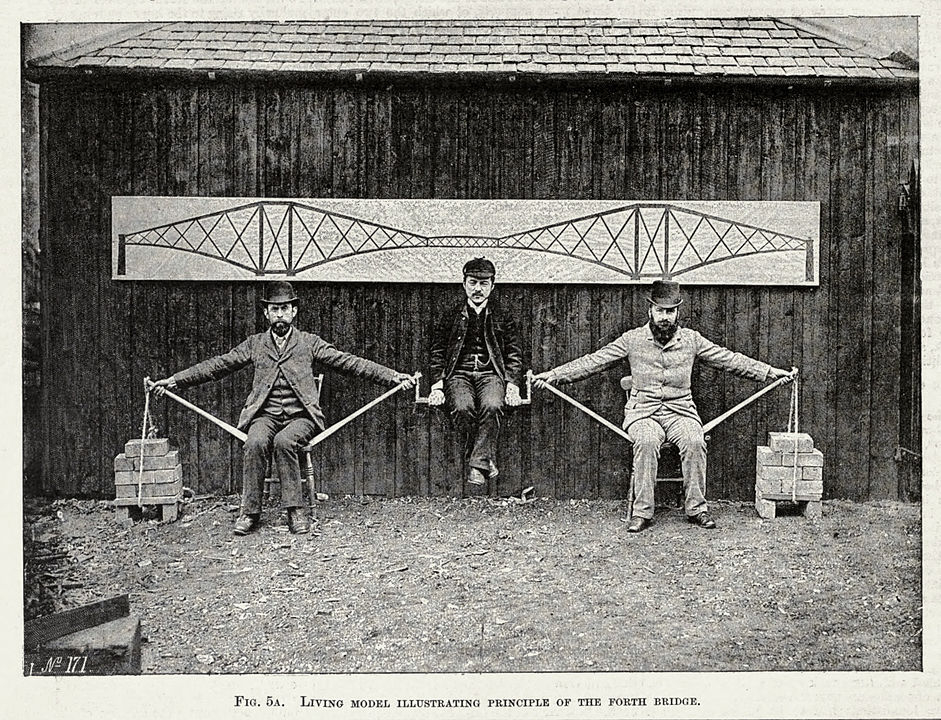
I then searched for Kaichi Watanabe in Japanese, and discovered from the Eikoku News Digest that he was known as one of the fathers of Japanese civil engineering, and also appears on the Scottish £20 note, sitting in the middle of a mock up of the Forth Bridge, whose design he worked on. At which point I realised he must also be known in the English speaking world too, and indeed there is a Wikipedia page on him.
None of the articles I have found about him seem to be aware of his Scottish wife and child, however, only mentioning his marriage in Japan, to the daughter of the family he was adopted into, Yoshi Watanabe.
His marriage to Yoshi took place before he came to Britain in 1884, and he had already had one daughter before Ellen Mary. He went on to have six further children by Yoshi and also a son, by a mistress, who became a well known pianist.
As was the tradition with wealthy Japanese, this liaison and child was recognised and the son entered on the family register.
Janet continued to call herself Watanabe until her death in 1946, at the age of 90. Under the 1870 Naturalization Act she had lost her British subject status on marriage to Kaichi, but Ellen would be British by “jus soli” having been born in Britain.
Janet and Ellen (or Nellie) lived with her older sister Mary until Mary’s death in 1902. Janet was named as executrix of Mary’s will, and the probate record refers to Janet as being the wife of Kaichi Watanabe, currently resident in Japan.
Janet was described as the widow of Kaichi Watanabe right up to the notice of her death in the Edinburgh Evening News, in 1946 – so she must have continued to be open about her connection to Japan, throughout wartime.
Kaichi had died in 1932, at the age of 74, after an illustrious career as an engineer, including as president of the Sangu railway company. There is no evidence he ever returned to Britain to see Janet and his daughter Ellen, however. Nor is there any evidence that Ellen visited Japan.
Ellen nonetheless put her Japanese heritage to the forefront of her acting and artistic career and reviewers frequently referred to her being “Japanese” and marvelled at her speaking perfect English.
Before becoming a performer she was a “photographic artiste” according to the 1911 census, living with her mother Janet in a tenement in Dalry Road, Edinburgh. Before that, and after Janet’s sister Mary’s death, they were living in a tenement at 37 Caledonian Crescent, just round the corner from Dalry Road, and Janet had been working as a dressmaker.
Ellen’s first performance was in an amateur dramatic society – the Newlands club, appearing in 1914, at the age of 27, as a French woman, Madame Didier, in Op o’ me Thumb.
She started performing professionally as Miss Musme Watanabe, in Rabindranath Tagore’s The Post Office, in Edinburgh in 1919, where her “wonderfully flexible voice, and her imitation of the bass of the men’s voices and the piping treble of the child Amal” was noted. (Gentlewoman – Saturday 8 March 1919)
She then went on to play all the parts of “a Japanese tragedy – The Pine Tree” in which the devotion of the servant to the master “a national characteristic of Japan” was “tragically brought out.” (Edinburgh Evening News – Thursday 22 April 1920).
She continued to recite a mixture of classical Japanese plays, the Bible and European literature such as Hans Anderson and Aesop, including broadcasting on the wireless.
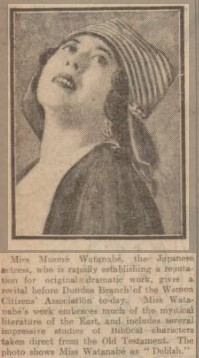
Above – Dundee Courier, 25 January 1923
She mainly performed in Scotland up until 1925, but in 1926 was in Paris and then also toured England through the late 1920s.
A review in the Falkirk Herald in 1924 described her as one of “the most fascinating and individualistic of artistes appearing on our platforms of to-day… In the day of the theatre and the music-hall, the cinema and broadcasting, the claim to have evolved a new form of dramatic art seems difficult substantiate. Yet it has been done by Miss Musme Watanabe, the Japanese actress of the platform, occupies a unique position in the dramatic field, but whose highly successful work has so far found no imitators. This is probable [sic] due the fact that Miss Watanabe combines the dramatic traditions of Japan with the most modern methods of the West in a manner requiring many years of study, and the possession of an unusual personality. The realism of stage scenery by which the Western actor seeks to create atmosphere has no place in the East, the illusion of scenery and stage properties being left to the personality and technical skill of the actor playing upon the imagination of his audience method which is just beginning to penetrate to the West.
With only a plain curtain as background, and on quite a small platform, Miss Watanabe has presented complete plays with ten or more characters, taking each part herself, changing her personality completely that each character becomes a clearly defined individual with a separate voice, gesture, carriage and even appearance. Miss Watanabe, in the words of a well-known critic, displaying psychological agility little short of marvellous.”
“Her nationality, combined with her perfect command of English, make her unique interpreter of the beauty and mysteries of the East, and she has done much valuable work in presenting to Western audiences works never before performed English, and in giving, in her own special method, new interpretations works already known. Miss Watanabe is deeply appreciative of the wonderful literary quality, and unerring insight into character possessed by the Bible author, particularly in the Old Testament.”
“These writings,” she says, “go down the very roots of human emotion, and are written with purity of language and dramatic intensity unexcelled in the whole range of literature.”
In 1927 she performed in Cuckfield in Sussex as a “Japanese lady”, wearing “appropriate Japanese costumes” for her presentation of a selection of Noh plays. In her introduction she noted that “the Japanese had always had an extensive knowledge of literature, but good illustrations of native literature in England were very rare. This was because the translation from Japanese into English was so difficult. She was that evening, however, going to give them two plays translated by Mr. Arthur Waley, of the British Museum.”
“An interesting fact concerning Japanese poetry was that it had developed on high level, and many Emperors and several Empresses of Japan had become famous poets. As regards the theatres in Japan, there was a great difference between the Japanese and European houses of entertainment.”
“If one wanted to see a play in Japan one had to rise early, for the performance began at am and continued all day, there usually being from twelve to twenty acts. (Laughter). In order to save time in changing the scenes, a revolving stage was used. This device was introduced long before it was ever heard of in Europe. Another feature of some Japanese theatres, which had not been adopted in the West, was the thoughtful provision by the management of a tear room. This enabled people overcome with emotion to go and have a good cry. (Laughter)” (Mid Sussex Times – Tuesday 22 November 1927)
I am grateful to Jamie Barras for the information that in 1928 Musme Watanabe was a delegate to the International Federation for Housing and Town Planning Conference in Paris – perhaps as part of the Scottish National Housing and Town Planning Committee, who also attended. The Federation had been established by Ebenezer Howard to promote garden cities in 1913. Perhaps her father’s profession as a civil engineer had been an influence after all.
In 1930, at the age of 45, she gave recitals as Madame Watanabe, the change of name reflecting perhaps that she had married Henry Scott Harrison, a photographer (although I was not able to find any evidence of this marriage). Again reviewers noted her “fortunate combination of Japanese birth and an English education”. She does not appear to have performed on stage again after 1930, instead returning to her other vocation as a visual artist.
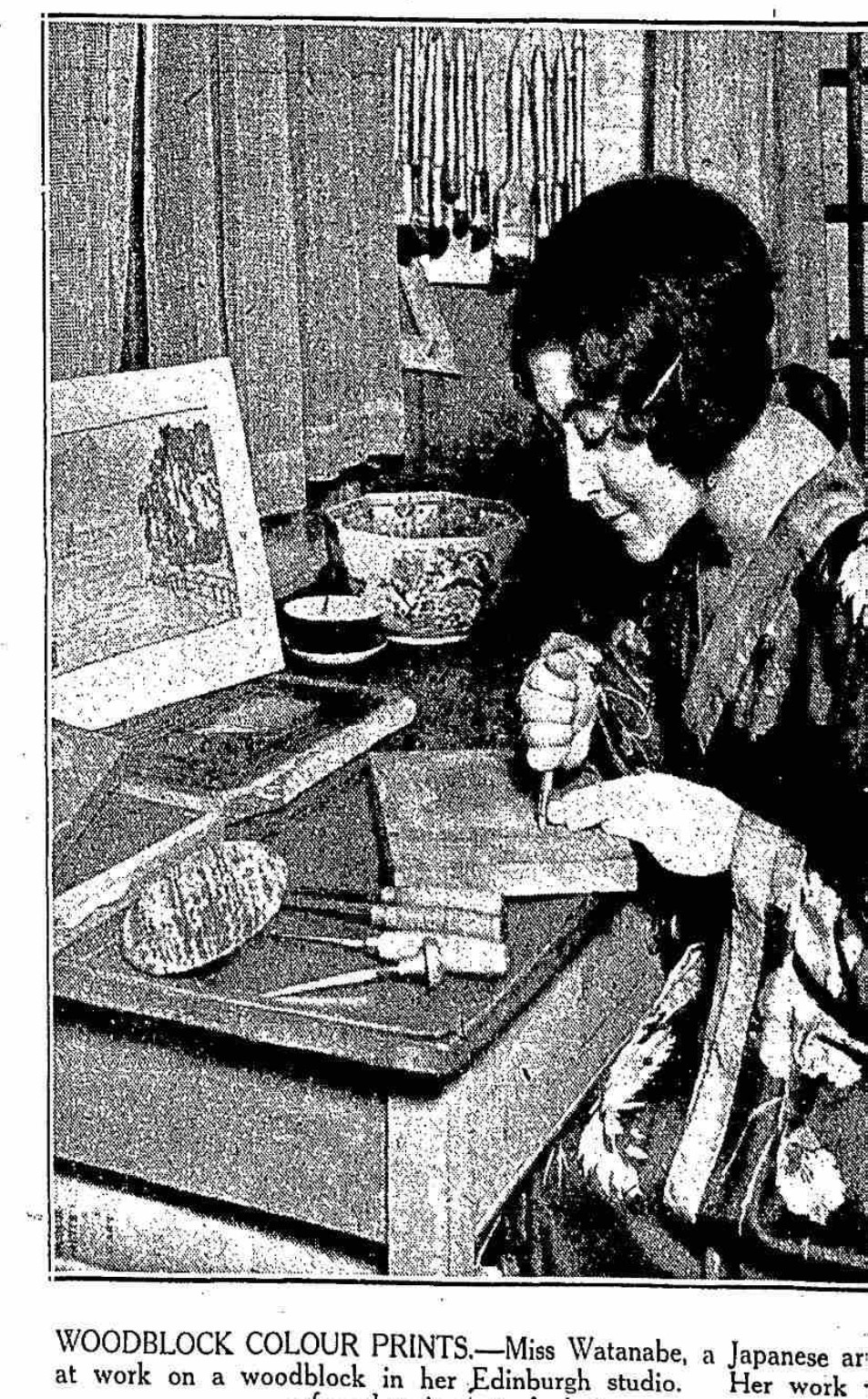
Above – The Scotsman, 21 November 1929 p 12
According to The Scotsman in 1929, Ellen had studied Japanese woodblock print making “with” Frank Morley Fletcher, at the Edinburgh College of Art. Morley Fletcher was principal of the college from 1907 to 1923 and gave some lectures during that period, although he did not do any teaching. He also published a book on Japanese woodblock print making in 1916.
Ellen exhibited her work regularly from 1923, including a print “The Pine Tree”, with the Society of Scottish Artists. She does not seem to have been a member of the Society, but exhibited again with them in 1929. Henry Scott Harrison became a member of the Society in 1931. Her last exhibition, as “Madame Watanabe”, in 1938, was of her painted fabrics and pastels at an exhibition in Edinburgh.
Ellen and Henry continued to live together in Edinburgh until her death in 1940, at the age of 52. Henry, who became chief press photographer for Edinburgh Evening News, died in 1952 at the age of 67. They did not have any children.
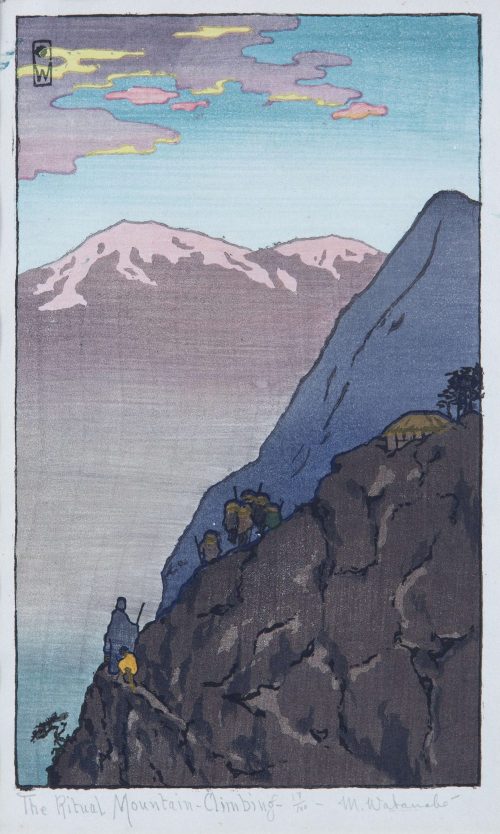
The woodblock print illustrating this post is “The Ritual Mountain Climbing” – signed M Watanabe.
 Ninjin