
Timeline
1870 January – February Professor Risley’s Imperial Troupe perform in Britain
1870 January – Mr & Mrs Thomas King and Frederick Page. arrived in Sarawak – from Manila – their ship the Sunshine was wrecked nearby, damaging their apparatus. Then went on to Singapore.
1870 February, a Japanese troupe at the Cirque Napoleon, Paris
1870 March – Royal Tycoon Troupe of Japanese in Madras and then Calcutta “under the management of Mr King”
1870 March – Imperial Troupe travel to St Petersburg
1870 March 12 – Matsui Gensui XIII returns to Japan with family
1870 April – Imperial Japanese Jugglers appear at Crystal Palace, London
1870 April – Frederik Blekman acts as interpreter and manager for Great Dragon Troupe in a court case in Belfast.
1870 June – September – Imperial Troupe (Sumidagawa and Hamaikari sections) appear in Vienna
1870 June – Thomas King’s Royal Tycoon’s Private Troupe arrives in Britain
1870 July – 1871 January – Franco-Prussian War
1870 July – Royal Tycoon Troupe at the Alhambra and then the Crystal Palace, with Tycoon’s Top Private Spinner. as selected by the tycoon to exhibit before Duke of Edinburgh at Yeddo – pedal balancer, female rope walker, ladder, tub equilibrist, 15 male and female
1870 August – Glover & Co in Nagasaki is declared bankrupt
1870 November – Isojirō, Isokichi’s brother has 1 year passport for troupe for Shanghai. Frederick Page, the British employer states 10 people to go to China, Europe, Australia.
1871-3 Iwakura Mission to United States and Europe.
1871 – 6 Meiji government starts to crack down on shrines, street performers – ending monopolies and official status of particular groups and censoring or stopping any performances deemed immoral.
1871 Peak of Japanese students going to Britain, France, Germany, America
1871 January – Isojirō aged 28 and 9 or 10 other performers including an apprentice Chiyokichi aged 15 depart Japan for Shanghai. Frederick Page, the employer states 10 people to go to China, Europe, Australia.
1871 January – William Grant, proprietor of the Great Dragon Troupe, is declared bankrupt.
1871 Jan-Feb Royal Tycoon’s Private Troupe including Isokichi, Naminosuke and Fujikichi in Britain
1871 Feb – Hasegawa Harukichi and Tannaker become co-proprietors of Great Dragon Troupe
1871 February – Fujikichi of the Royal Tycoon’s Private Troupe dies in London of blood poisoning from an abscess
1871 April census:
Great Dragon Troupe Blekman, Omoto, Hasegawa Harukichi (Harosan) 38, and Kanekichi, 11 (Tommysan) and Hasegawa Masajiro, 26, Kagami Godayū, 27, Kagami Katsugorō, 45, Kondō Fudekichi, 35, Kondō Yasokichi, 18, Kondō Torakichi, 13, Ogawa Torakichi, 18 are in Luton.
Otake (21, interpreter’s wife), Otani and Ohichi are in Peterborough (no record of Tannaker)
Hamaikari Denkichi (21), Yonekichi (Yonniekiche 18), Sentarō (Sandaro, 17), Chōkichi (Shooke 16), M Isangrave 40 (Sadakichi?), born in Japan – remains of the Imperial Troupe are in London.
1871 April – last performances of Royal Tycoon’s Private Troupe in Britain start tour of Europe and the USA
1871 April – Japanese troupe performing in Shanghai on their way to Australia
1871-2 Nagasaki connected to Vladivostock, Shanghai and Hong Kong by telegraphic cable. Telegram service connecting Japan to Europe and United States launched
1871 June 5 – Royal Tycoon Japanese and European artists, manager Mr F Page, F Stebbing director. Oska and the wonder child on bamboo, Nan Oski and Little Allright. Master Frank Stebbing (b 1861) on trapeze. Juggling by GoreKetche. Japanese lady O Ruce. Eso Ketche, Gengara and Wah Hobe. Faranoska, the Japanese wonder. Java bode 5th June 1871
1871 July – Blekman interprets in court for Fudekichi in Merthyr Tydfil
1871 July – Hayakawa Genjirō and 13 others depart Japan for USA
1871 July 24 – Page, 2 Stebbens (Stebbings), 4 Japanese, 2 Japanese women, 5 children from Singapore on Vice President Prins steamship
1871 September – Louis Soulier’s circus in Yokohama – equestrian and trapeze acts
1871 September – Arnhem – Royal Tycoon’s Private Troupe NAMENOSKI, first equilibrist. TO RA KITCHEE, accuracy specialty. OH RA TO, court top spinner to the Tycoon. Famous Salon artists Gin Geron and Jeddo. ESO KITCHÉE , clown and magician, never seen before, performing 6 turns. COO MA KITCHÉE , CA NA KITCHÉE, MO KO SO, HA SA, KIN TA Artists who perform the latest and most surprising turns. OH SA WA, OH MIT SA, OH SOO SA, OH CAN SA The only Japanese ladies who can leave Japan.
1871 October – The Japanese acrobats (Thomas King’s Royal Tycoon’s Private Troupe) quietly left Leeuwarden for Germany, without paying the advertising and printing costs, and kept the audience waiting in vain in the theater.
1871 December – Tannaker in court as witness for claim against the troupe’s manager for booking a band and then cancelling.
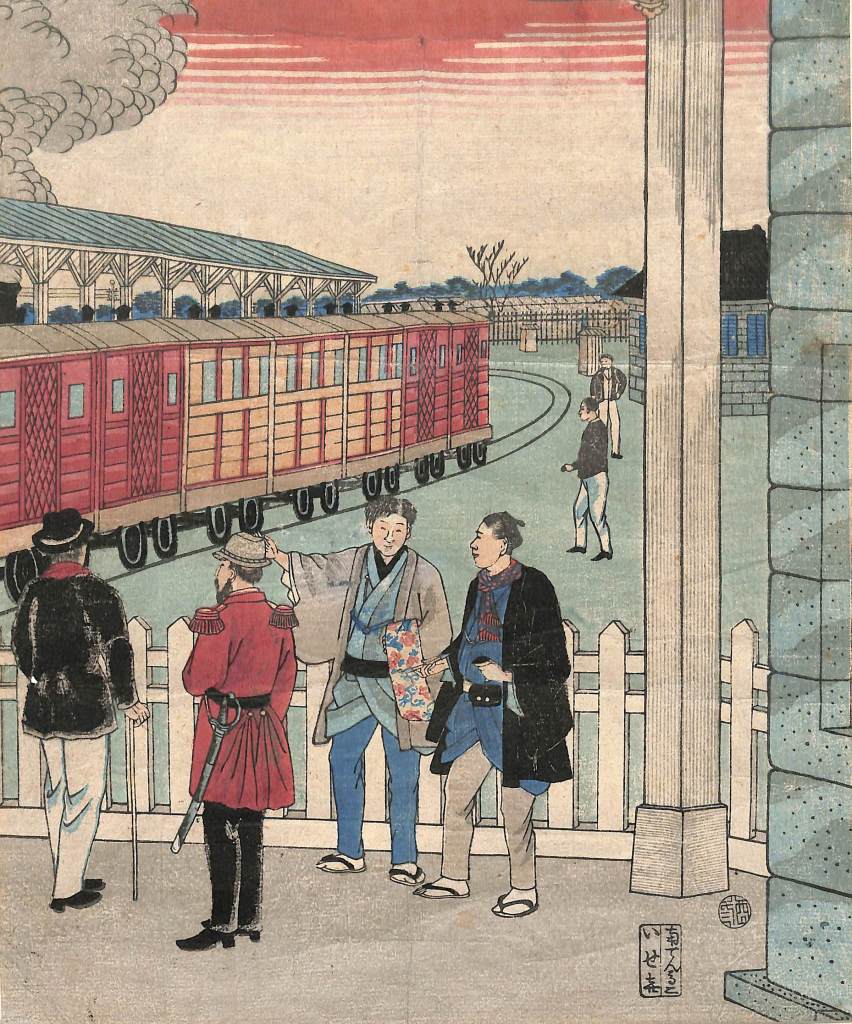
1872 Railway between Tokyo and Yokohama opens, construction supervised by British engineer Edmund Morel
1872 Koseki, family registration system introduced, requiring Japanese to have family names.
1872 Japanese government orders emancipation of girls and women held in bondage and nullifying debts incurred by their parents. Teahouses cleared of their occupants. Brothels become licensed.
1872 January – William Grant former proprietor of The Great Dragon Troupe tries to abscond by sea to Yokohama but is apprehended.
1872 January – February – Royal Tycoon Troupe of Japanese Juveniles in Bombay, prior to departure for Europe.
1872 January – Hamburg – 15 people – Gio Kitchee, Nomenoski, To Ra Kitchee, Gin Gero, Yo Schee Goro, Yeddo, To Ro Kitchee, Rin Zo, Ha Sa, Ca Na Kitchee (all male). Oh Mit Sa, Oh Mo To, Oh Foo Sa, Oh Sa Wa (all female) Coo Mo Kitchu (male) with Mr & Mrs King in a hotel. (Hamburger Fremdenblatt 27 Jan p4)
1872 March – Tannaker advertises himself as the sole proprietor of the Great Dragon Troupe and that F Blekman ceased to have any connection with it.
1872 April – July – Tycoon Troupe of Japanese in San Francisco – brought over from Japan by Robert Cunningham and Marshall. Ume Ketchi, Uki Noski or Uni Moska, Toka Ketchi. To Go Zo. Marshall & Co Great Tycoon Troupe. From Great Tycoon Theatre, Osaca.
1872 April Dragon Troupe of Siamese Juvenile Gymnasts at Crystal Palace – Gen Oska and Boy Wonder.
1872 May – Mikado troupe under direction of Mr F Page touring Bangkok
1872 May – Matsui Yoshigorō asks Thomas King and Isokichi for money to return to Japan but none given so returns to London and asks Terashima Munenori, first resident minister from Japan in London to loan the fare.
1872 June-July Mikado Troupe in Singapore, and will perform in Vienna at the great exhibition (World Fair? May-Oct 1873)
1872 June – Dragon Troupe of Siamese Juvenile Gymnasts – Ochoby, Gen Oska, O Le Mutch, Tara Moska and Tara Moska Ochoby appear at the Crystal Palace
1872 June – Iwakura mission sees Genjiro at the National Theatre in Washington (Kurata p 253)
1872 June – Tycoon and Dragon Troupes from the Crystal Palace – Brighton, Bolton, including Eso Kitchee, Ochoby, Gen Oska, O Le Match, Taro Moska and Taro Moska Ochoby also at Crystal Palace – as Siamese Juvenile Troupe. Wonderful act by Tara Nosky over the lake. Ochoby is probably the Japanese word “ochibi” meaning “little one.”
1872 July Mikado Troupe in Java
1872 August – December – Iwakura mission visit Britain
1872 August – Shimizu Seijirō 48, Shimizu Fujisaku 51, Shimizu Fukutarō 13, Shimizu Chōmatsu (Chiyomatsu) 9, Shimizu Anzō 31, Kagami Kichigorō 35, Kagami Otokichi 13, Kagami Harukichi 12 leave Japan for Hong Kong, Manila, San Francisco, Singapore, Malaysia, Zanzibar, Australia, Java
1872 September – Dragon Troupe of Japanese Gymnasts in London – Taro Noska, Le Match, Gen Gard, Wah Hobe, Gen Oska
1872 September – October – Charles Crosby’s American acrobats and troupe of Japanese performers – Berlin
1872 September/October – Thomas King hires another troupe of 13 Japanese performers (Awata Katsunoshin, Sakuragawa Rikinosuke) to go to Britain for 2 years – who initially tour India, then Australia
1872 November – 13 Japanese and 2 children arrive in Calcutta on the Travancore from Yokohama with Mr C Pasquali and Mr and Mrs King including Bungaro, Echowsi, Catshenoski, Terakitchi
1872 December – Tannaker on trial on charges of child cruelty
1873 January – The Mikado troupe in Hong Kong, with Miss Oosa top spinning, Takijiro, Oosakitchi feet equilibrists, Matzu slack rope. Giant Chang.
1873 February – Awata Katsunoshin and 4 others leave Japan for USA.
1873 February – Matsui and three others from the first group return to Yokohama
1873 March – Little Godie, son of Omoto and Godayū dies and is buried in Sunderland
1873 Basil Hall Chamberlain, author of Things Japanese, moves to Japan. Lives there until 1903.
1873 March – Japanese government officially permits international marriages. Foreigners, male or female, who married a Japanese, could become Japanese. Edict against Christianity removed
1873 April – Kioto Exhibition Troupe of Japanese arrived in Foochow, China, by the steamer Dragon. There was a Kyoto Exhibition in 1872.
1873 April – Charles Crosby’s Great Royal Tycoon Troupe of Japanese – Gdansk https://jbc.bj.uj.edu.pl/dlibra/publication/585850/edition/556748/content
1873 May – October – Vienna Exhibition Japanese section sponsored by Meiji Japanese government. Thomas Jeckyll‘s Four Seasons gates displayed. Mass production of Jeckyll’s fire fronts by Barnard, Bishop, Barnards begins. Christopher Dresser and Edward Lee procure Japanese and other materials for the Alexandra Palace and Park. Page’s troupe appears.
1873 June – Mikado Troupe may have changed name to Great Yeddo Troupe – arrived in Singapore from Saigon. En route for Vienna World Fair World Fair? May-Oct 1873. Were in Hong Kong, Canton and Macao.
1873 July – Shah of Persia sees Japanese acrobats perform at the Crystal Palace
1873 August – Mitamura Kumakichi and five others go to Hong Kong
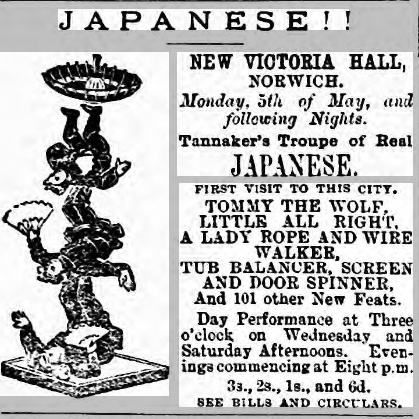
1873 September – Tannaker Buhicrosan registers his troupes, appoints John Hardman as manager.


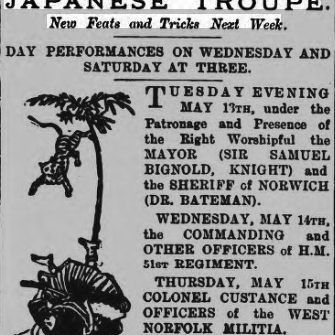
1873-6 Thomas Glover manages the Takashima mine, paying off debts
1873 September- Nihon Gakusei Kai, Society of Japanese Students formed in London by Baba Tatsui and Ono Azusa
1873 October – Royal Tycoon’s private Troupe in Rostock – Con-no, Can-no, Gin-ge-ro, Namenoski, Mo-to-to
1873 November – The Royal Victoria Circus (Wieland and Lyons) and the Kioto Exhibition Troupe of Japanese, is another attraction in Calcutta and is by far the greatest combination ever seen in India. (The Australasian February 1874) Then coalesced with Abell and Pollocks crowd. 12 Japanese performers.
1873 December – Mikado troupe in Karachi – Takijiro (Takejooroo), bamboo balancing with a 7 and 8 year old, Fujikichi (Fugeekeegee) magic juggling, Osabroo screen evolution. Miss Okhanna Butterfly trick, Omaza ladders with Tooktooroo climbing, Otooko five stick juggling. Will then return to Bombay.
1873 December – Japanese government recalls students studying abroad
1874 Okura & Co is the first Japanese trading company to open an office in London
1874 Mitsui & Co enter into an agency contract with American Robert Walker Irwin to represent them
1874 January Iwakura Tomotsune enters Balliol College
1874 January – February – Mikado troupe in Bombay. A. Feitelsohn is proprietor. 15 people. On the site of Chiarini’s circus tent. One was 15 years director theatre of Yeddo. Took-too-roo umbrella juggler. Kook-too-roo foot equilibrist with a child. Osabroo top spinner. Omaza swinging bamboo. Boy Echee-goo-roo climbing ladder of Omaza. Tokee gee ree and ladder and gum elastic boy on tables. Miss Okanna butterfly trick.
1874 March – Yamada Seizo and 13 others to Hong Kong
1874 April Hachisuka Mochiaki matriculates at Balliol College
1874 May – June Czechoslovakia – mentions of Japanese in the Myers circus
1874 June – Kioto Exhibition Troupe – Batavia. Pollock and Abell. Moberon the famous Japanese juggler. Double ladder and fence on the feet. Little Aky, Kamachie, two Japanese boys Allwrong and Noaccount. Mme Louise, Walter Howson, James Collins, S.C. Abelle. J Klear juggler.
1874 July – Kioto Variety Troupe Hr Pollock – Samarang
1874 November – 9 Artistes arrived by Eliza Blanche from Batavia = Kioto Troupe – jugglers, foot and shoulder balancers, top spinners, rope walkers, and acrobats. 5 men three boys. Director Mr F. H. Pollock
1874 November – Suzuki Yasokichi and five others to USA
1875 January – Kioto Troupe returned to Singapore from Australia on the Eliza Blanche
1875-6 Meiji government introduce taxes and regulations on street performers.
1875 February – October Mr Tom Wieland, clown, and Master Sydney Wieland with Royal Tycoon Troupe in Australia
1875 February – Sumidagawa Namigorō, Takamori Toyokichi and 9 others depart for tour of many countries. Namigorō and Matsugorō are issued passports to work in France, returning to Japan in 1884
1875 March – Japanese troupe arrives in Shanghai from Nagasaki
1875 May – Liberty’s opens in Regent Street. Hara Kitsui is one of the staff members.
1875 May – Loyal’s Imperial Japanese Troupe with No Account contortionising, Kay Jeddo legerdemain, Oto Jerro rope walking. Loyal trapeze. Pinang
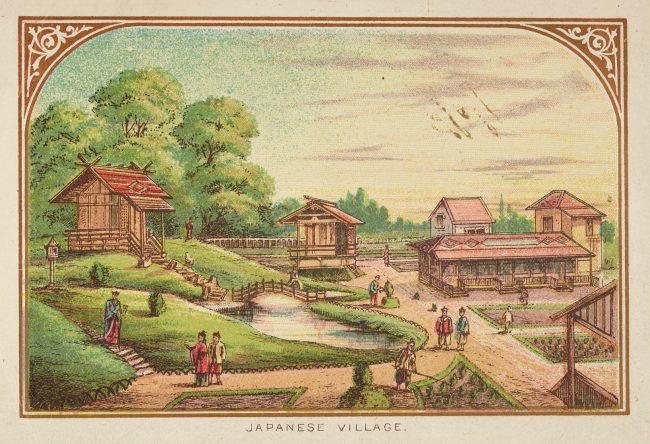
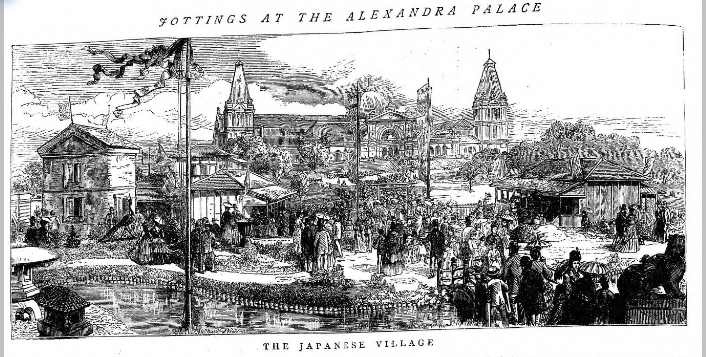
1875 May – Alexandra Palace re-opens, with a Japanese Village in the park. (Illustration above and below). Japanese Village continued at Alexandra Palace until 1886. 1878 “There is also a Japanese village, comprising a temple, a residence, and a bazaar. In the bazaar articles of Japanese work were offered for sale. A circus for equestrian performances was likewise erected in the grounds, together with a spacious banqueting hall, an open-air swimmingbath, and other novel features.”
1875 June – Of particular interest are the Japanese
court artists Mo-to and Assa, who achieve extraordinary feats in the field of acrobatics, and the Japanese Gin-Gero
and Ko-mo-Kitsche, whose productions on the bamboo Moravian Correspondent. Brno: G. Gastl, 24.06.1875,
15 (142), p. 4
1876 Glover joins Mitsubishi as a consultant, supporting their takeover of the Takashima Colliery.
1876 Japanese Consulate established at 83-84 Bishopsgate, staffed by 3 Japanese officials including Minami Tamotsu.
1876 February – P&O challenges Mitsubishi’s monopoly by starting own shipping service between Shanghai and Yokohama
1876 April – June – Jackitschy Troupe at Alexandra Palace
1876 May-November Jeckyll‘s Japanese Pavilion exhibited at Philadelphia Fair, Boileau Fountain unveiled, with Japanese panels.
1876 June – Brothers Moto and Assa, Gingero and Como Ketchy appear with Myers’s Hippodrome at the Crystal Palace
1876 August – Jackitschy Troupe in Stroud – Mothokischy (8), Juruschy Kingho, Itschko (2 youths aged 12 respectively)
1876 Taniguchi Naosada and Masuda Reisaku start studying at Glasgow University, in the care of Lord Kelvin.
1876 November – Gingero marries Annie Hughes
1876-1877 Christopher Dresser visits Japan as an emissary from British government, representing South Kensington Museum. Was guest of the Emperor.
1876 November – Great Original Tycoon Japanese Troupe – Gin Goro Jack, Fousah Ketchey, Como Ketchey, Moto Ketchie, A Sa Ma Ki, managed by Henry William Wieland – tour Britain
1877 – 1879 – commercial and industrial depression in Britain, unemployment rises
1877 January – Josiah Conder, architect, arrives in Japan
1877 January – Royal Tycoon Troupe of Japanese and Burmese performers – now managed by Walter Brown
1877 January – Satsuma Rebellion – to September 1877
1877 June – Robert Walker Irwin arrives in London, sets up agency to deal with woollen textiles, steamships and rice, representing Mitsui & Co
1878 January – Japanese Kotaki performs Pongo Redivivus in London Theatres
1878 Mitsui & Co send Mitsui Yonosuke to London to supervise agency of Robert W Irwin
1878 Isabella Bird visits Japan
1878 Paris Exposition Universelle. Gingero and Royal Tycoon Troupe perform man monkey act.
1878 October – Royal Tycoon Troupe returns to Britain
1878 Suematsu Kenchō arrives in London
1879 Mitsui & Co decide to set up a branch office in London. Motoaki Sasase sent to London by Mitsui & Co as branch manager. At 1 Crosby Square, 18 Bishopsgate within, offices shared with their agent, Robert Walker Irwin. Officially opens September 1879.
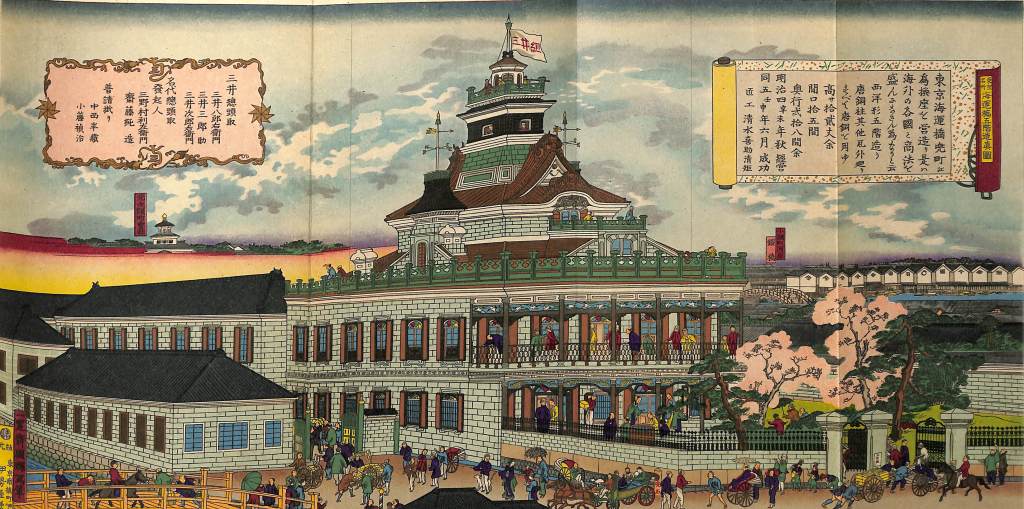
1879 January – July Zulu War
1879 April – Home Secretary warns managers of concert halls that in the event of a fatal accident to a child in a “dangerous exhibition” they would be prosecuted for manslaughter in London.
1879 May – second reading in House of Lords of Children’s Dangerous Performances bill
1879 May – Gingero’s Great Tycoon Troupe of Japanese – first appearance, touring Britain
1879 November – Royal Tycoon Japanese Troupe, managed by Walter Brown
 Ninjin